Paul Tichman: Brief Recollections on SACHED Trust and LACOM Durban
-
by

We would meet to discuss various aspects of South African trade union history and then write up the discussions. I recall the study group as asking really probing questions which also helped me to think in a deeper way about labour history and political economy. The idea was to produce a history of the labour struggle in a way that would make it accessible to ordinary workers. Later on, Gareth Coleman took up the initiative and this led to the publishing of “Freedom from Below”.
I was introduced to SACHED Trust in 1983. I was studying towards a MA degree in Economic History at the University of Natal (now UKZN) and the focus of my thesis was ‘African trade unions in Durban’. I was invited by a friend, Ahmedi Vawda, to participate in a labour history study group at SACHED Trust.
The SACHED offices were in the Grey Street area at the time, in the Bai Jerbai Rustomjee Trust building, where the MK Gandhi Library was also situated. I was introduced to Enver Motala, Director of the Durban branch of SACHED. The labour study group included Ravi Joshi, a brilliant mathematician who had ended up working for the Federation of South African Trade Unions (FOSATU), Vishnu Padayachee from the University of Durban-Westville, Shahid Vawda and others.
We would meet to discuss various aspects of South African trade union history and then write up the discussions. I recall the study group as asking really probing questions which also helped me to think in a deeper way about labour history and political economy. The idea was to produce a history of the labour struggle in a way that would make it accessible to ordinary workers. Later on, Gareth Coleman took up the initiative and this led to the publishing of “Freedom from Below”.
As a student I was also provided with an opportunity to do some part-time work at SACHED, manning the reception desk in the evenings. I got to meet some of the staff involved in the Turret Correspondence College (TCC), such as Jill Brown and Sheila Tyeku as well as Jayce Naidoo who was involved in the UNISA support project. I recall those evenings a being a hive of activity, with the TCC and UNISA students coming to classes and making use of the SACHED resources.
While employed as a Research Assistant at the Institute for Social and Economic Research at the University of Durban-Westville I was approached by Irna Senekal from SACHED’s Labour and Community Resources project (LACOM) to assist in a literacy project for workers at a FOSATU venue in Clairwood. This meant going through to Clairwood on Tuesday afternoons to teach in the literacy programme.
At an orientation meeting in preparation for the literacy programme I got to meet some of the LACOM staff members. There was the veteran Charles Ngema, who lived in Inanda Newtown, had worked in the trade union movement and was something of a poet and an inveterate practical joker. There was also the younger and very energetic Cyril Khawula, from KwaNdengezi. Libby Dreyer was also part of the team though I cannot recall whether she had joined LACOM at that stage or was still at university.
On the first evening that the classes began, we sat in the hall while the works were being arranged into groups. They did not realize that I understood isiZulu and so was eavesdropping in a sense while they chatted excitedly and nervously about the classes. One of the workers was saying that he was worried that the teacher would laugh at him because of his poor English. A very fit looking worker, who I later learned was an amateur boxer in his spare time, was saying that he would punch the teacher if he dared to mock him. I also heard one of the workers saying that he wanted to be in “the white lady’s class”.
The literacy classes were an interesting learning experience for me. While some of the workers dropped out after a few sessions there was a core group that seemed determined to learn. My knowledge of isiZulu proved useful at times as the literacy learners grappled with some of the English terms.
The literacy materials, developed by SACHED Trust were linked to workers’ experiences and dealt with the political economy of South Africa. The idea was that the literacy training should equip the workers with knowledge and skills for strengthening the trade union movement. A great deal of the material we used in the literacy classes focused on the daily struggles of workers.
One of the workers in my group, Qoboza, a shop steward who hailed from the Eastern Cape, developed a keen interest in poetry and went on to write and recite poems at various worker events. One of the poems, I recall, was titled ‘Apartheid, apartheid we hate you”.
**********
I joined SACHED’s LACOM project on a full-time basis in September 1986 as a materials writer and educator. In hindsight, it seems crazy to leave a university research post to work in an NGO but the opportunity to work with Enver Motala and the team he had gathered seemed like an offer not to be missed.
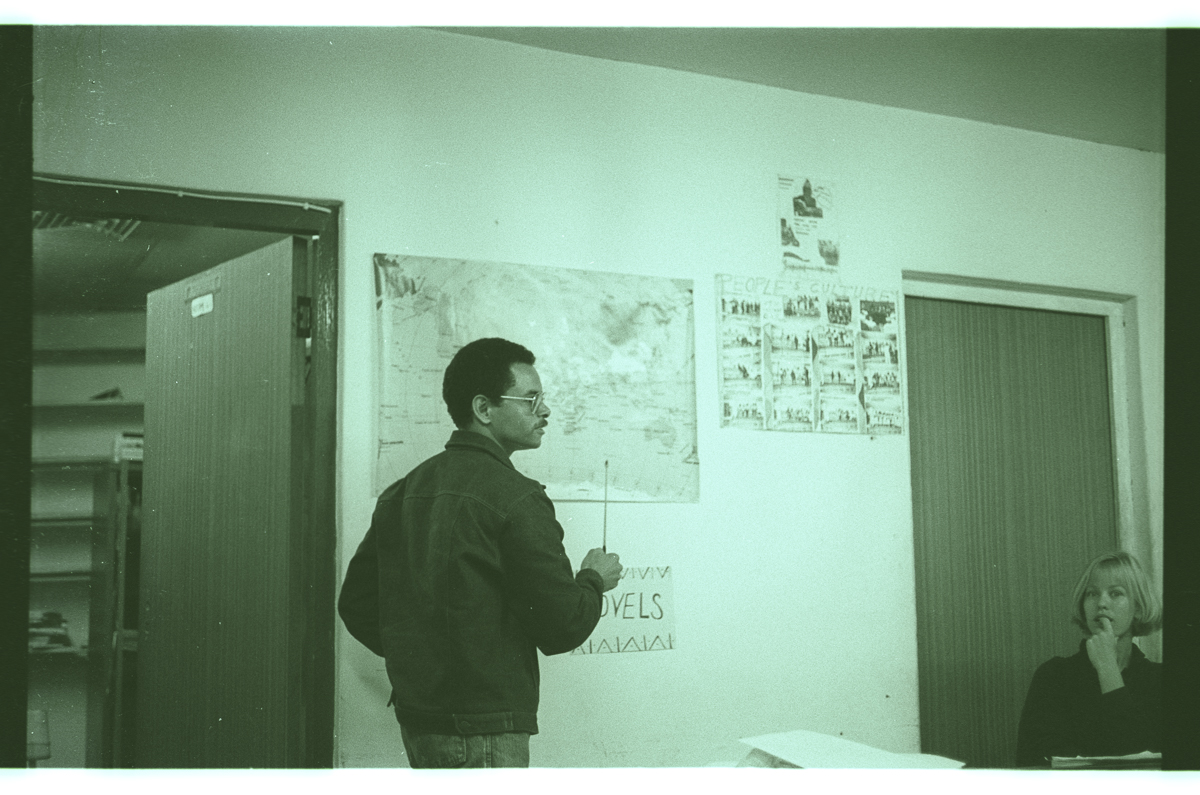
I was responsible for writing up materials on labour history and political economy, contributed to the literacy materials and ran training workshops for workers and community organizations on labour history, political economy and organizational skills. At the time the LACOM project included – in addition to Charles Ngema, Cyril Khawula and Irna – Gareth Coleman and Libby Dreyer. We were later joined by Rohan Persadh (Toes), Gladys Ryan, Desmond Mkhwanazi, Maria van Driel, Oupa Lehulehere and Judy Mulqueeny.
The Durban LACOM Branch, similarly to other branches across the country, was a hive of activity. In addition to writing up materials and running workshops we also gave support to the Federation of South African Trade Unions (FOSATU) affiliates during strikes, rallies and various commemorative events. From time to time the FOSATU Education section, then headed by Alec Erwin, would request our assistance with organizing of educational events. Our activities included assisting in setting up venues for the workers’ meetings, putting chairs in place, assisting with keeping minutes, running workshops and discussion groups and assisting with setting up cultural events.
The Durban office of SACHED was a highly stimulating environment where the LACOM staff also interacted with the Turret Correspondence College (TCC) staff, who included Gill Brown and Sheila Tyeku, as well as with Jayce Naidoo from the UNISA project. From time to time various people active in FOSATU and later COSATU would drop by the SACHED offices. They included Alec Erwin, Bernie Faranoff, Zwelinzima Vavi and Jay Naidoo of the South African Commercial, Catering and Allied Workers’ Union (SACCAWU).
We developed several booklets on various aspects of labour history – The Machine Breakers, Worker Cooperatives in Britain, the French Revolution, Democracy – as well as booklets for use in the literacy classes – Migrant Labour. Most of our workshops were for FOSATU and later COSATU affiliates. From time to time, we received requests from community organisations – mainly youth groups – for workshops on political economy and organizational skills. The LACOM branches also took turns to produce a magazine titled LACOM News.
The first national meeting I attended was a memorable event because it turned out some really heated debate. One of the delegates from the Johannesburg branch was being challenged for having worked with a trade union federation that was in opposition to FOSATU. At one stage there was a heated debate between Marcus Solomon and Enver Motala and I was surprised to see the camaraderie amongst them at the end of the day.
I soon came to realize that SACHED, and LACOM, was a place where your difference in political opinion did not mean that you could not work together. I also had an opportunity to meet Neville Alexander while attending a workshop in Cape Town and recall spending the evenings listening to his stories of his activism, subsequent arrest, and time in Robben Island.
For one of the conferences in Johannesburg we had hired a kombi and took turns to drive. We ran into a roadblock at some point and were pulled off to the side of the road and ordered out of the vehicle. Irna Senekal was wearing a ‘political’ T-shirt and hastily grabbed my track top to cover it. This very mixed bunch together in a vehicle clearly signalled to the soldiers that we were potential ‘terrorists’. We sat on the side of the road while the soldiers proceeded to offload and check through all our luggage before stripping the interior panels of the vehicle to check for hidden weapons and explosives.
During strikes we would be at the FOSATU halls, for example in Clairwood and Pinetown, setting out chairs, putting on videos and organizing discussion groups and workshops with the striking workers. I recall that in Pinetown the hall was adjacent to the Rainbow Jazz Club and that presented a challenge at times as we would have to go and round up some people who found the music and beers irresistible.
We had set up an office in Pinetown, which was run mainly by Cyril Khawula and Europa Ncusana. In 1989 we had the launch of a Workers’ Library in the Pinetown Office and after the event Cyril and me were transporting some of the workers home when we ran into a roadblock. We were taken out of the vehicle together with the unfortunate workers, loaded onto the back of a mellow yellow and taken on a crazy ride through the streets of Pinetown to a police station. At the police station we disembarked and were marched into a vacant garage. A group of men who were obviously security police came around and looked at us while having a whispered conversation amongst themselves. They then approached me and instructed me to accompany them. We went into a lift to the 8th floor, I think it was, and I was led down a corridor to an office. Two security branch members then took my haversack and began to empty the contents.
I was writing an article for the Natal Witness Echo at the time and had some potentially incriminating literature in my bag. They made a list of the books and articles in the bag. They also asked me what other names I used, which I found puzzling, until they asked me whether my nickname was Lucas. I then realized that they were confusing me with the guest speaker at the library launch, a union organizer from the Chemical Workers Union by the name of Lucas. Before the start of the event, I had been involved in a discussion with Lucas, and it seemed a ‘spy’ had mixed the two of us when reporting on the event. They grilled me on what was taking place at the SACHED office in Pinetown and accused me of working with the ANC who were bombing and necklacing people I argued that SACHED’s educational work was actually aimed at ensuring that we achieved peace in South Africa. At one stage one of the security branch men slammed the table and put his finger in my face accusing me of ‘trying to be clever’. He threatened to take me to an Inkatha area and release me there after telling the people that I was an ANC member. His colleague played the good cop and began to try to reason with me, arguing that we could help each other and that all they wanted was to ensure that the country did not erupt into violence. He asked me to sign a statement to say that Cyril Khawula – who I later found out was being interrogated in the adjoining office – was recruiting for the ANC, I said I could not sign such a statement because I had no knowledge of him recruiting for the ANC. I was then told that I would be held in detention and that, after 90 days they would simply place my docket at the bottom of the batch and keep repeating that until I was ready to talk. The interrogation was interrupted by the entry of an older man who called the two aside and had a whispered discussion with them. They then turned to me and asked me to follow them. We went down the lift and as we stepped out, I was relieved to see Enver Motala with his nephew, who was a lawyer, and Richard Lyster, a lawyer from the Legal Resource Centre. Richard was lecturing the security police, and they quickly handed me over to him. The following day we all scrambled to remove any material from our offices that may have been regarded as banned literature.
Irna Senekal may recall an incident where she was called to the Customs Office to provide an explanation for a batch of books that had been posted to SACHED from the UK. Irna had participated in an Adult Education Conference in the UK and had arranged for books to be posted to SACHED. Some of the books would have been regarded as banned literature. While Irna was explaining about SACHED and the purpose of the books, with emphasis on the TCC and UNISA projects rather than LACOM, for obvious reasons. The customs official interviewing her stepped out of the office to fetch a form and Irna calmly and coolly selected the books that were potentially ‘dangerous’ and hid them under her sweater and was able to safely smuggle them out.
After the protracted strike of the SARMCOL workers in Howick, the majority of whom were from Mphophomeni township, the Durban branch of LACOM was involved in running political economy workshops in Howick once a week. The SARMCOL workers had formed a co-operative – the Sarmcol Workers Co-operative (SAWCO) – that included a T-shirt screening project and an agricultural project. We would drive through to Howick early in the morning and leave after mid-day. The workshops were held in a stone building owned by a shopkeeper. The workshops always started with a prayer by old BabaZondi. He would pray that the ‘teachers’ would teach in a patient and clear manner and that the workers would be attentive and benefit from the workshop. One of the younger workers, Phillip, would often interpret in Zulu where necessary.
Mphophomeni was ravaged by political violence and there seemed to be funerals taking place every weekend because of the conflict between Inkatha and UDF supporters. Showing surprising commitment, the SAWCO workers continued to meet regularly to work in the cooperative and to hold various educational workshops, declaring that they were still on strike. We attended one of the sessions of the Sarmcol Workers’ court case against BTR Sarmcol. Although the Sarmcol Workers won the court case the company continued to drag out the reimbursement of the workers for the loss of wages.
We would receive requests from trade unions in other parts of KwaZulu-Natal from time to time. I accompanied Charles Ngema, Cyril Khawula and Demond Mkhawanzi on a trip to Empangeni where we ran a workshop for the Paper Wood and Allied Workers’ Union.
We travelled in SACHED’s old Toyota TUV. The vehicle was not very comfortable and the driver, in this case Desmond, had to keep a firm hold on the steering wheel as it tended to veer all over the road at the slightest bump. Charles was always a joker and, at one stage a BMW drove past us as we struggled up an incline. A dog was lounging on the back seat of the BMW. Charles pointed to the dog and said to Desmond that, while he rode in a scrap TUV the dog rode in the comfort of a BMW. He added that the dog would probably enjoy a dinner of steak that evening while Desmond had to make do with his ‘putu and beans’. Desmond, who had a rather quick temper, got very upset and threatened to let Charles take over the driving. At a packed trade union event in the COSATU Clairwood Hall Charles, who was playing the role of interpreter, once stripped off his COSATU T-shirt while on stage, to reveal an UWUSA T-shirt, resulting in a howl of protest.
One of the workshops Charles and were involved in was for the national section of Paper Wood and Allied Workers Union at the YMCA in Orlando, Soweto. On our first evening at the YMCA hostel there was uproar and students and workers were looking out towards the Orlando Station which was a little distance away.
We joined the growing group of inquisitive onlookers and saw that there was a large crowd gathered at the station. A group of students came from the direction of the station in a panic and announced that an Inkatha impi (troop) was heading for the YMCA. Charles and I looked at each other wondering whether we were about to be caught up in a battle. Students began to close the entrances to the hostel as we all kept a careful watch, from the top floor windows of the hostel. Fortunately, the rumour was unfounded. Some people had been thrown off a moving train and there had been some accusations and threats directed against hostel dwellers in the area, who were mainly Inkatha members. The hostel dwellers had threatened to take action against UDF supporters and some skirmishes had taken place, which led to the rumours and panic.
We had some very interesting non-racial social gatherings – at a time of apartheid – at our homes or at the homes of trade unionists. I recall attending a party in kwaNdengezi at the home of the late Cyril Khawula. kwaNdengenzi was a semi-rural settlement at the time and the track to Cyril’s home led past several homesteads. Residents at these homesteads watched wide-eyed as this very mixed group of people drove by. We also attended a birthday party for Jay Naidoo, General Secretary of COSATU’ that was unfortunately interrupted by the arrival of the riot police, forcing us to us to disperse post haste.
The trade union rallies were also frequently targeted by the police and at one of the May Day rallies we participated in at Curries Fountain the police opened fire on workers at the end of the rally, leading to several casualties. During the many Mass Democratic Movement marches that characterized the late 1980s the SACHED offices in Grey Street were well situated to take in all the action. From the balcony we had a good view of the Emmanuel Cathedral, which often served as the starting point for marches. During one of the defiance marches the police had prohibited photographers from taking photographs. A documentary photographer, Rafs Mayet was spotted taking photographs and was chased by the police. He ducked into the alley that led to the SACHED Trust offices and took refuge there. We sat with him on the balcony looking down at the police who were searching for him.
One afternoon Charles Ngema, who had gone off to the Pinetown office returned with a disturbing story. He had been driving with Cyril in SACHED’s little Datsun van when a vehicle tried to push them off the road. Cyril, who was driving, had managed to pull away. The vehicle had given chase, but Cyril managed to veer between some trucks and lost the pursuers. He informed Charles that he had recognized some of the occupants of the vehicle and claimed that they were members of Inkatha. Cyril would turn up to work armed with a revolver at times. It reached a point where Cyril no longer turned up for work. We were under the impression that he was caught up in the conflict between UDF and Inkatha supporters in kwaNdengezi. However, a union organizer informed us that there were rumours that Cyril was involved in factional fighting within the ANC youth in the township, had been accused of participating in attacks on other youth and was in hiding. A breakaway group from the UDF youth, known as Amavaravara, was fighting for control of kwaNdengezi. Sadly, we later heard that Cyril had been killed in the violence in the township. He was buried in his home village in the Port Shepstone area.
As negotiations between the ANC and the South African government began to usher in the promise of a peaceful resolution international funders rather suddenly began to cut back on the grants they were giving to South African NGOS’s. SACHED, along with many other NGOS’s was suddenly faced with a crisis. SACHED set up a National Strategic Planning Group to look at reshaping the organization to meet the demands of a democratic South Africa while also attempting to build sustainability. As Acting National Co-ordinator of the LACOM Project I found myself on the Strategic Task Team. This meant shuttling between Durban and Johannesburg to national meetings on a regular basis as well as taking trips to Bloemfontein, East London, Port Elizabeth and Cape Town. SACHED’s leadership took a decision to close down the various SACHED projects and replace them with more strategically aligned projects. Staff were required to reapply for posts. It was a difficult time with many staff feeling the pressure of the uncertainty and many staff chose to leave SACHED.