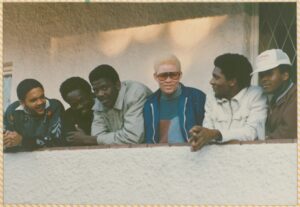

Interview with Letta Mashishi, conducted by Laurence Stewart, 16 October 2024
-
by

Letta Mashishi speaking about Klaas Mashishi: He liked the fact that there was room for creativity. Where they could talk about producing materials and also actually produce them. He liked them very much. And also, he liked [that] he wasn’t scared about the political environment there. That he could get into trouble. He was conscious of the fact that he could get into trouble at any time, but he felt safe at SACHED with the kinds of people that he operated with, Robin Lee and David Adler around that time
Laurence Stewart: So, I have a few questions but I think maybe just briefly and, in any detail, you could tell me about who you are.
Letta Mashishi: Who am I? [Laughs] I did nursing after matric. My late husband got arrested, I think, just at the time when I was actually on leave that month when the case was heard in Pretoria. So, I attended the whole case and then I was on two days’ leave when they were sentenced, and then he was sentenced to 8 years in prison. So, we met at high school. And I think he was a class ahead of me. In those days, when I was doing Form 3, we called it the Grade 8. He came from Atteridgeville, a different place. And we were at Lady Selbourne, we came to school in Lady Selbourne. He did his matric at Lady Selbourne.
Laurence Stewart: Okay.
Letta Mashishi: It had a little reputation that it was a good school and you know in those days they travelled from Atteridgeville to Lady Selbourne, that’s where we met.
Laurence Stewart: Okay, about Klaas, what about his background?
Letta Mashishi: He did matric at Selbourne. I think they were about 10 or 12 or 15 at that time. In those days, they were very few. And I was very proud that he was the only one who got a clear pass. They used to call them M2, M3, and he was the only one who passed everything. And then he went to Fort Hare. Yes, he went to Fort Hare and did a BA degree. And then thereafter taught for a year as an untrained teacher. He was not a qualified teacher. What did you call them? Yeah, he was not a qualified teacher, he just had a BA degree. Then he got a job as a teacher in Mamelodi in Pretoria. He came from, his home was in Atteridgeville. And then he got arrested in sixty-four [1964] and was sentenced to eight years and then was released in ’71. Exactly eight years and he was banned thereafter for two years.
Laurence Stewart: And at what point did he join SACHED? Was it after his banning?
Letta Mashishi: Because he was banned, was not allowed to be in a company of more than three people. That was part of the banning order instructions. So, he worked at the bus company, I think it was called African Bus Service A P S for about four months, when his banning order expired.
Laurence Stewart: Okay, so this would have been around 73 or something.
Letta Mashishi: ’73, yes.
Laurence Stewart: So, he was at the bus company?
Letta Mashishi: He worked at the bus company as a costing clerk. I don’t know what that entails, but I just know it was a costing clerk.
Laurence Stewart: Yeah. And after the bus company, did he join SACHED?
Letta Mashishi: After the bus company, I was a teacher at high school. So, I used to travel. After getting married, because he was banned, he was given a house. Let me put it this way, the powers that be at the time did not want him to go back to Atteridgeville for fear that he was in the group. I think in the group with Dikgang Moseneke he was in that group. No, he was not the only one who [was a teacher], I think Jeff Masemola also had a degree and he had been a teacher at high school. And so, because he had a degree, they felt he was going to be a bad influence if you went back to Atteridgeville. So, before he was released, they forcibly removed the parents from Atteridgeville and said “if you don’t agree to go to Mabopane to go and live there, then when he gets out of jail, we’re going to send him to Pietersburg” and we don’t know anyone in Pietersburg and they had no relatives. So, the parents decided. He [Klaas] was arrested ’63, the father died in ‘64, got a stroke and died and yeah that hit him very hard. So that’s how he was saved from not going to Pietersburg.
Laurence Stewart: Just about his when he was arrested in 64, what was he arrested for?
Letta Mashishi: For sabotage.
Laurence Stewart: For sabotage.
Letta Mashishi: They called it sabotage, yeah.
Laurence Stewart: Was it, did he really do sabotage?
Letta Mashishi: No, hayi. He attended meetings. He used to attend meetings and he used to address people at some of these meetings. And he was also even accused, even after his release, he was accused that he had been addressing people on Robben Island he used to get visits you know, they did spot checks to see if he was obeying the banning order and that kind of thing.
Laurence Stewart: And, so he was in prison at?
Letta Mashishi: The case was heard in Pretoria, in Pretoria city. He was sentenced there and then he was sent to Robben Island.
Laurence Stewart: So, he was on Robben Island for eight years and then he served his banning order in Pretoria?
Letta Mashishi: In Pretoria, yes. And then after finishing the eight years when it was due to get, when the sentence was due to come to an end, they brought him to Pretoria from Robben Island. And then they released him exactly on the eighth-year day. They didn’t want any nonsense.
Laurence Stewart: Yeah, eish. And after then he returns to Pretoria and his banning order is finished. He works a bit at the bus company.
Letta Mashishi: At the bus company, yeah. And then he didn’t like it, but he was working there because he was given a place where we could work without being, I think that the people there were, there was someone, the chief director came from the UK, I’ve forgotten his name now. He was very sympathetic, and he gave him a job and said, even though it’s at a bus company, you are not going to be going to meetings, you’re going to have your own little place where you’re going to be working alone and you’re not going to be intermingling because just so that when they do their spot checks and they find him alone and all not with more than three people. But otherwise, he served it and thereafter he came to join me at the school where I was teaching. He taught for four months and then he joined SACHED.
Laurence Stewart: And what school is that where you were teaching?
Letta Mashishi: Ga Rankuwa High School
Laurence Stewart: Oh ok, Ga Rankuwa High School. And what subjects did he teach?
Letta Mashishi: English.
Laurence Stewart: And yourself?
Letta Mashishi: English.
Laurence Stewart: Oh ok, so you were in the same.
Letta Mashishi: When he was at Robben Island, I think I had done nursing. I didn’t like it at all. After completing, then I think I went to you know, Turfloop? I went to Turfloop and did a BA. We were doing a BA degree under UNISA at that time. I did a BA degree then. So, when he came back, I already had a degree. Then he encouraged me to do honours. I majored in English and philosophy. So, he encouraged me to do honours. And he was very, he was a very nice person. Honestly, I’m not being, I’m being honest, he was a very kind man. I did masters before him because I was saying, you know, I’m struggling and I can’t do this. And he was used to reading a lot, particularly at Robben Island. His father had – before he was arrested, his father had been working at CNA, Central News Agency. His father was given newspapers, which were dumped at his gate. And he was asked to sit there. The parents said, you know, go and sell them. But generally, he said it was very very boring he didn’t like it. But he had to sit there. You know, occasionally a teacher from somewhere would walk there and buy one paper, that’s how he developed his English, he read a lot of those newspapers, just to keep himself busy.
Laurence Stewart: Oh, okay. And then he also read on, there was a big reading culture on Robben Island as well.
Letta Mashishi: Then there was a big [reading culture there], and he was one of the teachers there as well, yes. A very big reading culture there, yeah.
Laurence Stewart: After, so you say he joined SACHED after you were teaching together.
Letta Mashishi: Yes, we taught together just for four months. Four months, and then his banning order just ended. He could then look for a job wherever he wanted.
Laurence Stewart: Ah, okay. And why did he choose SACHED?
Letta Mashishi: He didn’t choose it, he was chosen. There was somebody called – konje who was the director? One of the directors was Robin Lee.
Laurence Stewart: Robin Lee, yes. There was David Adler.
Letta Mashishi: David, it was David Adler who actually came with Robin Lee. In fact, the way he was speaking, they recruited him from the school. I don’t know I think they saw the list of the people who had been arrested and wanted [them]. And they went about recruiting. So, they came to the school and they told him that they had read about him, and they’d seen some of the things he was doing on Robben Island, and that he had been teaching and that, that’s how he joined SACHED.
Laurence Stewart: And did they ask you?
Letta Mashishi: They didn’t ask me, we were not married. Huh? No, we were married.
Laurence Stewart: You were married.
Letta Mashishi: He didn’t ask me, he just told me. They interviewed you know two other people. Yeah, and there was another person, I’ve forgotten his name. He’s since passed away. Who also worked at the SACHED. He was recruited around the same time as Klaas.
Laurence Stewart: And when he joined SACHED, what were his first, I don’t know if you know, but what were his first impressions of the place?
Letta Mashishi: He liked the idea that they were concerned about quality education. And he liked that the offices were not high-class offices. Including, generally the place was not top class, but he liked the kind of place, that they were doing. He felt that it was quality work, and that he was going to be learning a lot for himself as well. And he was also encouraged because he started training teachers at one point to teach through the medium of English. And that’s what kept him going. He liked it very much.
Laurence Stewart: And what did he do there?
Letta Mashishi: He taught, he was one of the teacher trainers.
Laurence Stewart: Okay. Do you remember which project that was on?
Letta Mashishi: Were there projects?
Laurence Stewart: There were all kinds of projects, so there was projects like Khanya College, publishing project.
Letta Mashishi: No, it was not Khanya. Khanya came much later.
Laurence Stewart: Khanya came much later, yes. There was the Bophuthatswana teacher upgrading project.
Letta Mashishi: He worked on that as well.
Laurence Stewart: Oh, he also worked on that.
Letta Mashishi: He had already been working at SACHED and then when they started the Bophuthatswana thing, he was one of those people who used to travel to Mafikeng and all those places. He used to travel a lot.
Laurence Stewart: So, you’re saying he one of his duties was he was teaching teachers
Letta Mashishi: Yes.
Laurence Stewart: At first. Okay and so this would’ve been in mid-seventies, about ‘74?
Letta Mashishi: Yes.
Laurence Stewart: And he was, where was he based?
Letta Mashishi: Originally, he travelled between Pretoria, we lived in Pretoria. He was from Pretoria as well. So, he used to travel from Mabopane to Johannesburg.
Laurence Stewart: Okay, to the Johannesburg offices?
Letta Mashishi: To the Johannesburg office, yes. At Simmonds Street. Yeah, he used to travel there. And then it got a bit too heavy for him. He used to come home late. Leave very early. And then, I think SACHED sold him a car. The first car we had, it was a car that had been used for driving around and they sold him a car. And the travelling was a bit much for him. That is how we moved to Johannesburg. I haven’t got any relatives around here, both of us. All our people are in Pretoria.
Laurence Stewart: Oh, okay. And when he taught at SACHED do you remember some of the content which he taught or some of the ideas that he was using?
Letta Mashishi: I know that he taught literature. I remember at one point he asked me to come and address, not to come and address, but to teach something… No, he used the books, they were writing exactly the same books that were prescribed for the students that were full-time students. So, he asked me to come and occasionally and I’ll go there on weekends with him and give lessons to the teachers that were being trained at SACHED.
Laurence Stewart: Oh, okay. And if you speak about the materials that were used at SACHED, do you remember?
Letta Mashishi: They produced materials, yeah. I think I saw something in the garage recently. Yo! I’ll ask Mpho if he can [get them] I just put it to one side.
Laurence Stewart: But was he using these materials to teach?
Letta Mashishi: They were using those materials to teach. SACHED produced materials, they produced them. And sometimes they took turns in producing those materials. And so, they used them. I actually used them when I was given a part time job just to because they were teaching teachers using those materials and they gave them out to the teachers.
Laurence Stewart: And so that was in just outside, not to do with SACHED, it was just your own?
Letta Mashishi: Ah there, even SACHED.
Laurence Stewart: Yeah, but I’m saying even in your own work, you were using them.
Letta Mashishi: Yes, even in my own work I was using them. Even in my own teaching occasionally I would run through the poetry book and see what they have done and obviously as a teacher you add your own ideas as well to what you have seen but I did use them.
Laurence Stewart: Interesting. Did you, how did Klass interact with some of the educational ideas at SACHED, the particular kinds of methodologies that SACHED had?
Letta Mashishi: It was almost like they were expected to use the materials and to […] They had weekly workshops or something like that, where they would discuss the materials that were produced and then they would go and use them with their teachers, give them out to teachers and help the teachers to access the information or the ideas that were contained in there.
Laurence Stewart: And also linked to his own political views how did that interact with, SACHED was not political in the same way. Was there any interaction between?
Letta Mashishi: I think that David Adler and Robin Lee were quite alert to it. I think that’s partly why they recruited him. They were alert about the political situation at the time, and also, they felt they were giving a helping hand. They were not particularly opposed to the fact that he had been arrested and had spent some time on Roben Island. So, that’s why he liked working there.
Laurence Stewart: And linked to his teaching?
Letta Mashishi: It did. Yeah. Obviously, I mean, for example, if you do poetry, then you come across an idea and then you make the connections yourself. And I also did that.
Laurence Stewart: So, he was at SACHED from about let’s say ’73, ‘74. When did you finish at SACHED?
Letta Mashishi: I think just before it closed. No, after his banning order had expired. When did he finish at SACHED? I don’t know. But he worked there for some years.
Laurence Stewart: More than ten years?
Letta Mashishi: Around ten years, maybe eight to ten years. Or even more. Because, I don’t remember the order well, but the way, when they were at SACHED here he used to be part of the team that produced the materials. And then later on, they would go and test them out. And then they would take or go to Makapanstad in Pretoria, and go to Mafikeng, and they would be traveling around like that. Carrying those boxes of materials in the car.
Laurence Stewart: So, he helped develop some of these materials?
Letta Mashishi: He helped develop some of the materials, yes. I also helped develop some things in English because, yes, I was a trained, qualified teacher of English at the time.
Laurence Stewart: And so, you said earlier that you were also a tutor at some point?
Letta Mashishi: Not a full-time tutor, but I was [part-time]. Because they were teaching on weekends, the teachers go to school during the week. So, they come there on weekend, on Saturdays. So, I used to go there. I used to go with him to SACHED on Saturdays. And that’s how I taught.
Laurence Stewart: Oh, okay. And in terms of the materials?
Letta Mashishi: And I think they gave us a stipend or something. Me a stipend. He was full-time there, but I got a stipend for teaching.
Laurence Stewart: And when you helped develop materials, how did you how did that happen?
Letta Mashishi: We look at the, there was, the curriculum was there for everybody. And so, we just look at the curriculum and then we say, okay, I’m going to be doing say this book or these poems. Or I’m going to be incorporating language in this particular prescribed book, which I’m going to be presenting as to the teachers after I’m reading the section with them. Then you look at the, say, grammatical issues that arose out of portion you had decided to do. That’s how we extended what was given to us.
Laurence Stewart: And in your view as well as from what you remember of Klaas’s view what, I mean, SACHED was alternative education. In could you describe that a bit?
Letta Mashishi: It was meant to, I don’t know how to put it, dilute the harm that was coming in. It was intended to produce better qualified matriculants and better qualified teachers who could teach through the medium of English in a better way than they had received training.
Laurence Stewart: And as far as you remember, Klaas was never involved in anything other than English. So that would have been on the teacher upgrading, or teaching teachers with materials.
Letta Mashishi: And the production of some of the materials.
Laurence Stewart: And the production of materials. This was all within…
Letta Mashishi: …What he was doing. Yeah.
Laurence Stewart: Do you remember some of the materials that were the names of some of these materials that were produced or that he helped produce?
Letta Mashishi: We could go and see quickly if I can find. I hope you can. If I don’t find it, I’ll come back,
Laurence Stewart: But so, some of the names of it was like there was Learn and Teach [meant to say Right to Learn!], there were all the Turret books.
Letta Mashishi: Turret, yes, he worked a lot on the Turret materials.
Laurence Stewart: And Turret had all kinds of English books, different kinds of…
Letta Mashishi: That’s right, yes.
Laurence Stewart: Literacy.
Letta Mashishi: Yes, he worked a lot on Turret, I remember.
Laurence Stewart: Oh, okay, so did he work for Turret?
Letta Mashishi: It was part of SACHED?
Laurence Stewart: Yeah, so it was one of the, this was another one of the projects. Okay. Yeah and of course the methodology in these books is a little bit, was a little bit different from the methodology that you would get in say, a government book. Do you have any insights into what way it was different?
Letta Mashishi: I think it was more supportive of teachers, for instance, in literature it helped in the interpretation of the books, which the teachers would not have been able to do without the support of the [books], you know, wouldn’t have done as well. Because they had the SACHED materials and it helped to improve the quality of teaching. But also, to help the children think more and better about what they were reading and the prescribed books.
Laurence Stewart: That’s interesting.
Letta Mashishi: They were very good. I think some of the materials were very good.
Laurence Stewart: Yeah, that’s partly what this project is about. It’s recognising even some of the gaps today which exist in the materials produced and trying to make these materials accessible for people to use. Because they’re obviously not in production.
Letta Mashishi: Yeah, they’re not in production anymore. That would be very helpful. Very helpful. And I’m sure very many teachers would welcome them. I mean, they cry out for assistance. I do get some teachers occasionally coming to me and saying, “You know, we learned that you used to do this, and can you help with this kind of thing?” And also, at some schools, I got a shock of my life. There’s a school close by here, within walking distance from here. I went there, and first of all, the head of the English department was very terrified when I offered to assist. Very scared that he would be exposed. And also, I got a shock of my life that they no longer teach poetry in the schools. This, I just heard this year. They don’t teach poetry anymore. You know, they just teach short stories and maybe… In the past, we used to have to get the students to read, to go through, I think, poetry, drama, novels, and something like they used to be asked six questions and then they could answer four or something like that, you know.
But we took them through all that and the choice was theirs. They would select, maybe, I’m going to be answering maybe one poem and I’m going to be answering this. This has really changed it. I think in the past when they used to answer four, there was also a Shakespeare involved. Then, because of the Shakespearean language, many teachers later just ignored it and taught the short stories. They ignored it but then later on, even the poetry was dropped. That’s what I found terrifying.
Laurence Stewart: I just wanted to ask a bit more about Klaas’s view on SACHED, in terms of the culture of the organisation when working there?
Letta Mashishi: He felt it was very good, it was novel, first of all, but he felt the kind of work that was happening was very good and worthwhile, and he was really disappointed that it had to close down.
Laurence Stewart: And his relationship with other colleagues?
Letta Mashishi: I think they lost contact. Look, John Samuel did not even know that Klaas had passed away. I think he said he was, he phoned me thereafter… Oh, no, he had lost contact with him so much that he didn’t have his phone number. Then he got one of our son’s phone number. And then he contacted me and he said, you know, I heard from your son that Klaus died and, I didn’t know that he had passed away. He lost contact completely.
Laurence Stewart: But at that time…
Letta Mashishi: They were very close. At one point he was assistant director.
Laurence Stewart: Klaas?
Letta Mashishi: Yeah. You don’t know? In SACHED.
Laurence Stewart: To John Samuel?
Letta Mashishi: Yes, to John Samuel. And then John Samuel, I think at one point, I don’t know whether he had gone on leave or what.
Laurence Stewart: So, then he would have been acting director.
Letta Mashishi: He was acting director, yes.
Laurence Stewart: You don’t remember around what year that was?
Letta Mashishi: Sho! I think we were still living in Pretoria then.
Laurence Stewart: Oh, because I think John Samuel, I think he came like 1979, 1980, because before it was David Adler.
Letta Mashishi: David Adler and Robin Lee. Yeah, it was David Adler.
Laurence Stewart: But then David Adler got banned in 1978. And he went to the UK. But then, I think, then there was maybe Interim, and then it was John Samuel from 1979, 1980 all the way until…
Letta Mashishi: And then Klaas worked very closely with John around that time, the same time, yes. And then at one point John Samuel, went on leave or abroad or what, and Klaas looked after SACHED at the time when John Samuel was there.
Laurence Stewart: In addition to the different skills with English and creating materials, did he also, did Klaas also have organisational skills of helping manage and run projects?
Letta Mashishi: Yes. I learned from him. I was a teacher and then I worked at Wits and worked on what was called the Schools English Language Project. And then I took over from there. I was taught by him on, say, how to organise a budget. We had things like a portion for salaries of staff and then a portion for operational costs, say, travel, stationery, and those kinds of things were separate from the salaries. And the salaries would include contingency monies in case the teachers got, the government said the teachers were going to get an increment this year, then the people who worked on this project also would be accommodated in that kind of way. I learned a lot, Klaas used to help me quite a lot with those kinds of things.
Laurence Stewart: So, being so involved in SACHED in different parts, in some management and how did it work with his other kinds of political activism? How do you, how did he see it as fitting into his broader vision?
Letta Mashishi: They used to get visits, sometimes they came to SACHED. They knew, they traced him, and he didn’t like it. It offended him quite a lot, and…
Laurence Stewart: Who is this that came to SACHED?
Letta Mashishi: The policemen who were looking, who were supposed to be secretly looking at the activities of the political prisoners or ex-political prisoners. Yes, they used to do visits occasionally. And also, to check on them to see if they were not violating their banning orders and things like that.
Laurence Stewart: And he didn’t like that?
Letta Mashishi: He didn’t like it. No, he didn’t like it. I remember one time, on a number of occasions, they came at home and he just sat. And wasn’t answering, and he was saying, “and then?” One time, he didn’t answer. They said “we are looking for Klaas Mashishi” and he said “I’m Klaas”. He knew that they were detectives that were following him up…
Laurence Stewart: But was this because of his SACHED activities or because of his history more? Of being an activist?
Letta Mashishi: He went to SACHED after being released from Robben Island.
Laurence Stewart: Yeah. Just about his [time at SACHED]. Were there any key moments or highlights at SACHED for him that you remember?
Letta Mashishi: He liked the fact that there was room for creativity. Where they could talk about producing materials and also actually produce them. He liked them very much. And also, he liked [that] he wasn’t scared about the political environment there. That he could get into trouble. He was conscious of the fact that he could get into trouble at any time, but he felt safe at SACHED with the kinds of people that he operated with, Robin Lee and David Adler around that time. I don’t remember the others, but he felt comfortable and he was free to do [what he wanted]. And also, he was a little naughty. Sometimes he took liberties and go where he was not supposed to go. For instance, when he was banned, he was not allowed to come [visit]. My home was in Ga Rankuwa but they were removed from Atteridgeville to Mabopane. So, he used to sneak out in the middle of the night with a little hat and cap and then come to my place and I didn’t like it at all.
No, I didn’t like it. I didn’t want him to get arrested again and then I’ve got to remain behind. And also, I think that there was a child on the way and I didn’t like it. I didn’t want him to be arrested again. And they did arrest him again briefly, I think for about a week or so. I don’t remember but he was naughty also. He used to go to meetings and sneak out. Sometimes he didn’t tell me, but he says he didn’t tell [me]. Even when he got arrested initially, I didn’t know. He told me when I came back, I said, “but when did you go to these meetings?” He said, no, “I came to your place to see you when I left there, I went to the meeting.” [laughs] I discovered after he had been released. But he says he was protecting me. He said that they would have tortured you and you would have been tortured by the community as well. They would have said “you are a sell-out”. Because he says they hit them hard. They tortured them. I remember one time he said there were younger boys who had been arrested around the same time as them. And he was saying, you know how people in the community say, “no, this one is a sellout”. They say no please, no. You don’t know how these children were tortured and they were much younger than we are – and pain thresholds are different. People don’t withstand pain in the same way.
And he would say to me no, no. And he would try to make them feel comfortable, but because they accept the [punishment], you know, they hit you so much and then he would come and say, “Letta said you were at a meeting with so and so why didn’t you say that?” And then they torture that. Tell us somebody else. And then you try to be strong and you try not to give in and then… “But who was Letta with?” Then they put pressure on you that way. So, they used to tell me that be careful. I didn’t want to get you involved because they treat them really very badly. They use electric things to, you know, to [torture].
Laurence Stewart: And in his time at SACHED, this kind of police violence towards him was less? When he was at SACHED, the police violence towards him was less? Or even though they came to visit sometimes, they left him? Did they leave him?
Letta Mashishi: No. They didn’t, they didn’t stop. But everybody was aware. Robin Lee was aware. David Adler was aware. And they were aware that he was being followed. And he was also conscious of it. And he didn’t have a car originally then. Sometimes they would arrive at home. I remember one time they said they were looking for something, and then when I went to the bedroom, not here in Pretoria, they followed me and he said, “don’t ever allow them to follow you to the bedroom”. You know? But they were taking advantage and I was terrified of that. I was scared. He said, “no, don’t allow them. It’s your house and you’ve done nothing wrong. If they’re looking for me, just say he’s not there. And if they’re asking you for things, you wait for him.”
Laurence Stewart: You say he was, you say Klaas was upset when SACHED closed. What was that about?
Letta Mashishi: He felt he had been attached to the quality of work that was happening there. And when it was folding down then it didn’t make him happy. Also, he felt that people, teachers were going to lose out a lot. And he felt that they needed it more now than they did in those days.
Laurence Stewart: Towards the end?
Letta Mashishi: Yes, towards the end. He felt that teachers needed the kind of support that SACHED was giving them. More than they used to in the past.
Laurence Stewart: Yeah, just out of interest, did he did he work on – he didn’t work on the newspaper project?
Letta Mashishi: Yeah, konje what was the newspaper?
Laurence Stewart: There was different newspapers, there was People’s College, which was just for six months, but not everyone worked on that [and] there was the magazine Upbeat.
Letta Mashishi: I think he was involved in those. He was involved in those.
Laurence Stewart: Yeah, no, I’ve asked many questions, so I don’t want to ask too many. I think you’ve remembered quite well.
Letta Mashishi: You think so?
Laurence Stewart: Yeah!
Letta Mashishi: Thank you.
Laurence Stewart: Yeah, let me turn off the recorder, but we can continue to [talk].