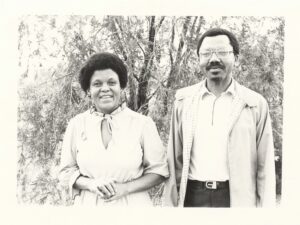

Lucy Alexander Interview by Tammy-Lee Lakay, Cape Town. 31 July 2024.
-
by

So, every angle of difficulty was experienced in this. In this educational world, because the key issue with popular education is start where people are at, where adults are at. Use their education, their experience more than anything, which they’re very able to talk about and they know the oppressions that they suffer from. And he’s saying, “no, but if you stop at that,” but no one was going to stop at that. It was the entry, and it was the giving adults a voice and it was dealing with the things that they wanted to deal with.
Lucy Alexander: It got burned.
Tammy-Lee: A lot of it. Yeah, I heard that. We’re still waiting because there are some bits of SACHED that weren’t like burnt. So, like the audiovisuals. So, we’re just waiting for those.
Lucy Alexander: Was the SACHED stuff stored at African Studies as well?
Tammy-Lee: A lot of it. Yeah. So, the papers are burnt, but the audiovisuals are okay. So, we’re still waiting for feedback on those. Mayibuye also has a bunch of audiovisuals, like VHS tapes with plays and the Working Women book launch and things like that. But I also don’t have access to them because it’s like the audiovisual guys are working on them. So, they’re not in the boxes. So, I’m a bit bummed about that.
Lucy Alexander: Yep. That’s a pity… Yeah. Okay.
Tammy-Lee: As I’m sure you’ve done interviews before. So yeah, if you have any questions, please feel free to ask. And I’m just reminding you of the ethics, to skip any questions if you don’t want to answer them. Yeah. And I look forward to talking to you.
I have questions over here, so I’ll move between you and the… But I’m here. My first question is a personal background. Who are you and where are you from?
Lucy Alexander: I was born in Port Elizabeth and grew up in Johannesburg for my father’s work reasons. And schooled there, went to Wits there. And then independently moved to Cape Town in 1976. And had been a short while in the UK. I mean just experiencing it and doing quite menial work. And by that time, I’d done bachelors and an honours in art history. So, bachelor’s with languages, maybe going to teach and fine art to a point. I’d started in architecture and then I’d swapped over to bachelors.
Couldn’t do maths. It’s not relevant to the issue. (laughs)
So then, a job at the National Gallery in Cape Town, now Iziko, and as an education officer. And during that time, we had a relatively progressive director. So, he used to allow two of us to go to Nyanga Arts Centre to teach once a week.
Tammy-Lee: Wow.
Lucy Alexander: And I had a personal connection to there. And then later I became involved in that period. I was at the National Gallery for 10 years. I became involved with CAP as a teacher with Cecil Skotnes, and teaching drawing and painting, which I never was really a painter, but I was a drawing teacher, and sculpture.
And then in ‘86 left for Pretoria, spent about a year, not quite a year, at UNISA Art Gallery as curator. That was exciting because I suddenly had space to be a curator. And then came back to Cape Town and for me, politically, it felt like the worst time. The universities were being strangled by the government, if you stepped out of line, funding would be lost or subsidy would be lost, etc. And so, then I left National Gallery and, or I came back, looked for a job, worked at Extramural Studies and made the shift to adult education. So, I left visual arts.
I did that diploma at UCT, part-time teaching at the Community Art Project (CAP) at the same time. And I’d become a full-time teacher at CAP for that period. It must have been, I can’t actually tell you how many years, but it could be three or four, and then it would be more than that. Then the SACHED job came up.
Meanwhile, at CAP, we were completely struggling for funds. I’d been left as acting director, and we were waiting for Zakes Mda to come and take the lead. Zakes kept us waiting six-months and then got a Fulbright Scholarship and went to the States. So, at that point, I exited. And I think Mario, no. Zayd Minty took over. So, I was at SACHED from mid-92 to mid-96.
Tammy-Lee: Wow. I actually interviewed Mario as well last year.
Lucy Alexander: Okay. So, for the project.
Tammy-Lee: Yeah. It was a small project because the CHR does this thing called NAV (New Archival Visions). So, it’s like breathing new life into the archives that are just like standing there. So, I chose CAP because my Activism in Archives class with Koni spoke about CAP, so I was intrigued.
Lucy Alexander: Yes. I ended up the last standing board member of CAP.
Tammy-Lee: Wow.
Lucy Alexander: So, I personally, while working at UWC… another person we numbered that archive. We hired a book and carried it to CHR. We wrote the letter giving it to UWC.
Tammy-Lee: Wow.
Lucy Alexander: I almost signed it for them. And they finally took it over because I worried that if we didn’t get it in its entirety, and I know it had much too much, drawing projects and things in it. We were bankrupt at CAP, so they would sell off the good pieces. If the legal, the person who dealt with the tidy-up got their hands on it. We got to see Centre for Humanities Research to Premesh.
Tammy-Lee: Yeah. Wow. I also found the letter that give that gave the SACHED collection to Mayibuye as well in the archive. It’s between, so it’s so interesting to find those, because I don’t know when it arrived and things like that. So, there’s like proof of the journey almost.
Lucy Alexander: It’s very much proof, there’s a tiny room in, there’s a, an old, let me not go off track. Okay. Stay on track.
Tammy-Lee: Okay. But no, don’t worry about it. So, you’ve told me how you came to join SACHED, but I suppose my question is, yeah, like that shift from like visual art to adult education, like how, how did that even happen?
Lucy Alexander: I think while working at the National Gallery in Pretoria, I moved in at the beginning of ‘86 to UNISA and I think it was just a sense of frustration with the art world which had been building and its irrelevance to many things at that time. And then, I worked, I enjoyed and worked hard at UNISA to produce exhibitions. I had free reign, which was nice. But I think I was frustrated by the elitism. And the… we used to run what was called the Cape Town Triennial, which was actually a really interesting showcase of some visual art at the time, contemporary art. But the experience of being a curator there and it was just a difficult space to be.
It felt irrelevant to what was going on around us. ‘86 was a difficult time, and it was a violent time. And I think it was less hidden than it had been in ‘76. So, it was in your face at that time. And so, then I was at UNISA. My husband had been avoiding the army for quite some years, because they call people up every year, and he was in America seeing whether he could leave the country, and I was working at UNISA, and then he had, he came back because his visa had expired, and he had a heart attack, so I came back to Cape Town in a hurry. And as a result, I left UNISA, and that was the moment when I cut from the art world, except for teaching at CAP. But then I worked at UCT, adult education, and I started studying at UCT adult education, and changing track and pretty much left the visual art world behind, except for Community Arts.
Tammy-Lee: Wow. It’s fascinating.
Lucy Alexander: So, in adult education, we had an incredible team. We had Neville Alexander as a lecturer. It was a kind of eye-opening experience. The adult education course at that time.
Tammy-Lee: Yeah. Wow.
Lucy Alexander: UCT and UWC both ran education courses.
Tammy-Lee: I also spoke to Shirley Walters, who I think was head of CACE at the time. 80s/90s. It’s wonderful how these, people are at all ends of the art and then adult education spectrum. Next question, did you work in the Cape Town office, hey, of SACHED?
Lucy Alexander: At the time they were in the Observatory in that large building in close to the Lion Match factory. If you want the name of the building, I can give it to you. It’s just not coming to mind right now.
Tammy-Lee: Yeah. When it comes to you.
Lucy Alexander: And I was interviewed specifically for ASECA which was Louise Vale’s project or initiated with Louise at the helm.
Tammy-Lee: And it’s funny you should mention Louise because she was asking me about the ASECA materials because they are at UWC in the library. So, because we’re digitising a lot of the SACHED materials, and I suggested we put the books that were digitised on the university database as well. So, I’m just thinking about ASECA because I was looking for the materials.
Lucy Alexander: She asked me if I had the educational materials. I’ve got this Integrated Social studies and English; it’s called Communication in English.
Tammy-Lee: Okay.
Lucy Alexander: Sadly, I offered many more in the last, maybe six years ago, cause I was moving. And nobody wanted them, and I was going to give them to Saide, but it required that I shipped them up to Johannesburg and I would index them, and I just didn’t have the energy for it anymore. So, I think it went on to a library sale or something.
Tammy-Lee: Oh, and now we’re looking for it. It’s really sad almost because the project we’re working on there was, they’ve been wanting to start it for so long. I think it goes back to 10 years ago with the first like proposals being written in 2014. So, it’s really sad that a lot of the stuff is now they’re missing or
Lucy Alexander: Yeah, dispersed.
Tammy-Lee: So, you worked on ASECA. Wonderful. So, what was your role in ASECA?
Lucy Alexander: I was Curriculum… I’m not quite sure what the name was anymore, but I can look. Curriculum Coordinator for the Humanities. So initially, I think I was almost the first employed by Louise for that project.
And she was at that time doing the research on the potential audience. So, there was a very thoroughly developed process, very systematically developed. And they were doing this huge project, a big data collection organisation. I mean she’ll tell you the names where they interviewed a large number of youngsters about their circumstances and the impact it has on their, had on their schooling and lives.
So, living, remember the key finding was if you live 10 Ks from school you’re bound to drop out within a certain time, if you walk to school. So, there was interesting information derived from that study. That was more or less the time I came in. We were building up to a curriculum research process.
So, within six months, I think a team of six or seven had been put together. Two of whom were one was Natheem Hendricks, who was already working at SACHED in a different role. And then Nandipha Matshanda. She lives in Cape Town still. She and I were the humanity, he was more on the sociology, politics side of things, I was more on English language teaching.
And Muleki Luke in PE, who was also… They came in as interns, the three of them. Natheem wasn’t especially intern material at that time he’d been working for quite a while. But the other two were first jobs they were taking on first jobs. And there were a lot of processes at that time because people being employed and many meetings and SACHED was an incredible organisation for training.
So, they had a long experience in distance learning, and the program we were working towards was distance learning mainly aimed at adults, but adults stretching from out-of-school youth to adults who needed a second chance, yeah.
Tammy-Lee: Explain the story. Sorry, no go on.
Lucy Alexander: No, I mean that is my first memory of it and putting together when we had access to a lot of expertise. So, it was just after the whole NEPI research project, which was starting to draw the route to the new curriculum to school after 1994. Or education after 1994. So, there were a lot of people interested and willing at that time. And I think we had the money to pay them to be consultants in many consultations.
So, there were meetings about the English curriculum in the Eastern Cape and in Gauteng and who knows where. We gathered lots and lots of material about what different curricula should look like. And my memory is of how difficult it was then to put it together. Because there was such diversity at that time.
We had, we had really good people who’d worked for SACHED in developing some of the previous iterations of adult education, alternate adult education. In fact, ASECA was initially going to be called the Alternate Adult Education Curriculum. And that didn’t sound good, so then they found a… I think it’s a Venda language word for it.
Tammy-Lee: Okay.
Lucy Alexander: So, ASECA has meaning in that regard, yeah. I mean those teams of people who acted as consultants, trying to think of some of them. There are lots of faces, but not names coming to light, but it was a mix of we had at a point, we had Neville Alexander on the Integrated Social Studies course consultation team that was at a point where we came unstuck in Pretoria with the department who wanted everything as it used to be.
And we were pushing against that. So, it was a very challenging role. It was it felt way beyond where one was at that time because we were dealing with outcomes-based education ahead of the country. We were learning from people from Scotland and Prof Richard Chiawena from Zambia, Chris Yates from the International Extension College, which is a big group distance learning operation that had trained people in commonwealth countries for decades. So, a huge team of trainers, including trainers from SACHED who had been training staff in developing curriculum, either for labour or for adult ed. And had been trained themselves, I think by similar organisations.
But we were trained in audio, using audio with the written materials. And then, someone must have talked to you about the nature of distance learning.
Tammy-Lee: Actually-
Lucy Alexander: It wasn’t…
Tammy-Lee: No. You will be the first. I spoke to Natheem, but we spoke mostly about Upbeat.
Lucy Alexander: Okay. Okay. Yeah. So, the curriculum or the distance learning mode was something that SACHED was familiar with, but they had always, I think, used it in dual modes so that you would have contact sessions where you could, and then the materials to enable the student to carry on, on their own.
It takes a huge amount of self-motivation to be a distance learning student to start off with. And then through IEC, we were also being trained to create audio tapes in that, I think I’ve got one or two tapes, little cassette tapes that the student would get, and they would integrate the tapes with the written materials.
There was a very tall man called, someone Thomas who would come up to train us in that. So, we were hugely trained, and we were being trained in managing or coordinating the development of materials, in coordinating the development of a curriculum, being at all those events. And then in English, we were also using various English teaching, theoretical methodologies we were being trained in.
So, genre-based learning and so it was, it was like a wave coming at you. And yet you were required to be getting on with it, recruiting people, groups of writers who were part-time. Training the writers, getting that whole process underway. So, I would say in ‘93, we must have had interns on board.
And then there was one other person, Jim Needham, who was in my equivalent position. He was Science and Maths teaching, and Natheem worked with him. And then those two sort of internal staff would have a team of writers. I can remember the Science ones more easily; it was James Garraway. It was… and Natheem will remember some of the maths writers, but there were people who were experienced teachers, but also had some writing experience.
We had people like Marilyn Brown, others might come up. I mean, I think from the books, you’ll see in the credits, although SACHED’s very, they were not very keen on names being assigned to work. We anonymized everything. We were a collective so that there were various inherited discourses and manners of being that were quite strong still.
Tammy-Lee: Wow. And it’s the same with CAP almost when you try to lump everyone together, they’re like no, no but it was painted by an individual.
It’s interesting. A lot of the SACHED materials that I’ve come across unless it was like or, so then there won’t be a name, but if it was like a book or something, there’d be like, Pam Christie or Karen Press or the name would always be there as okay. I don’t know.
Lucy Alexander: I remember a debate about it, but I’m pretty sure there are in the books.
Tammy-Lee: Yeah. Yeah. They are because I changed. Yeah.
Lucy Alexander: Have you had the ASECA books?
Tammy-Lee: I haven’t found ASECA books, but I found them on the university library site. Okay. And all their names Garraway was there as well.
Lucy Alexander: Okay, good. Yeah.
Tammy-Lee: That’s so fascinating. I haven’t the archive consists … There’s a lot in the archive. There are books in the archive library books that are not SACHED and then there are materials and a lot from the 1990s. So, I feel like I know more about the 90s than the past. And so, it’s so wonderful to actually hear about ASECA and not only look at the archive.
Lucy Alexander: Yeah, I think it is because, ASECA was the let’s just call it the dying gasp, but it was the end of SACHED because by ‘96, things were falling apart. All the senior leadership had gone into government or somewhere else. Funding was shrinking and it fizzled at that point. The big vision of community learning centers spread around the country, and all the tutors that had been trained and the sort of community learning centre managers that all just dissipated, which was a huge loss.
What it became after that was just Jenny Rabinowitz and Nandipha really, and one other person, an admin person. So, by mid, I think Louise left us, I think in early ‘96, because by July ‘96 I joined CACE at UWC with Shirley et al. Also working in a sort of distance learning mode so the training helped me tremendously in my career. But it felt as if yeah, there wasn’t much to hold us there anymore. And they were having to look to industry, with the skills development strategy that was going to be the market.
So, it was going to go into companies where the staff needed to back up their higher education their senior education and their secondary education. So, they were selling it to big businesses who would then use the materials in the context of their workforce.
Tammy-Lee: Do you know what came of that? Was it successful?
Lucy Alexander: I don’t know. Nandi would know, Nandi will not talk to anyone. She left, if you can find Jenny Rabinowitz, that’s the person to talk to. She’s in Johannesburg if she’s still with us. And Louise might know, but Louise was away for that period. But it was as if all senior leadership, the kind of energy disappeared very quickly.
And yeah so it was a hugely exciting buildup and then really a collapse, I think. SAIDIE people, SADIE would probably know where Jenny is. And there may be people with institutional memory of… because there was a woman who I wrote a tutoring manual, which I’ve still got. And then because SAIDE suddenly got employed, they wrote a tutoring manual. She used to do quite a lot of training in distance learning. Gosh, I’m battling, but I’ll try and retrieve that name. I worked out its 22 years. I’ve changed roles quite a few times. Yeah.
Lucy Alexander: So, more about ASECA, maybe?
Tammy-Lee: Yeah, sure. If I actually have a question about the NEPI, if you do remember the NEPI. But if you do have more to add about ASECA, that’d be great.
Lucy Alexander: What is your question?
Tammy-Lee: Oh, it’s two questions. One is, do you perhaps have the CACE publication from 1993 that has an article about the NEPI?
Lucy Alexander: A CACE publication?
Tammy-Lee: Yeah.
Lucy Alexander: I don’t know, my books are sitting in Bergvliet I’ve tried to give them to someone. Do you know what it’s called? I can, I have one. I’ll send you a copy of it.
Tammy-Lee: It looks the same, but there’s this one specific article about gender in the NEPI that I’m interested in, but I can’t find it anywhere. But I know it was in…
Lucy Alexander: Okay, I’ll have a look. There’s an outside chance. And then, your focus is on women’s issues within
Tammy-Lee: In education almost, and how they’re prevalent in the archive and what we can take away from that. It’s very confusing, I know.
Lucy Alexander: Okay yeah. Some books… I don’t know that I have much. It was certainly a theme that ran through much of the curriculum. And let’s just think. Yeah, I had an interest in feminism from my art school experience. So, after leaving Wits, I finished a final degree through UNISA and that was around feminist art.
I did about three years through UNISA, practical art whereas the other, I’d finished with history of art. So, I think many of us were feminists at that point. So, it did infuse the materials, and it was questioned in terms of balance and issues that we talked about. But yeah, sorry, that’s a message.
Tammy-Lee: No problem.
Lucy Alexander: Yeah, there’s only one document I can vaguely remember, but I weeded out this community development archive or library being set up in KZN through a friend who works there now. And that’s why it’s sitting in her sister’s house in Bergvliet for her to carry to KZN piecemeal.
Tammy-Lee: Yeah. Wow.
Lucy Alexander: So, the archive is being dispersed even further.
Tammy-Lee: Yeah, and it’s sad, but it’s also great that the material sort of lives and is exchanging hands. Everyone I’ve asked about the NEPI, they’re both like I know I was part of it, but I don’t remember. That was the takeaway from one of my interviewees. Did you work on the NEPI? Or?
Lucy Alexander: No. No. At that time, I was trying to keep employed. I’d come back to Cape Town after my husband’s illness, and I was six months here and three months there and doing some traveling stuff as well. So, it was more, it felt as if it was the universities and the struggle intellectuals who were running NEPI.
And it was written at quite a high level at pretty much a policy level. And I think a lot of that was infused through Louise and the overarching curriculum document that we came into. So, we were trying to take it forward. The requirements of that, but then we started working on four area-specific curricula, which were in tune with that and the user profile the big research project that had been run, trying to understand who the students were.
Really, that was a really interesting piece of work. Hopefully, a copy of that exists. Louise will give you the data collection organisation was one of the big ones, probably still exists, but I think it’s been superseded by others that are more… that are more quantitative and qualitative.
Tammy-Lee: Interesting. This is fabulous. I love it. Wow. I think I had another question. Yes. Briefly, because you joined SACHED at a very peculiar time. The 1990s, there was so much happening in South Africa and that obviously affected anti-apartheid movements and organisations such as SACHED. So, I think I’ve the question that I wrote down is about feminism, but I’ll start with the demobilization question. Because you spoke to it as well. It was happening to CAP and then it started happening at SACHED. What was that like?
Lucy Alexander: The experience of being in ASECA was that as far as you could, you had to keep your head down because the quantity was so immense. The quantity of work that had to be covered was overwhelming.
It was a very overwhelming period. And I think we were burning out left, right and centre. So, I think other members… SACHED felt like a highly political organisation, but then there was this little cell of people who had this educational marathon to run. And occasionally we went out to rallies or marches, but not generally, I don’t think I can say all that much about it, except that it was happening around us and making it even more difficult because you were drawn into meetings and things that you really couldn’t keep the job going if you got too involved.
So, I’d say that Louise is probably your best spokesperson of that, but I think it also may be opened up a space for looking at the future. And it took the pressure off because the period that I was full-time at CAP, we were being raided. We were being trained how to respond when the Special Branch raided.
We were under tremendous pressure. There was pressure at that level and other people were at huge risk. You didn’t necessarily know who was at risk, but there were people there who were at risk. And the second period feels more like a kind of it was, by the time I came there, 1992, it was deep into a new start. You know, it was still, the terrible massacres going on in Boipatong and other places, but it had become factional or political. So, in KZN, ANC, Inkatha involving our students where I had to go give evidence and that was CAP but literally a year before you were in this boiler.
And then somehow by ‘92, it was as if the lid had come off the pressure cooker. It was, I don’t really know. I think people like Natheem, et cetera, the real activists will know more. But. I think the feeling was different. It was hopeful and you were engaged in a project that was entirely blue skies and people would have education.
And the slogan of “from sweeper to engineer,” and those, that kind of discourse was about, it was extremely hopeful. So, then it was really disappointing by ’96, well ‘94 with what was the actual date of the opening of parliament? That’s when we really lost everybody. The director was doing the seating at the opening of Parliament. People were just, their heads went somewhere else.
Tammy-Lee: Wow.
Lucy Alexander: It was like it was just fizzling out. It was dreadful. And we’d met in Eastern Cape, and we’d met in KZN and the tutors and the community learning centre people had all been trained. And that started, but just was never going to be, so it was incredibly disappointing.
Tammy-Lee: Wow. I’ve never thought about it like that. That is insane.
Lucy Alexander: And in that period before that. That might have been interesting to know what year that was because we kept having to go to Pretoria to try and get these, there were four, four modules that were going to serve for adults.
And we were trying to get them accepted by the department and the department was still the old guard, literally heavy old guard. And you’d go to these meetings, and you’d be talking like that. So, the one kind of telling his story over tea where he’s trying to self-justify that he was, it was his mission to bring education to black people.
So, there was such a blindness still in the people that you were talking to, and you were not trying to convince him that your curriculum. was what was legitimate. They were pushing where they could. So, Unit 7 in the Integrated Social Studies is an interesting one because they made us rewrite it.
And we’ve got Neville Alexander, Andre the historian, I can’t find his name.
Tammy-Lee: Proctor? Andre Proctor? Oh, I’ve interviewed him.
Lucy Alexander: Okay, Proctor. And who is the old man? He was one of our advisors and they basically asked is apartheid and resistance the name of the module. And they wanted us to show the sunny side of apartheid. That’s my joke, but I can give you the two. That’s an interesting thing with the old and the new. When we were allowed to have and what we weren’t allowed to. We were being censored and those meetings were extremely stressful. We had Nan Yeld there as a co supporter.
She worked at UCT, and she had been in the English advisory group. But she never… Okay, no, there was a level at which she wasn’t seeing what was being lost. So, we were saying this is Communication in English, it’s going to help adults to actually get the skills that they need to operate in the world with greater confidence and with greater writing ability.
And the, and she thought it was an achievement that we got it through, but there were compromises about they wanted more literature to be introduced. We had one, I think we settled for 1984 in the end, because in an ironical way it told the story that had been, had happened and what was going to happen. But she thought we would try out triumphant and I burst into tears at the end of the meeting.
Tammy-Lee: Wow.
Lucy Alexander: So, we weren’t quite succeeding in convincing the old guard that this was okay.
Tammy-Lee: Yeah.
Lucy Alexander: You know? But it became irrelevant in the end anyway. But those, that was extremely hard work to do, to go up there and deal with people who simply had, didn’t have the ability to see it in a new way.
Tammy-Lee: Wow. That’s insane. That’s going to be such a good point to make later. Wow. You have highlighted some of the questions I was going to ask you like, what were some of the tensions you experienced when having to defend and present on evidence for students of CAP. Anything else like that, like you experienced maybe at SACHED between ‘92 and ‘96?
Lucy Alexander: But I think the learning curve was extremely steep. So only Natheem had worked in SACHED and obviously Louise had worked in SACHED. I’d worked in CAP for many years, but it wasn’t quite the same because we were trying to create a new formal curriculum. We had done one-year, two-year courses at CAP and that had also been a kind of curriculum development process, but it was extremely steep. Taking on all these new modes and taking them on with understanding and in a practical way like outcomes-based education distance learning everything was coming at us very fast, and an end-product was needed.
You had to have the materials there and they had to be printed, and they were being driven down to Grahamstown because we were there for a training course, but the materials weren’t off the press yet and so on. So, it was tough at that level. I found the dynamics within SACHED really difficult and time-consuming.
I think in NGOs of that era, a lot of energy went into keeping the NGO afloat and different leaderships desires and demands, and that’s side-tracking the central project, which is part of it. It will always be part of any enterprise. But when you’re faced with a deadline, sometimes, that’s a difficult thing to navigate.
And I wasn’t experienced in SACHED. I didn’t really know the dynamics. And we were four, four different projects and one looking at worker education and one looking at primary education, us looking at adult education. And then there was a fourth one. There was the Upbeat. So, everybody in a certain way, struggling for funding. So, there was a certain competition between groupings and that would have created some tensions as well.
I think in SACHED, I found it quite difficult to be white. ASECA was seen a bit like an upstart. In my opinion, that you are the new kid on the block and you’re absorbing a lot of funding and they’re these new people, why aren’t the old people in the… it wasn’t said, but it felt like that.
And then there was one incident at a training course where one of the old guard trainers laid into me publicly with 90 people there or whatever. That was unforgivable and she was taking out her anger at ASECA or something else, but she laid it on the one white woman who wasn’t particularly aggressive.
So, I experienced that in a few places, and it was early days for that because simply that you were working there and were committed to the cause legitimized you in camp. I mean I did many years of work there, voluntary, and non-voluntary. But at SACHED one was less known, and that was quite challenging.
Yeah and the dissolution, which was extremely sad. You didn’t, you got the feeling, I think the Jenny Rabinowitz project, and I can’t even tell you what it was called… at least meant that it wasn’t all just being put in the waste. But it you didn’t really know what would happen to the material and so on in the long term.
Yeah, there wasn’t much vision for where it would go next. And one also felt that one had let an awful lot of people down. It was that same enthusiasm that we created around, the launching and so on. When Grahamstown, I remember particularly, it fizzled. There were no more salaries. There were no more opportunities. Yeah, that was difficult. And then the kind of theoretical language stuff that we were supposed to be internalizing alongside all the other things, I found that challenging. There was an advisor, Felicia Forrest, who had done particular linguistics courses in the UK.
And that was also coming at me, things should be done in this way. Integrating all the demands of theoretical demands that came out of groupings like NEPI, et cetera was coming at us as the Curriculum Coordinators it wasn’t really being mediated through anybody else.
Except Louise, who was balancing many things, but it felt like it was a huge undertaking. I think the outcome is, was up to the point. And Louise and I tried to work out when did she leave, because she left for the Netherlands, because Peter, her partner, got an opportunity there.
And that’s when our operations started teetering. The other thing, the opposite of challenge was the people. It was a really good team, a really nice bunch of people working in ASECA with the same kind of commitment and energy.
Tammy-Lee: Yeah.
Lucy Alexander: And not that many tensions within the organisation. But the fallout was, the fallout on Nandi was serious. I think complete burnout. And yeah not everybody survived it.
And then, yeah it was on the learning side, it was an extraordinary opportunity. Except for the adult education course that I had done, ‘89, ‘90, nothing came close to it, educationally not the degrees, not anything, really, yeah.
Tammy-Lee: Is that the one from UCT or UNISA?
Lucy Alexander: No, UCT I did the adult education diploma with Clive Millard, Tony Morphet, Neville Alexander, those people. UNISA that was a fine art degree.
Tammy-Lee: Yes.
Lucy Alexander: A very strange degree. We used to take our sculptures to the station and send them up by train.
Tammy-Lee: Wow.
Lucy Alexander: And then by packaging that year, more than anything else.
Tammy-Lee: My word. My last question to you is yeah, based on your time at the organisation, what do you think about the archiving project that is happening now? What are your thoughts on that?
Lucy Alexander: I think it should have happened 10 years ago because that was when I was ready for it. It just, I’m all for it happening because I have worked in museums, and I have a feeling that history is really important and in the sense that it gives opportunities for people to see alternatives, to see the possibilities when governmental structures become really heavy and immovable.
I feel that for that purpose it’s really worthwhile. I would, apart from the objects that one will collect, I think in a way, it would be interesting also to capture the lessons, good and bad, that we learned from it. And if people, I think you have had collective gatherings, but I wonder whether all the people who are politically significant and activists in that world to talk about what they were creating, what they were trying to create.
I don’t have a real sense of that. I have it in CAP, but I don’t have it in SACHED. And to try and capture that through, through collective discussion could be really interesting. I think from Louise and John Samuel and people who were the originators, you’ll get a lot of the vision. But there’s a middle grouping who are activists and as long as they don’t dwell on the sort of personal negatives, I think that that’s the history that interests me in a way. The dynamics of those educational projects are interesting. What we can learn, what we could rebuild because there was huge energy and CAP after it changed its name, and I can’t even give you the name right now, but that energy, that volunteerism, it went.
We used to work night because generally, adults, if they were adult students, they couldn’t come during the day, but that later group only worked during the day, nine to five, no voluntarism. And so, it became like a formal organisation and those are the elements that are most lacking I think in post ‘94 South Africa.
There is a lot of it, but there’s a kind of formalizing and another attitude to it, you know, whatever.
Tammy-Lee: I like that. I like the idea.
Lucy Alexander: I think it’s a good project. Initially, even the idea of it just made me feel too tired to be part of it. But I think, 22 years is a long time. And I think you are working with the disappointment as well with some of us.
Tammy-Lee: Absolutely.
Lucy Alexander: That it fizzled. All of that exciting project fizzled, so you, initially one could barely talk about it. One had to move away from it to not have to admit that this had all just been wasted, actually. Awful. So, if there if you can make something from which to learn, go for it.
Yeah. Yeah. So, it’s the NEPI report on feminism.
Tammy-Lee: I know the NEPI is, you can find, this is a CACE article by AnnMarie Wolpe. Annmarie Wolpe or Wolpe?
Lucy Alexander: Wolpe? Spell it for me.
Tammy-Lee: Oh. W-O-L-P-E.
Lucy Alexander: Oh, oh. Okay. Now where’s her archive?
Tammy-Lee: I don’t know.
Lucy Alexander: If she’s still with us.
Tammy-Lee: I think she’s passed on. Yeah.
Lucy Alexander: Because her husband, Harold, was a big figure. So, you need to find that archive.
Tammy-Lee: My mission today.
Lucy Alexander: And I’ll ask my sister who knew someone who knew her. Because African studies will know where Was he Harold? There were, there were Harold Wolpe.
Let me just quickly look up Harold Wolpe. They were all activists, and he was instrumental in that. Yeah so look up his story. Yeah, Harold, South African lawyer and sociologist. So, you’ll find that archive.
Tammy-Lee: I’ll just give it a look.
Lucy Alexander: Okay. Yeah. They lived in Newlands and then there was an annual Harold Wolpe lecture for many years at UCT. He was interesting.
Tammy-Lee: Yeah. I see that. Wow. Cool. Yeah I did a quick Google. He’s also cited, I think, where I found her article, he was cited as well. Yeah, so they go together almost.
Lucy Alexander: They may have blown up pylons or else the other people that my sister knew blew up pylons, I can’t remember which.
Tammy-Lee: Okay, wonderful. Yeah, that’s all my questions. Do you have any questions, Lucy? Any? Any questions before I go?
Lucy Alexander: No, I don’t think I’ve really given you much sense of the kind of feminist project, but it felt more like it was women centered, women’s sensitive the work that we did. But the book that Shirley Walters et al. produced On Our Feet. It was Women and Popular Education. So, that course had run in 1989, and I’d been to it as a member of CAP, and that had also been quite an instrumental piece of work. Now, I’ve either got it or it’s in the house in Bergvliet.
And I’m about to go retrieve the stuff in Bergvliet because she never takes it and I’m terrified that someone will sweep it out one day. I have about three big bags of materials.
Tammy-Lee: Yeah. Keep them safe.
Lucy Alexander: And then what is Louise has asked about the two sets of materials. Do you want, will you be the conduit?
Tammy-Lee: Yeah, I can. It’s not an issue because we are building the collection and we’re adding things, and it will be easy to digitize them, and you know they’re safe if they’re with me. Me particularly.
Lucy Alexander: Careful with the two unit sevens. One doesn’t get cast aside as duplicate. It’s not, no. It’s the darker side of apartheid. And then which where are they being archived at?
Tammy Lee: They’re doing it at Wits and then, because there’s some books here, we’re thinking of doing it with either Memoirist or Stellenbosch University. Memorist is near UWC, Epping. I don’t know if you know where Epping is.
Lucy Alexander: What is it called? Memorist.
Tammy-Lee: It’s a new company. They also do digitising and things like that. But because our scale for the Cape Town stuff is quite small, most of them went to Joburg. I went to Joburg recently. So, all of it’s being done at this. your alma mater.
Lucy Alexander: Yeah, but would you not want to keep the books?
Tammy-Lee: No, we’ll keep them, of course. We’re just talking about the digitising as well, because I think that’s what Louise is hammering on about in the email. She was asking about it. Okay. Yeah, no they can come, and I can send you the I have a form that you can fill out that says like you’re giving it to the archive, and they’ll be safe there.
Lucy Alexander: Yeah, no, that’s fine. So just when you want it, but I’ll that On Our Feet is interesting because what CACE did was it invited women from a whole lot of different NGOs and we did a course in teaching or drawing feminism into curricula and activities at NGOs.
Tammy-Lee: Yeah. Wow.
Lucy Alexander: Using a popular education modality and CACE was very significant in bringing popular education, Paulo Freire, into our lives. I mean even in ASECA, I was pushing that, and we did push it in the in the face-to-face stuff, but, I remember Joe, what was his name, he was the prof of English at UCT, coming down on me, “Are you going to use popular education? Are you going to deny people access to more education that’s racist in itself.”
So, every angle of difficulty was experienced in this. In this educational world, because the key issue with popular education is start where people are at, where adults are at. Use their education, their experience more than anything, which they’re very able to talk about and they know the oppressions that they suffer from. And he’s saying, “no, but if you stop at that,” but no one was going to stop at that. It was the entry, and it was the giving adults a voice and it was dealing with the things that they wanted to deal with.
Tammy-Lee: Yeah.
Lucy Alexander: But he, there was a kind of theoretical debate going on in his head. I think that Freire didn’t take it far enough that people got trapped in their own knowledge and didn’t move beyond that. Never mind.
Tammy-Lee: I see we do have the book at the university library. So, when I’m back there, I’ll go check it out, On Our Feet.
Lucy Alexander: That was the third significant moment in my education.