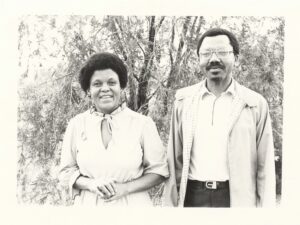

Irna Senekal is interviewed by Enver Motala, SACHED Durban, 6 January 2022
-
by

Irna Senekal and Enver Motala are sitting together and are going to be talking about our life in SACHED. We both worked together in SACHED in the 1980s. And so this will be essentially about that.
Enver Motala
My name is Enver and I said to Irna that I’d like to start with her recollection along the lines of three issues.
The first being just simply some background of how and why she joined SACHED when she was in Durban at the time. The second is what exactly she did when she was at SACHED. The content of the work she did in SACHED. I think she was in the Lacom project. And then thirdly, some reflections on all of that and both about what it meant then and what it might mean today. I think we can talk about that here now. So that’s where we’re going to go.
I have a very hazy memory of that period. Of course, I remember you joining, but I don’t even remember under what circumstances and where you came from and what you are doing before.
Is it true that I remember you and Solway Piper opening up these big banners at a nationalist party national meeting?
Irna Senekal
Okay.
EM
Say something about that please.
IS
Okay. So before I go there, I should sort of take another step back and say, when I came to Durban, well, I qualified as a teacher, language teacher in English and in German. And so I started as the German teacher in a high school in ………….
I think, roundabout there and loved my teaching, loved the engagement with young people and had a class from what was standard 6 to standard 10, so from grade eight to a matric. And at the same time as I was teaching, I lived in a flat that I have no idea what that street is called or road, a fairly large one that goes past Howard College, past the University and across behind and meets up in Lamontville and Cato Manor.
So it goes into that long road of Cato Manor. I can find out what it’s called. But at that time there were emerging student protests in Lamontville. And I think at that point there was no school in Cato Manor and there was obviously also political mobilization at the medical school of the University. And so students came across that Hill right past my flat, chanting and singing, going down to the medical school.
And in many ways, this was one of my first experiences of mass protest. I did not fully understand what was happening. I mean, I understood that they were protesting about conditions of school and the teaching of Afrikaans and oppressive system under which people had to make their lives. I understood that in very broad terms but the details of it was not known to me because unlike white, English speaking counterparts who may have had as part of their studies of political experience on a campus, my political experience was very different. It was steeped in the national party and African nationalism in universities and kind of small acts of resistance.
BREAK
So I think we were coming to my consciousness about what kind of world we live in.
And so, unlike people who grew up and went to University on an English speaking campus, mine was a very different experience. I tried to understand what was happening there. And I could begin to see the differences between my teaching and what I experienced is this huge gap in my understanding of the world. It really shook me. I think what happened and the police brutality that happened. At the same time, I wanted to unlearn what I’d learned or learn new stuff. And I left my teaching job after one year. I think it was then that I ook a job as a library assistant, and I had to work at the University. I had to work at the University library for two years before I could study free of charge.
We’re talking of University of Natal.
And what I then ended up registering for was a degree in applied linguistics, an honours degree in applied linguistics. And they had a very good school of applied linguistics. And so I became interested in both thinking about schooling differently and thinking about language learning, in particular, literacy. And also because I’m someone who moved from a completely Afrikaans speaking environment into a world that was predominantly in English. And my own transition was kind of also interesting how that happened for me. So I then took a job at a school.
What’s the area where you stayed? Overport and behind it mayva Maval?
EM
Below the University?
IS
No. Behind where you were staying in an area that I think it’s called Maval. This is so long ago that I can’t remember properly, you know, that it’s like 40 years ago that we’re trying to stretch to. I think it’s called Mavil. It starts with the acid.
EM
Maybe you’re talking about Punta’s Hill. No, because where I was living was far from Maval.
IS
No, Overport and behind Overport going towards Pine Town. What is that area called? An area where there was a big and well known coloured school.
EM
Spark Estate.
IS
Sparks Estate. Exactly.
So I started teaching at Sparks Estate, and I was an appointee of the school governing body. I wanted to understand what was happening in other schools, and I was the school librarian, and I taught some English. And so every year, the school governing body would have to reapply to appoint me.
And so at the same time, I became aware of Black Sash protests against the establishment of tricameral Parliament and other laws that were affecting people. And I think first I ended up joining Black Sash, and I can’t remember how that all fit. Whether Sparks Estate teaching was before Black Sash or after, I think it may have been after Black Sash. Search? And at the same time there was a night school for primarily, I think, African people, adults who went there at that huge Catholic Church across the road from SAched’s offices.
EM
Oh, in town. The Cathedral.
IS
But what was it called, Saint……
EM
I know it called Cathedral.
So there was a nice school there.
IS
Okay. Yeah. Next to the Cemetery. Yes.
So there I ended up teaching English. And because there was no one to teach biology, and I did well in biology at school, I ended up teaching biology. So there I made, I suppose, a repetition of the conditions that pushed people out of school. So no textbooks. We were up in the Church Hall, in the ceiling, in the attic, where there were old Church pews and broken down stuff. And we had to make a small classroom in the middle of all this chaos at night where people were coming back from work in a factory or in a shop and trying to get their Matric.
And I was wholly unprepared for this in a way, I think of it sort of arrogance in a way, an assumption that I could do this because I was a teacher. And it just led me to question whether this was helpful to people at all and what the alternative would be. And through Black Sash and people like Solvay Piper, I then became involved with what was the NUTW Textile Workers Union, their attempt at shop steward training and literacy classes for shop stewards.
And I continued teaching at Spark Estate and did this again in the evenings. And this was different. And through that, the connection, through those bits of teaching and experience in the Union, connection was introduced to SACHED.
EM
But we were then not across from the Cathedral. Then we were in Richard Road near Alhambra. No? Or you joined when we were across the Cathedral?
IS
Yes.
EM
Okay. So that was somewhat after.
IS
So the time that I joined you was probably about 1984. That’s the bit that I’m uncertain about. It may even have been after that, because I remember the COSATU formation in 85. I remember being there and translating stuff from English into Afrikaans and being told off by Fred Souls and other people from Utah. Not that my Afrikaans was not good enough.
……. very powerful moments of questioning who I am and what I can do in the world, I suppose, how I find myself in the world. So they pushed me to think, and I don’t want to use words like white privilege, because that was not conceptually there, but it was there as who am I as a person who would be situated in the world as a white Afrikaans young woman? And how is it possible to be different in this world that would position me like that, with all the things that go with it, with coming from an Afrikaans environment and being a young white woman who’s probably very to come back to them.
EM
So what do you remember when you first joined? Second, what was it all about?
IS
So what promoted that was Literacy classes with shop stewards at the NUTW and the potential extension of that. So I came to SACHED because it seemed that doing these classes.
I think it was a negotiation between possibly John Copeland and Sulvig and yourself. And I can’t say what happened on the second side. I don’t think at that point there was a labour and community project yet.
I can’t remember whether Gareth was working there already.
EM
No, the project already existed.
IS
I think it just started. And so I came in specifically to do this teaching and then Charles joined. Because he joined after you. Yes.
So he was then a shop steward at was he a chemical shop steward? I know that he’d lost his work, his job. He had been fired from the factory out of a strike. So Charles and I then started as a kind of pilot project in Pine Town, teaching workers who were interested in learning. And there me, I am so bad at remembering names, a Union person. And then he came. NAME
And what was really interesting was the way that Charles and Cyril approached things. They were quite different. There was quite a big age gap between both Charles and Cyril, and Charles was quite didactic. He was saying, like, Hold the pencil like this and form your letters like that and say after me, because that’s how we learnt. And Cyril did things a bit differently. So Charles was very strict and Cyril was, I want to say, a sort of automatic, more natural teacher. So he would encourage people. He wouldn’t say, Hold the pencil like this. He will say, oh, your A is looking good. Can you try this as well?
So he encouraged people and in a way, the two of them working together, they became a team. The literacy classes in Pine Town and those first, Charles and Sarah were both working with people who could not read and write; accomplished shop stewards and arguing in both English and in Zulu, but who had not learned to write and could not read.
So I was looking for ways that would take us beyond the kind of way in which all of us were schooled, which is in this kind of automatic repeat, see this word repeated learn lists of words and so on, completely out of context.
We had to make the material that we were using because there was nothing. What was it called? Read. There were some publications because a literacy movement was beginning, was emerging. Learn and Teach, SACHED publications?
EM
No, there was some stuff SACHED was doing in the National Weekly, supplements in national weekly, which had to do with literacy. I’ve also forgotten the names of those things.
IS
So we had to really search to find it and primarily we had to make our own and so we ended up making up stories that were familiar to people. Me drawing to some extent on my learning in applied linguistics, which is about language acquisition and different approaches to it. And then our attempts at trying to understand a Freirean approach
It then extended to be something that any shop stewards in Pine Town local could join. And so we had a number of classes and we had people. So Charles and Sarah ended up doing the first literacy classes for people who were learning to read and write. And we were trying to find out more about how a Freirean approach would work, struggle to find literature, had to sort of guess our way into learning language in a context that made sense to people, with words that come from people’s own experience in language. And Charles and Cyril did initially this combination. And this is, in retrospect, really interesting, a combination of English in IsiZulu so that people were writing in isiZulu and introducing English because many people could speak English but not read and write. So they had this oral language ability, but the textual and visual part of it hadn’t come together yet for them. Although we also found that one of the first things that we used to do was to ask people how do they know to get from where they live to a new place? So they describe that and then people discover that they are actually reading, so they know they can read the name of a street or a building.
EM
Stopped you there for a moment because I want to fill in some other parts of it.
This work in Pine Town actually resulted, can you remember, I want to remind you, refresh our memories about it – resulted in our setting up a full time office in the Pine Town area and then doing a recruitment drive for the literacy classes. And in the first year when we attempted to, we had several thousand actually potential learners, though when it came to the starting of the classes, we initially had a few hundred only because of work created constraints et cetera, et cetera. And the numbers then dropped quite significantly as a result of a whole range of issues because there was no negotiated time of for learning. And workers had to come in the evenings. Winter was difficult.
IS
Yeah. When they came off shifts. So we had classes basically every time people came off shifts and they worked swing shifts. So sometimes they would work at night, sometimes they would work until midday, and sometimes they would work until late afternoon.
Branch that was initiated as a result of this work. Ultimately. It became a full time SACHED centre. and we once a year hosted a workers day at the Pine town Centre.
I remember cooking for hundreds of well, a few thousand actually.
I remember Kulsom and I cooking in the back in large pots over open fire.
EM
Precisely. Yeah. So that’s how that centre really became.
And Sarah became virtually full time at that centre, and he had one or two other helpers there. So it really grew into a very active place. This little beginning from the literacy courses. And then we had a full kind of library there and all of that.
IS
Okay. But I remained in town and was traveling out anyway, was trying to remember what I drove because I didn’t have a car for some of the time. I remember sort of traveling on the train to Below, where I was staying.
EM
And remember we then started a branch, even in Newcastle. I forget his name now. So there was a full time branch there, too.
And so we had a van also at a certain stage. But the important point was that between that, in addition to this literacy work, which was quite a large chunk of other work which had to be done, there was now an initiative also to start some other educational work. Well, other educational work was running alongside it even before some of that.
IS
So there were different things, and I can’t remember the sequence of them. So I’m just going to tell you and then maybe you can remember how they work.
First of all, there was a sort of ongoing project that you and Gareth were involved with that had to do with the writing of South African history for workers. And so the history Freedom from Below book emerged. And you asked me to, I think, proofread some of it and to simplify language, which I then did.
And then we tried, in a very crude but the best that we could do at that time to try to get some active reading strategies involved in this process and to bridge between someone maybe reading to other workers and questions that workers could ask to engage with the text.
So there was this worker that was kind of figure drawn with questions or comments, Tommy. Throughout the book, if I read it now, I look at it and think I would definitely do it differently. But it was an interesting attempt because what I think we tried to do was to not only write the content of history differently, but also to support people’s engagement.
EM
And it’s hard to think back to that time where so many people had extraordinary literacy in an oral way across languages and sometimes across several languages but were denied schooling. And so reading and writing was absent for people. And we also did numeracy with Charles and Cyril. Okay, so out of that.
IS
That little bit of support. Other bits of work emerged for me because of the request that came from the trade union movement.
One of them was writing the history of different revolutions across the world. And the two that I then ended up writing very slowly was the French Revolution and the Spanish Revolution. I don’t think I’ve changed being a slow writer. And what was absolutely incredibly valuable to me was that it was a way of teaching myself. So writing in plain English meant that I was unfamiliar with all of this. I’d never learnt it, so I had to learn it and then find a way to communicate what I learned and saw. And then I remember having regular conversations with you about what I was writing and how those conversations and questions were helpful and supportive and at times critical. So you would say, well, have you thought about this? Or you would reinforce what I was doing? And it’s a thing that you still do in supporting people’s writing? I think so for me, this was one of the editing of this South African history. And the writing of those two things were incredible learnings for me.
And then there was the literature that we shared. So I started reading sort of initial first things about the Russian Revolution, those wonderful set of books. Well, they weren’t books. We had sort of photocopied pages from the Petrograd Soviets who wrote that.
EM
About the best collection of writing and all of that stuff.
IS
So there was that special library that was hidden away downstairs. And so being able to draw books from there to read was amazing for me. There was that bit of campaign writing. Yes. So then there were two strikes, right? There was the OK Bazaar strike. So the first strike of workers of shop workers, the first big strike of shop workers was the OK Bazaar strike. Writing small pamphlets and drawing in.
And so I started, in addition to this writing, doing writing with Karen Hurt and Shamimari, who were editing the women’s magazine, Speak.
Yeah. And so I wrote occasionally, interviewed people and wrote up stories for Speak magazine. And what that did for me was obviously introduce the issue of women and women’s issues from a workers perspective and a feminist perspective into my own thinking. Again, stuff that I did not know before. And that in itself was another education.
That work really started out of the network of connections that SACHED had and I suppose the initiatives around workers struggles that developed in Durban at that time. And I think Durban was probably unique in that way. But maybe I just don’t know what happened in Joburg or Cape Town in Pietermaritzburg. Then there was the strike of workers Ateco the tier state and the trade Union members. Workers were evicted of the subeco to State Farm.
EM
Where was it?
IS
Can you remember it? To the south, almost near the former Transkei. In that border area in the Port Edward area, yeah, you have to go past Port Shepstone and then you drive towards Underburg. So somewhere in that area. So I never got to the Free State.
But we then had and Shafteurs had negotiated with and.
This was that interesting issue of how in the trade union movement there were different political strands apart from the obvious ones, people who are more oriented towards the ANC and SACP, possibly, although the SACP was a lot less visible and there’s more ANC support. There were people who supported Inkhata.
And the negotiations between workers and the shop stewards had to be with Inkhata Chiefs in that area to allow people who literally once they were evicted from the farm couldn’t get home and they didn’t have the money to get home. And the negotiation with Chiefs allowed people to settle temporarily in those areas. So I did a series of interviews with people together with Mo was at Foe. And then I wrote up a history of land and of the subeco workers and their strike.
And again, that was massive, massive learning and also learning from people who work at Afra at that time because they were involved in helping people settle.
EM
And then there was, of course, the strike at Samco because they’re workers. And you will remember us going out and supporting the building of electricity program and how it can be thought of.
IS
That was a huge bit of work that we tried to do.
EM
And that too was complicated. I mean, I have this memory of us sitting in that. I think it was a chicken coop. It was something like that.
IS
It was a chicken coop. We were sitting on tins and being told by Zondi about the importance of the literacy work. By the way, who was the organizer there? Can you remember?
EM
What’s his name, he is now with AIDC? I can see him. I don’t know how he came to South Africa. Strong British accent. Roger.
IS
Roger.
What happened was some call. And our literacy work had to do with the workers struggle to establish a cooperative that would help people to generate funds that could be distributed amongst the strikers. And again, they had access to land.
EM
Plus the button making.
IS
There were two cooperatives. There was an agricultural cooperative and there was a T shirt and button making cooperative. And we were to support those workers, literacy in particular, so that people could begin to read financial statements and could make rules and keep minutes and records. And so it was all in many ways quite functional literacy. But also part of the conversation that you had with Bob Zondi was about astronomy. Do you remember that?
EM
Well, from the basic literacy, it went to a whole range of other things, political economy, production systems. And ultimately we wrote those two little booklets, one on human evolution and one on the solar system, because that’s how the thing developed. It broadened considerably there. And I think I was there for many years. I think you had a seminar for many years, Ravi, who used to work in the unions, went there to set up their financial system and so on. So we went at one stage, if I’m not mistaken, we were going twice a month to.
IS
But that very first conversation had this absolutely life altering conversation between you and Baba Zondi for me, because you asked there was not just him there, there were other shops stewards, and you asked how would you know what is an educated person? And what the workers answered was that it was Boba Zondi, and you wanted to know, how is that possible? And so this explanation developed out of a lot of questioning and answering that essentially he knew things, and the fact that he could not read or write didn’t matter. It was the knowledge that he was able to share with other people and that he gained this knowledge by asking questions and getting people to read to him. And so this curiosity that he had about the world is what made him educated and his ability to share it. And for me, this was one of those things that it had never come into my consciousness in this way to question whether I was educated. I had degrees, but I entered this world and more and more discovered myself not as a knower, as a person who thought I knew, but actually whose knowledge of the world was totally skewed and lacking.
It has never left me that idea that it’s both a curiosity and it’s an understanding of how limited our knowledge of the world is, even as we are learning all the time, and how that is totally unrelated in some ways to qualifications.
EM
But I particularly remember that discussion because there are a number of workers when we first raised this question, who gave us fairly formal answers. Yes, about cap and gown and people with degrees and so on and so forth. And it really was an iterative conversation which gave rise to this really very profound understanding of what is the meaning of knowing, of understanding and what its social content and its context was and how it is constructed and so on, so forth.
So, yeah, that was a really important formative discussion with those workers in particular. There was a similar discussion with other workers elsewhere also, because the whole education program was premised on our trying to engage with workers on the basis of their life experience also and their knowledge and building on that with whatever knowledge we might have had also, but on the assumption that really we were as ignorant about things as we might have thought others were.
IS
There were two things. The one is the first sort of, I suppose, consciousness for me that there’s knowledge that is privileged and certified, but there are a whole lot of other ways of knowing and understanding the world in ways that are really important and deep and that I had no knowledge of. And it’s something that has absolutely stayed with me. So that if today I’m meeting someone who is a community food producer, I’m meeting that person as a knower of what he or she is doing. And what I bring is something that stands in conversation with what that person knows. Yeah. And I think for you, this idea of knowledge production has been a constant thread in your own writing and engagement with the work. So did it start there for you or did it start earlier? How did this start?
EM
I think all of these things start in the process of some other engagement when you are confronted with a situation in which you have very little prior experience and it forces you to think about it and forces you to think about your own lack of knowledge of these issues. And the only way to really deal with that is not to jump into all kinds of made up ideas, but to start asking some questions about yourself and your interactions. That’s the way to do it, as you are describing, actually. So I think that’s how I think all proper and decent learning, deep learning takes place for anybody. And I think the workers movement more than anything else, of course, showed me that directly because as you know, I had lots of prior sort of political education, but really education out of textbooks and out of being lectured is completely different from this kind of. So the other thing you now want to know is what about your experience second relationships within it, the politics within it, just even if it’s the Durban and the wider SACHED and so on, so forth. Was there something in particular about
IS
Yeah, because there too we were building relationships where we’re not trying to complex relationships.
EM
But what have you to say about some of that, some sense of what Sached was trying to do or not do or failing to do?
IS
I think that I can really talk more about Lacom than Sached, because that’s a project in which I worked.
EM
But it existed amongst a set of projects together.
IS
Yes, I see that. I think that the bit that was interesting to me was our acknowledgement of the centrality at that particular time of workers struggles and the potential to bring about political change, because we could see in the way that workers were exercising their power in the factory. What are the substantial changes that could emerge from that? And then the other bit that went with that is that it’s acknowledgment that workers were not separated from community struggles. And often workers at that time were people who led those community struggles who were actively involved in it. So our notion that workers and community struggles because it’s also the beginning of the connection of various community based struggles across different communities under the UDF. And so although I think we were critical of some of the politics of the UDF, what we acknowledged was the need to connect workers and community struggles and to see this as part of the same struggle, that’s one element of it. The other was this idea about the a relationship between workers and intellectuals and people who stand outside of the labour movement. But in solidarity with the labour movement.
IS
There were, I suppose, principles in the way that we were working that are also things that have stayed with me. And one of them is that struggle of workers should be led by workers, and the decision making about what is important and what should be done eventually has to be made by workers themselves. So someone who stands as an intellectual in solidarity with people do so without undermining workers power. It’s an acknowledgment of people who are directly affected, leading their struggle. It doesn’t mean that you don’t have a place or don’t have a voice or can’t say or do something, but it’s an acceptance of workers control of a struggle. So that was the other really big thing. And underpinning that was Democratic processes for decision making, both within Sached and support by SACHED of those processes within the labour movement.
EM?
Because there were a lot of resolutions like that. Actually, we were just reading off these national resolutions, each Union’s resolution on world control, on Democratic development, et cetera, and trying to translate some of that into I think there was a limit to which one could do that in an NGO.
Yes, but I agree with you that we were heavily influenced by all of that in the way in which we even conceptualized how we might work.
IS
The other really important part was both sort of class struggle and an antiracist position, and that, I think, was strongly there in the labour movement, but also within Sached. And again, a similar thing applied that as a person who’s categorized in a specific way or whatever that it’s a recognition of the oppression of black people as a whole in South Africa, and therefore the leadership of struggles by people who come from that experience and background. So it’s not separate from this notion of workers control, I think.
EM
How did you experience gender issues?
IS
So wait, before we get to the gender issues. So one example, it was at a strike meeting, and I’m trying to remember, it was an NUTW strike meeting. And whether I was painting a banner or I was doing something, someone was criticizing me, saying, what is this white woman doing here? And then Jabu said to that person, the job from NU to WC to that person, you should not look at what the person looks like on the surface, but at what the person is doing. And are you forgetting your union resolutions?
There were other examples like that. But for me, the thing that was interesting was that and stayed with me is this idea that to look beyond what the person looks like and how the person is situated socially and see what the person is doing. And that’s the useful way of looking at the world. In a way, I think that this existed in second to some extent. So am I answering your question?
EM
Well, just to come more specifically to the second issue, of course.
Now can you remember whether the Lacom project in which you were, what was the nature of its relationship with some of the other projects, not in terms of the content of its work, but in the content of the way in which things functioned?
Because we had several projects, if you remember when Sheila was leading the Turret College project and then we had the Unisa support project, then we had the distribution of Upbeat and so on. Were you there at that time?
I figured I was doing that and so on and so forth, analyst projects. We had several projects all at one time and several centers in Italy itself. So there has to be some kind of a relationship to which existed in that center which made it either topsy turvy place. What did you think about it from your experience?
IS
I think because I was so completely immersed in the Lacom work, I did not understand some of the other work well enough. I thought that the Turret work was important. I thought that there was much to learn from the learning material, the writing of curricula that are radically different in the Turret work that could help us in Lacom. And so that book on capitalism that came out as part of the College material, which I thought incredibly helpful and could still be used today. So there was stuff like that that I think was useful. I must admit that I don’t remember much of the debates. I think that what I seem to remember is that it was easier to find a budget for the work of Turret College from outside funders and for Unisa support than it was for the Lacom work.
EM
Did you go to national meetings at all?
IS
No, I didn’t. I think Gareth is the person who went from Lacom, but not me.
I did go to one meeting where Neville was there. And so it’s again sort of a memory of one of those things that stayed with me. And I remember saying something possibly quite ridiculous and Neville asking, but what is the purpose of education?
What appears to be an obvious question. It actually became a question that I keep asking myself in different settings. What is the purpose of this education? Because I think often the assumptions that are made around the purpose of education are not visible and are fundamental in shaping the kind of education that is produced. One of those things I have a very sort of selective memory, maybe.
EM
A long, long time. But you don’t remember how I’m trying to work out whether you have any adverse or other memories about the workings, the internal workings. Was it a reasonably okay place to work in that sort of stuff?
IS
Well, it was a radically different place to work in, and a lot of that had to do with my interaction with you. And although there was kind of a very flat hierarchy at Sached in Durban, in my view, I could tell you frankly what I thought. And if you thought that was a ridiculous idea, you would be equally frank in saying something back to me.
But it was for me easy to talk to most people, easy to work, and I didn’t have difficulty in working with people. And it might be that some of the politics that underpinned different people’s position was not that obvious to me.
Within Lacom there were conflicts, I think, and there were two streams of conflict that I was aware of and to some extent. Okay, so let me put it like this. We’re talking about a period during which there was heavy state repression, and there was the emergence of a conflict between Inkhata and the ANC and Gonzale Nutelle that eventually killed Cyril meant that he was in hiding and all of those really tough and hard things. And at the same time that I was supported and encouraged to participate, there were for people who did not know me well.
IS
I think there may have been questions about who I was, whether no, that did happen, not with you, but whether I was an apartheid spy. So it had to do with that surface identity of white Afrikaans woman who had, in many ways made this radically radical shift didn’t happen with people who knew me well, but with other people, I think it was sometimes there, for example, with Leo and Nishana, there was always that distance and distrust.
So what I was aware of was at the national Lacom meetings to which I went, that there was the kind of nationalist trend that were primarily from people in East London, Gavin, and people like that. And I remember Charles sitting in a combi deliberately. He knew how to stir the pot. But Charles kind of giving the power salute when we were there, something that you would normally not do and maybe in the songs that people sang. So there was this kind of little pushback. There was the labelling of people in Sached in Durban as workerists in some meetings. And then there was the kind of split between the work that some of us were doing in Durban and in Pietermaritzburg.
But I was not really ever because I worked on the periphery of some of the projects. And I was also not friends with people, close friends with people. It’s more difficult to say. I think I was a little older.
Speaker 2 (47:44)
Yeah. And you left by a certain night.
Speaker 1 (47:50)
When the things really came to a head I had left to work with homes.
EM
Well, there was some further development along those lines, but yes, there was always that tension. There were those tensions always. There were no question about it because they represented the tensions in the country at the time. They represent exactly the consequences of that we feel to this day. What about gender relations at work, at Sached actually? What did you think of those? Because even politically, we never really dealt with those issues properly in the labour movement or even in our work properly.
IS
Okay. So out of the SPEAK work, the woman question certainly entered my consciousness in a new way. I had experienced that kind of oppression as a child in a conservative community. So things that girls could do and not boys were also not allowed to do, I suppose. But particularly the sort of holding back I felt of choices for girls because the expectation was that you will be a mother and you will marry and your job will be to be a wife. There was that and my own resistance in our family to that and to the particular notions of it that was solidified in the Church. It was a separate conversation. But what speaks it for me, and I think there wasn’t a similar way of writing and thinking with working class people in Sached at all.
He introduced me to what happens for working class women, how they experience this oppression, which I felt in my own life, and how their class position really deepened that and limited choices for them. So there was that awareness that was growing, and it was really growing around the notion of the triple shift that women are working.
Then there was the kind of beginning of a really sort of a black feminist movement that put forward the idea that the experience of black women in particular is very different of that of white women. And so one could not say that all women experience oppression in the same way.
And there were women stewards, particularly sort of out of University, who were pushing this kind of call, a universal feminism. And there was a pushback against that. None of that really emerged strongly in Sached, I think primarily because my sense was that Sached developed people together before looking at gender and race, even thinking, let’s draw this person in because you were trying to create a particular profile. I never had that sense. So I don’t know what happened for you.
EM
Well, I think there was no push from the labor movement to begin with, because a lot of our work was actually being shaped by the developments there. And that push didn’t exist there. It existed in universities and elsewhere, yes or no.
IS
So there are two things that I think constrained that space. The first part was that at that point, most of the labor leaders who made decisions that affected education were male, with the exception of Chemical and Adrienne, who was then in Numsa. But that came a little bit later.
EM (52:54)
What Chemical were you thinking about? Because Chemical was but it was even Hassan who worked with us, became an educator. What about Martin?
Speaker 1 (53:12)
Yeah, there was Martin, but she was Adrian’s policy, of course.
(53:19)
Who now is that where Bonnie Bed Crispy Bonnie.
IS
You had intellectual women in the labor movement playing a leadership role, but working class women in leadership position, so being the National President, being the vice President, being the Treasurer. So in the Central Committee of Trade Unions, there were very, very few women represented. And this happened across the board in Cosato. And so I think that the consequence of that was that the question of women didn’t come to the fore so strongly. What did emerge at that time? And these are the debates that came out and speak was this issue of women’s work and men’s work. What is women’s work? What is men’s work? And getting workers on the shop floor to talk and capturing their voices and experiences and then beginning to show that there are men doing different things from what they are, what is the kind of normative role for them. So there was an article in Speak, for example, that I remember about a man who was washing nappies of his child, men cooking and so Speak itself as a magazine that specifically wrote for a black working class had shifted that and I think was widely read. So together with that, then once they started and this is much later, I was not at SACHED.
Then once they started the campaigns around the Labor Relations Act, they were the campaigns about parental leave and maternity leave for women.
EM
To push you back a little bit because I’m trying to understand what was the nature of gender relations that you experienced in your work. In SACHED.
IS
Most of the people that I worked with were men.
EM
Yeah. Okay. Well, they were men, but what was the nature of the relationship? Is the question not the gender?
IS
No. As I’m trying to think. So was it gender that influenced that? Most of the workshops with the labor movement was led by you and Gareth and maybe later over I don’t know.
EM
But primarily Garreth didn’t do many workshops. Actually, he did a lot of the preparatory work.
IS
And so when I think back then, I think that had to do with what people’s work was more than…..
EM
I’m really trying to understand whether in SACHED itself we had also adopted a kind of conventional division of power.
IS
And so the person with whom I had these debates most often was Jace.
EM
Jason.
IS
And they were quite funny because we would go to one another on purpose about who was making tea and coffee and washing up and then a series of conversations about, okay, so who made his sandwiches and his mother always made his sandwiches and at one day where he was particularly fed up with me. I think he said to me, well, you know, I’ve tried to do this, but this is the one space of which my mother has control in her life and she’s not going to give it up. There were these small conversations in Sakura and sometimes they led to this kind of debate, but they weren’t in my experience, they went central.
EM
Yeah, we made a decision that every single person had to rotate all jobs within the limits of what was possible, including the reception work, including the making of.
IS
Obviously. So now I can remember this conversation with Jace happened while we were doing reception work, right. But it hadn’t really it’s not the thing that stuck in my head that there was that decision. I think because my focus was elsewhere, my focus was on relationships with people.
EM
Really it might have stuck if, in fact, it had one thing have a very adverse effect on you personally, then I think you remember yeah, I want to stop here and just then do another final tape.