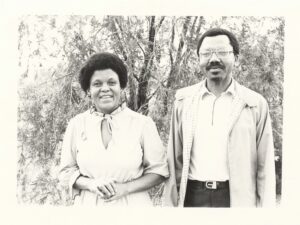

Interview with Orenna Krut, 28 November 2023
-
by

I’d say the key, from a SACHED Books point of view, was connecting it with the education publishers who could get books into schools. It was about creating an alternative publishing network of people who thought educational publishers could play a different, more challenging role and influence the mainstream sector to do better with its skills and resources. And it was about forming links with people who were contesting, who were thinking differently about, “yes, we are a commercial publisher but can we push our history books a little bit, can we innovate in different ways despite the curriculum and the exams”… So, I think that SACHED books, small as it was, and we were never more than about five or six people, punched above its weight and played a significant influencing role in much larger debates around educational materials.
Laurence Stewart: Okay, today is the 28th of November, this is an interview with Orenna Krut. I wanted to ask you, Orenna, if I have your consent to record the interview?
Orenna Krut: Yes, it’s just for recording purposes, not for quoting or reuse purposes, is that right?
Laurence Stewart: So, what we do is, well what I’ve done with other people and it depends on the kind of consent you’re giving, but it’s to record, transcribe and then we don’t have a particular, and then to store it on a private OneDrive.
Orenna Krut: Right.
Laurence Stewart: This is set up by Louise Vale, we don’t exactly… Louise needs to put out a communication about what the interviews might be used for in the future. She’s got to think about it a bit and I have raised it with her. The project is thinking about it.
Orenna Krut: I’m very happy to be recorded so that you can then transcribe but I would want to be checked with if I am to be quoted anywhere.
Laurence Stewart: Yeah, yeah, no that’s all good. Other people have asked for similar things. So, it’s no problem. So, I think maybe we can meet for maybe 45 minutes to an hour.
Orenna Krut: Ok.
Laurence Stewart: And yeah, I’m gonna conduct the interview in a sort of life history format. So, it’s a bit about as much as you want to give, of course, about your life and then in relation to SACHED, so to build a bit of a story around that.
Orenna Krut: Okay.
Laurence Stewart: Okay, cool. Alright, so thanks for agreeing.
Orenna Krut: Tell me something about you, so I know who I’m talking to.
Laurence Stewart: Yeah, that’s no problem. So, I’m Laurence, I’m employed on the SACHED project. Previously I have worked on, I’m a history student, I did my Masters through WITS on the Industrial and Commercial Workers Union. And then I kind of have been doing work with archives and interviews and all kinds of things, so I was a decent fit for the project. I’m both conducting interviews, like the one we’re doing today, and also if people have extra material, I’m not an archivist, but I collect the material, check it against an existing catalogue and so on. So, I am, yeah, I, this is kind of my, this is my work. There is another person in Cape Town who is doing the same as me. I heard her name is Tammy-Lee.
Orenna Krut: Okay, perfect. Great, thank you.
Laurence Stewart: I was wondering if you could just start a bit and as much as in as much detail as you would like to give on your early life, your parents, where you grew up and so on.
Orenna Krut: I was born in London but have lived in South Africa since I was five years old and am a South African citizen. I became politically active at university. The influences on my political ideas were going to a Jewish secondary school and learning a lot about the persecution of Jews particularly during World War II and thinking about what the parallels were between anti-semitism and apartheid racism, and I was a member of a Jewish youth movement called Habonim which had a socialist angle to it which made me think further about what society should look like and how people should be treated. Then I got to university and joined NUSAS and was active in a whole range of NUSAS subcommittees and attended the launch of the UDF. I did a Master’s degree at Wits
[05:00 Minutes]
in English literature. During and after my studies I worked for various NGOs. My first commercial job was as sub-editor at an engineering trade newspaper. I knew little about engineering but got to understand trade newspapers. While employed there I saw an advert for the position of Manager of SACHED’s publishing unit which was called SACHED Books. I thought I’d give it a go as I hoped for a career the publishing world. I was given an interview. I don’t know how reliable my recollection is, but I seem to remember being interviewed by a roomful of at least 10 people who did not seem to warm to me. When the interview ended I ‘knew’ immediately that I hadn’t been hired but then I was thrilled to get a call to say they wanted to offer me the position. And that’s how I joined SACHED [laughs]. I think that was 1988. That wasn’t very much on early life – do you want to ask anything specific about my earlier life?
Laurence Stewart: Well, just about your… so your parents were both from the UK?
Orenna Krut: No, they were South African.
Laurence Stewart: South African, but you were born in London?
Orenna Krut: They just happened to be living there for a couple of years.
Laurence Stewart: Okay. And you grew up in Johannesburg?
Orenna Krut: In Cape Town, actually. Primary school in Cape Town, and then moved to Johannesburg from high school on, and then went to Wits University.
Laurence Stewart: And were your parents… what kind of jobs did your parents do?
Orenna Krut: My mother was a social worker – although she was trained as a social worker, I’m not sure if she ever actually worked as one. My father never finished university and did waterproofing and home repairs and things like that.
Laurence Stewart: So, you say that some of the moments of sort of politicization started in your, you went to a Jewish secondary school.
Orenna Krut: Yes.
Laurence Stewart: Could you just tell me a little bit more about that? Yeah…
Orenna Krut: Yes, so being in that school and I suppose just growing up with accounts of the traumas of my ancestors…. My father’s family came from eastern Europe, and I grew up with those tales of pogroms and mass killings in my consciousness. And at school, we watched the films taken by the US soldiers who liberated the concentration camps, I remember a moment in a film where it seemed we were looking at emaciated corpses and then the corpses moved and I realised I was looking at barely-alive survivors, human beings who had been through the most horrifying organised atrocities. This background meant that I engaged with what it meant to dehumanise people and what can happen when you stop seeing human beings as people. And I looked around at an apartheid world and I thought, when you have prejudice and stereotyping and you dehumanise people, the end result, if you take it to its extreme, is violence or holocaust. Clearly South Africa was not a holocaust, but the dehumanisation felt very common and too familiar. And I felt that it was my responsibility to learn from my history and to make sure that I played a role in actively ensuring that I wasn’t repeating it, or a role in countering what was happening in South Africa. So that was an awakening. I was in high school during the 1976 uprising and remember hearing about it and being anxious about what it meant. I did history for matric and the history teacher said one day, ‘this is not in the curriculum, I’m not supposed to tell you, but you can’t be a student of history without knowing this and I’m going to tell you anyway’. And she handed out a small slip of paper which said the ANC was formed in 1912, and it provided some detail about the formation and purpose of the ANC. Until that moment I had no idea about it and little sense of a history of contestation and struggle. And it’s always stayed with me, that little strip of paper that gave me the huge insight that the history I received was a partial one and an intentionally selected one. And I started thinking about what was hidden.
Laurence Stewart: And from secondary school you went to WITS almost immediately…
Orenna Krut: Yes, I went the year after I matriculated.
Laurence Stewart: What did you study in your undergrad?
Orenna Krut: I did a BA with English and Psychology and then English Honours and English Masters. From when I enrolled at Wits, I knew already I was going to join NUSAS, I joined it on day one.
Laurence Stewart: At Wits?
Orenna Krut: At Wits.
Laurence Stewart: Had you heard about it before?
Orenna Krut: Yes. Through social networks I knew that there was political activism against apartheid at Wits and I was looking forward to being a part of that. There wasn’t really an opportunity as a school student at the time, or it didn’t seem like there was so, yes, so I joined on day one
[10:00 Minutes]
and spent the next eight years being involved in various forms of student politics. That included Wits Student which was the student newspaper, the Women’s Movement, and being one of the NUSAS representatives to the UDF after it was launched. There were other sub-committees and points of activism within NUSAS.
Laurence Stewart: So, just to get the periodisation right, you said you were at school in 1976, was that, were you in matric in 1976?
Orenna Krut: No, I matriculated in 1979 and went to Wits in 1980.
Laurence Stewart: Okay, and you were at Wits all the way until the UDF launch in 1985 and even until ‘87?
Orenna Krut: Yeah, I completed my Master’s in 1988, some time in that year. And I worked at the engineering newspaper for at least a year, which would have been about 1987, before joining SACHED. And also at the time I moved from student politics into other areas of the struggle. So I was quite a senior leader in COSAW, the Congress of South African Writers. At the time it was led by Njabulo Ndebele. Nadine Gordimer was with us, Achmat Dangor, all kinds of brilliant creatives. Cultural activists played a very important role in the struggle because they painted a different picture of what South Africa might be like, they helped people to imagine what it could be. They imagined change before it happened in reality. At the time there was a kind of hegemony of what South Africa was. And the cultural activists created a different possibility. So I feel COSAW was important. I was also part of the Johannesburg Youth Congress, JOYCO for short. So, essentially I was immersed in Congress movement politics.
Laurence Stewart: And so, and the links, I guess the link between your English literature MA was that you went you worked at the newspaper and you were part of this writers’ collective. Did you say you worked for NGOs before you went to SACHED?
Orenna Krut: Yes.
Laurence Stewart: What kind of…
Orenna Krut: I worked at one called CRIC, which was Community Resource and Information Centre, which did a lot of work at the time with trade unions. There was also a CRIC in Cape Town, which is a different CRIC. But this CRIC did work with unions. It was the height of apartheid. Some of our staff were detained by the security police. One of them, Stanza Bopape, was detained and then killed. Today there is a street in Pretoria named after Stanza. I remember the devastation of his family when told he had ‘disappeared’. Our offices were firebombed. It was that kind of time in the 1980s.
The reason I took a commercial job in the engineering newspaper was…. I had gone through university and worked in the NGO sector and there came a point where my Master’s was finished or almost done. I had essentially supported myself through university and through bursaries available at the time. Then my wonderful grandmother died. And I woke up one day and I had almost no money and little sense of security and I knew that I had to get a job that was professional and dependable and that actually paid enough. And I heard that a sub-editor job was available at the engineering newspaper, and applied for it. I had lost my voice for 11 days around my grandmother’s death. And I was invited to an interview. And I thought, how am I going to do an interview? I literally couldn’t speak. Luckily the editor of the newspaper asked me only one question, which was, “can you start on Monday?” So, I answered, [whispers] yes. And I went home and began on Monday, and my voice came back [laughs]. As the sub-editor, I was responsible for editing all the articles, designing headlines and so on. Perhaps I was hired on the basis of my English literature degree, plus by then I had done some freelance editorial work. I had studied English literature because it came easily to me and I loved it, and it allowed me to do what I was really at university for, which was politics. If I’d had career advice, I might have chosen a more practical degree. But yes, that’s how I ended up at the engineering newspaper. And, slightly unexpectedly, there were very nice and extremely progressive people who worked there. But I was not very fulfilled. I had done some freelance editing for a progressive trade publisher and had an idea that I’d move into publishing and we’d have champagne and cocktail parties and launch interesting novels and poetry and things. And when the SACHED job came along, of course it was nothing of that glamorous ideal, it was all science and maths and education and so on, but then the education bug really bit me
[15:00 Minutes]
at SACHED, it was interesting and meaningful, and I’ve stayed mostly in education since that time.
Laurence Stewart: Could you tell me a bit about that? Just about how, what SACHED, how did it influence you? What was that, you seem to have an impression of it immediately that there was this education bug. What was that? What was the [unclear word]
Orenna Krut: Education specifically? Well, at the time, I think there was such a different approach to education. Now it’s something government has to deliver. But then the South African experience was of stratified apartheid education and the exclusion of black students from education opportunities. At the time, simply offering decent education was in itself a revolutionary act: before one got to the quality and content of the education, the simple act of extending it to people who were excluded because of their race was in and of itself a challenge to apartheid. It doesn’t quite have that same impact today, where access – certainly to schooling – is universal or close to universal. Then, simply making English or maths or science accessible through books was critical. And similarly SACHED had Khanya College, I was never involved in Khanya, but simply the act of making higher education available to people who might not otherwise receive it was challenging the status quo and opening up possibilities for people who wouldn’t otherwise have had them. I find it really interesting to think about that idea, that simply having access to education is transformative in and of itself. It’s now almost humdrum, expected, a right. And it should of course be a right, but it’s a right with potentially a transformative impact that one can remain appreciative of.
Laurence Stewart: Yeah, and you, did that kind of link a bit to your political activism while at university? Did it kind of mix quite nicely with it? [talks over each other]
Orenna Krut: Yes, yes, absolutely. SACHED was the largest anti-apartheid NGO at the time, I believe. Certainly the largest anti-apartheid educational NGO. There were always political debates in SACHED. I did not participate in all the ideological conversations. I was a little outside of it. I think SACHED Books, which was what I headed, was seen as slightly more, what’s the word, we engaged with the commercial world at the time because we had partnerships with commercial publishers who distributed our books, the SACHED books, and so there was that interface with commerce and business. We were different from some of the other parts of SACHED that were more, well, just did not engage with the commercial world at all. So, for me personally, that engagement with commercial publishers opened up a new world that I moved into later when democracy arrived and I learned about combining commercial principles with an ideological mission.
Laurence Stewart: So, just to go back a little bit, had you heard about SACHED before you joined?
Orenna Krut: I am not one hundred percent sure now how much I knew of it but I understood its broad mandate and I certainly knew and welcomed the ideological positioning of what I was applying for.
Laurence Stewart: Okay. And, okay, and that, but it wasn’t, I guess it’s correct that you didn’t have a particular… sort of you weren’t gunning to go to SACHED, it was an opportunity that arose and you kind of vaguely knew about the organisation and then you joined.
Orenna Krut: I didn’t have SACHED specifically in my sights, but when the opportunity came
Laurence Stewart: So, you joined in 1988?
Orenna Krut: Yes.
Laurence Stewart: But what kind of work did you do when you arrived?
Orenna Krut: I was hired to be the Manager of SACHED Books, which was one of the many departments that the SACHED Trust was organised into. It was the division that published educational books.
[20:00 Minutes]
Laurence Stewart: And what kinds of work did you do? Were you, so did you just manage projects? Did you ever create content? Did you edit?
Orenna Krut: I definitely didn’t create content. All of the authorial work was done by external authors who were experts in their fields. Our job was to conceptualise, find authors, commission, manage the development of the content and manage the production. We had no resourcing for marketing and sales, for getting our books to reach their target audience. So I negotiated with the commercial publishers to co-publish with us, and they would include our books in their promotion plans, they would ensure our important educational books saw the light of day and get them out to the people they were published for.
Laurence Stewart: And were you based in Johannesburg?
Orenna Krut: Yes, in the SACHED office that was in Bree Street in the Johannesburg CBD.
Laurence Stewart: Ah, okay.
Orenna Krut: Yeah.
Laurence Stewart: Um, and so, say, do you know how long you… I’m not… did you say how long? you might have started in 88 or 87. How long did you stay at…
Orenna Krut: I was there for six years.
Laurence Stewart: Okay. And did your… yeah?
Orenna Krut: I left in the period following the release of Nelson Mandela from prison, I left in 1994 around the time of the first democratic election. It had become clear to me that the funding which had previously gone to anti-apartheid NGOs such as SACHED would now be diverted to the new government and that organisations like SACHED would be without funding very shortly and therefore unable to operate. And so, I did two things; the one was to find a new job, which I’ll tell you about, and the second was to ensure the sale of SACHED Books as an entity because it meant all the work we had done would have some kind of a future, and of course that we could avoid some or all job losses. And I was successful in shepherding the sale of SACHED Books. Whereas I think other parts of SACHED simply closed and stopped, and the value was lost to the country.
Laurence Stewart: And the range of… did your role at SACHED, was there a range, did it range over the six years or did you…?
Orenna Krut: No, that was my job.
Laurence Stewart: Okay. I don’t… is there anything you kind of have to add about the job?
Orenna Krut: My job was co-ordinating and managing an increasing list of educational books, which included The Right to Learn (2nd edition), the first edition had already been published, which was a seminal work and extremely popular. There were Read Well and Write Well. At the time of my appointment, SACHED Books had a relationship with Ravan Press which was an alternative publisher publishing very important texts. What I realised when joining was that that was not the best partner because Raven Press was a trade publisher with no real links into the education system, where SACHED was operating. And so, I proposed to SACHED management that we rather co-publish with educational publishers who could actually take our books into schools and into the departments of education, where they would reach students and teachers more effectively. I would say that was a key difference in strategy that I devised and executed. We co-published then with Maskew Miller Longman, Heinemann Centaur, a range of different commercial publishers which have all changed brand and ownership since then. We found that educational publishing houses were more effective at getting SACHED books out into schools because that was the business they were in. Our sales and print runs increased. Those co-publishing agreements became a stepping stone that helped me to take my next career step into commercial publishing. At the time, education publishers essentially serviced an apartheid education system. They produced the books for the curriculum of the day and for the exams of the day. And I was part of growing a different way of thinking about publishing and what the role of publishers was.
Laurence Stewart: Yeah.
Orenna Krut: From the platform of SACHED Books, I helped to launch something called the Independent Publishers Association of South Africa which aimed to help publishers rethink their role under apartheid and in preparation for democracy. We convened an important conference in 1993, called Publishing for Democratic Education, and published a book which anthologised the papers and resolutions, also called Publishing for Democratic Education. The conference was held together with a wide range of players in the education field at the time. One of the speakers was John Samuel who had been the head of SACHED at one point, but now headed up the ANC Education Desk. The book should be in the SACHED archive, if it isn’t there already. Co-ordinating bodies in the anti-apartheid education sector attended and there were several policy conversations about what education publishing is for, what it should look like, what principles should guide it. There was a clear position against state publishing. There was an imperative to look at increasing African language publishing. So, a huge amount of conversation and debate which then challenged the formal publishing sector
[25:00 Minutes]
to really think about their role. Later, the mainstream publishers association and independent publishers association merged to create a publishers association that was more conscious and more challenging perhaps about its role than it might have been previously when it… Well, I don’t want to say that commercial publishers always supported apartheid publishing. In the main many did, but there was always contestation, there were always progressive people even in commercial publishers who were trying to break with tradition and produce different approaches and voices, and many of them then became our publishing partners with SACHED.
So, I’d say the key, from a SACHED Books point of view, was connecting it with the education publishers who could get books into schools. It was about creating an alternative publishing network of people who thought educational publishers could play a different, more challenging role and influence the mainstream sector to do better with its skills and resources. And it was about forming links with people who were contesting, who were thinking differently about, “yes, we are a commercial publisher but can we push our history books a little bit, can we innovate in different ways despite the curriculum and the exams”… So, I think that SACHED books, small as it was, and we were never more than about five or six people, punched above its weight and played a significant influencing role in much larger debates around educational materials.
Laurence Stewart: Um, okay, I guess, I guess in that trajectory, I’m not sure if you have any particular highlights that you could speak about.
Orenna Krut: I think my biggest highlight is probably the publishing conference and the book and resolutions that came out of it. So, if you are archiving, do you have a copy of it?
Laurence Stewart: I’m not sure what year was the publishing conference?
Orenna Krut: I’m just going to get it. So, this is the book. You can see [shows the book to the camera]
Laurence Stewart: I think I’ve seen it, yes.
Orenna Krut: First impression 1993. It’s really interesting and important. As captured in the book, the conference came out with twelve resolutions called “a vision for educational publishing in South Africa” and that was a joint collaboration between SACHED and what at the time the National Education Coordinating Committee, NECC. It’s fascinating because the resolutions capture a vision for educational publishing which is partially realised now, but I feel has not been realised fully today. Today we do have some level of state publishing which exists in parallel with a free market system. There are some parts of the current environment, such as the intellectual property regime, which is not as friendly as I would hope towards publishers and indeed towards all creators across multiple sectors. A more inclusive, collaborative approach would be better for education. It’s interesting to see what of this is carried forward and what isn’t.
Laurence Stewart: And so, you would say there’s more continuity between the way publishing was done, for educational publishing was done during apartheid and today than not?
Orenna Krut: Not at all, no. Much has changed fundamentally and for the better. But I would say that there are some unfortunate steps towards state publishing which I think is not helpful. Government’s role should not be to create textbooks, it can set the standards for textbooks, do quality assurance, procure and distribute to its schools – and help facilitate a thriving and varied publishing sector.
Laurence Stewart: I don’t know if you could just speak a little bit more about the role players in that conference. Who was it with and what kinds of people?
Orenna Krut: So, it was a collaboration between SACHED and the National Education Co-ordinating Committee. We were co-hosts and conceptualisers of the conference. And beyond that, the only other thing I can really tell you about is
[30:00 Minutes]
the speakers. Which included the ANC education desk, as I said, in the person of John Samuel.
We had intellectuals and academics in the field of publishing, intellectual property, adult basic education, with a section on affirmative action in the publishing industry. And there was a case made for establishing a National Book Development Council which was in fact established but unfortunately closed after government withdrew its funding. The idea of a Book Development Council was, to my knowledge, mooted for the first time in public at this conference. So, although people may not know about the conference, many of the ideas that became quite socialised at the time were expressed and articulated there. And then later captured in this book which was published by SACHED itself.
Laurence Stewart: Just to speak a bit more generally about your time in SACHED, could you make a comment, or ya, could you make a comment on the culture of the organisation? From when you arrived and perhaps if it changed at all…
Orenna Krut: As I said, I was quite external to some of the big debates. Let me say that as a sort of disclaimer at this point. SACHED was the home of thinkers and intellectuals, many of whom are in my world today as friends and associates. It was a place of a huge amount of debate, it had connections into communities, there were many brilliant people with significant experience and strong convictions. And so, the meetings which I attended were often lengthy, argumentative, ideological and challenging. I did have a concern that SACHED – or some of the people within it – became quite internally focused in the sense that people hoped to see themselves as not just employees but as beneficiaries, rather than seeing the beneficiaries as being the broader community that was being addressed. Sometimes the debates seemed overly detailed and inconsequential, such as whether management meetings should have sandwiches catered. Or some individuals felt that if they worked for SACHED their children should be entitled to bursaries – and maybe they should, I am not even saying they shouldn’t, I just felt concerned that sometimes there was an inward focus, a ‘what about me?’ question that perhaps was valid but potentially distracting from the core purpose. So, I think that that was one tension which I observed. SACHED was always somewhat controversial as it didn’t fit into the Congress movement. I had some activists tell me that I should not be there, or should not associate with some of the leadership. But I was clear that the work of SACHED Books and of SACHED more broadly was important and necessary, and that while the debates were useful and important, they didn’t take away from the fact that SACHED had a positive impact on so many lives. There were so many students who came through Khanya College, or read the wonderful Upbeat magazine, or advanced their lives through the books published by SACHED Books.
[35:00 Minutes]
Notwithstanding or perhaps because of the very important debates, SACHED was part of a broader movement for democratic education and it played an important role.
Laurence Stewart: Maybe if you could, could you just say a little bit about that – you mentioned the outward looking nature of SACHED and how, sort of that being one of its best attributes. Could you just speak about that in relation to the publishing.
Orenna Krut: In the end, if you publish a book and it sits in a warehouse, you have achieved nothing. So, you have to see sales as an indicator of your impact. It’s not the making of a book that has any impact, it is about the book reaching its audience. And so, if I think about sales, I saw that despite that fact that our books were not on approved lists of the various education departments at the time, some sold upwards of 20,000 – 30,000 copies which was actually pretty extraordinary. It was evidence that there were people hungry for what we had to offer – and it was evidence of an effective marketing and distribution strategy, which we achieved with our partners in the publishing industry. Not every book was successful, not every book spoke to everyone. Sales varied quite a lot, as one would expect. But in the end, that’s how I judge it. Did people want it, did they vote for it with their wallets. And I felt that we got a lot of votes, given what was against us at the time.
You may not be aware that both then and now, for a textbook to sell into a government school it has to be on an approved list. Approved by the department of basic education. And that is your ticket to play, your entry through the gate. And we didn’t have that entry ticket. So the sales were despite the disadvantage of not being on approved catalogues. And as I say, it spoke to something, we were able to reach people who needed us. And what we offered was the history of Apartheid education, Pam Christie’s book. It was reading skills, writing skills, maths skills, science skills, history skills, some literature, voices of black children that were not often heard under apartheid. At the time there were of course other publishers such as AD Donker, David Phillip and Ravan Press who were publishing black voices. So I am not claiming we were alone, but rather, we contributed in that space and particularly in the sphere of school education. We contributed to that space. We thought not just about what to publish but what the unique positioning of being a publisher is about – what are you there for, what values guide you? What is your purpose? How do you know if you have been successful? We took those debates forward and challenged the traditional role of an educational publisher – instead of serving the dominant education system, we challenged, stretched and subverted it. Have I answered your question?
Laurence Stewart: It’s alright.
Laurence Stewart: So, you mention that you left in 1994 amidst some of the move away from NGos toward government. And then you did different things related to education. Could you just speak about that kind of trajectory and also if possible, if applicable, the relationship to SACHED as you moved on
[40:00 Minutes]
In your career? Or in your life…
Orenna Krut: I mentioned earlier that we co-published with a whole range of commercial publishers. One of those was Maskew Miller Longman, a leading school textbook publisher at that time. In 1994 they approached me to take up a management position in their Johannesburg office. It was good timing. I anticipated the demise of SACHED. I anticipated that what we thought of as alternative education was about to become mainstream education under an ANC government. I had gained invaluable skills and experience that would now be needed in a commercial publishing house. And so, I accepted the position. But I was concerned about the future of SACHED Books, with its backlist and experienced people. I didn’t want all that work and history to be lost. So I asked Maskew Miller Longman if it would consider buying SACHED Books. And it did. SACHED an imprint of Maskew Miller Longman for several years and focused on adult basic education.
As a publishing manager for Maskew Miller Longman, I was able to contribute the skills and experience I had gained at SACHED. And it was a friendly environment to those ideas at the time, there were people at Maskew Miller Longman who welcomed the move towards democratic education and wanted to be part of that. And so, at that time I was in charge of African language publishing, Afrikaans second language, history, teacher training, some early grade reading initiatives, amongst others. So, I was in charge of a whole range of areas where I could bring some important principles and implement wonderful publishing programmes. On a more personal note, I had to negotiate the change from a non-governmental, funded organisation to a commercial company operating on commercial principles. I needed to learn about business, and quickly. And so, when Maskew Miller Longman offered me a job, I asked them to put me on a programme offered by the Wits Business School called Strategy, Leadership and Change Management. And that opened my world. When I walked into that course on day one, I struggled with the language, the discourse, the assumptions, which were all unfamiliar to me. Four months later when I completed the programme, I had achieved the second highest score in the class. I was able to put words to the strategy I had applied at SACHED. I was able to be a much better leader and manager than I felt I had been before. And I guess I am only sorry that I didn’t have all that insight when I was at SACHED. But we learn as we go.
Laurence Stewart: And you’ve stayed in publishing ever since, right?
Orenna Krut: Pretty much. I have also spent some years as a consultant, working particularly in education and culture and business development. And I led City & Guilds, a leader in vocational skills, for several years in sub-Saharan Africa. But most of my career has been in leading educational publishing houses. After becoming a director in Maskew Miller Longman, I went on to be Managing Director of Heinemann Publishers and then became Managing Director of the Pearson Schools Publishing. I am currently Managing Director of Troupant Publishers, a specialist publishing house focusing on vocational education and training offered in TVET colleges.
Laurence Stewart: I guess, it kind of flows quite neatly, just to ask about the relevance of SACHED for today. You have touched on it a bit and what has been lost, what parts of SACHED culture have been lost. And even the publishing mode and so on. Do you see a relevance for SACHED and some of the practices for today? Do you apply it perhaps in your own, in
[45:00 Minutes]
some of your publishing today?
Orenna Krut: Well, I think that so much time has elapsed that I can’t say I think back to SACHED when I take a decision today. There have been decades of experience in between. But I think what SACHED really thought about, that I’ve taken into my world is that is that publishing is about learning, more than about teaching.
Laurence Stewart: Yes.
Orenna Krut: I think the dominant mode at the time was about – we have information, we are transmitting. And at SACHED we were thinking hard about how people learn, what challenges they might bring to the learning process and how we might address those. Certainly it’s important to improve teaching, but the proof of teaching is in the learning. It’s in the advancement of learners. It’s about making learning accessible, useful, expanding. As a country we aren’t doing as well as we should in this space. We have too many people with poor literacy and numeracy. We have students entering university and TVET colleges with poor reading, writing, reasoning and computing skills. But we can fix it. And one of the ways you fix it is by making available a range of quality materials that do the work.
Laurence Stewart: Yes.
Orenna Krut: And from SACHED until now I have worked very hard at making materials that do the work of teaching and learning. Materials are not sufficient, but they are a huge part of a solution. There was an important case some years ago where Limpopo failed to deliver textbooks and the judge on the case put forward that textbooks are a right. We need to support a flourishing publishing industry, we need teacher choice for textbooks, and we need to ensure that there is one textbook per child, per subject, per level. We don’t buy in sufficient quantities today – the size of the publishing industry has not grown at the same pace as the size of the school population. I’m afraid I don’t know the source of this estimate, but the estimate is that the ratio of child to textbook in South Africa is estimated at around three to four children per textbook.
Laurence Stewart: Ok, I have kind of gone through a lot of the questions I had planned to ask. I don’t know if you have anything to add which, perhaps to fill in any part of the timeline or any, maybe any idea that I’ve missed.
Orenna Krut: What’s coming to my mind is a story. Which was the
[50:00 Minutes]
murder of Chris Hani. And SACHED books wanted to bring out a book and do it fast so that people would know who he was. One of the members of SACHED, one of the staff members, had known Chris Hani in MK and he helped us to write and produce this book incredibly quickly and we managed to get it into the large book chains. And it felt at the time so important, such an important history and a commemoration because it was such a big moment in South African history. It needed to be marked, and we needed Chris Hani’s story to be out in the public domain, accessible to all.
I have a question for you – so have you interviewed other people already?
Laurence Stewart: Um, so I have really been trying. I have interviewed two other people – I have interviewed Helene Perold and…
Orenna Krut: Helene Perold was my manager at SACHED.
Laurence Stewart: Oh, ok so your worked quite closely with her…
Orenna Krut: Yes.
Laurence Stewart: Ok. And then I also interviewed another guy I don’t think you would know him, his name is Clive Nettleton, he was there before you. Ten years before you…
Orenna Krut: Oh
Laurence Stewart: Um, ya. I am trying, lots of people are a bit ill because you know the project is, it’s almost for some people fifty years after they were in SACHED…
Orenna Krut: I guess people are getting old.
Laurence Stewart: Yeah, so it, it’s going fine.
Orenna Krut: I do think that that interface that SACHED had is critical today, which is that there isn’t a commercial world and a value-driven world. It’s the wrong binary. The commercial world has to serve its clients properly, serve its audience properly and be responsive to its audience and it needs to have principles and ways of working that are ethical and effective. So, I remain idealistic. I grew Heinemann to being the number one publisher at the time. But it was a highly ethical, highly responsive, very innovative, very feet on the ground kind of organisation. And that model of ethical and accountable commercial entities is absolutely critical to South Africa’s prospering or growth.
Laurence Stewart: I mean because I was also talking to Helene about it and she was saying that there were all sorts of debates and about putting authors’ names on books, I think this might have been before you were there. But, so there is, there is a sort of the publishing was tricky and there were quite a lot of tensions in the organisation about how to… So you led, ya…
Orenna Krut: I wasn’t there for debates about authors’ names. We definitely put authors’ names on our books. But there was a tension, we had an interface directly with that commercial world which had not covered itself in glory in opposing apartheid and perhaps people were a little judgemental of SACHED Books. But it was critical to team up with commercial publishers who had the resources to reach our audience, and who were very willing to do so. There is nothing worthy about having a book that can’t reach anyone because you are unwilling to partner with the people who can reach readers. So, there is a kind of practical approach – identify where the power is and use it appropriately and ethically.
Laurence Stewart: Ok, we are at about 55 minutes I think we don’t need to go much further.
Orenna Krut: Yeah.
Laurence Stewart: I am going to turn off the recorder.
[End]