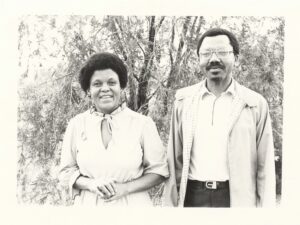
Group Interview with John Samuel, Lindy Wilson and Marcus Solomon, 14 June 2024
-
by

And what I basically did was – and this has always been my work philosophy – was find good people, give them the money, give them the space and they will do miracles. (John)
And the one idea is to use Upbeat to inspire young people to take up writing, to have writing groups attached to the library. Because libraries are fairly decentralised institutions and they spread all over the country and you have a library and you have a building and so on. So, you don’t have to hassle with all of that. But if we then made available some of the material that we [have] including things like Upbeat I think we could stimulate a wave of creativity in young people. (John)
So, our principle was – which is what Paulo Freire taught us as well – look, you must just listen first and you must find out what, where people are at so that you can create some kinds of examples of where they’re coming from, so they must give you some of their background. (Lindy)
So, we were all learning, and I think if there’s anything we did, although it was a struggle sometimes because you know some of us thought we were trained teachers like “we were going to teach you” No, you had to also learn! Creating that learning environment. So, you learn to teach and to also, sometimes you have to teach, but most times you have to learn. So, it is a learning environment. I would think that, John, is one of the hallmarks of SACHED. (Marcus)
there’s a lot of studies being done on children have agency from the time they are born. [all agree] And the learning process is ongoing. But it’s so repressed by the education system. The minute you enter the school, the learning is stopped. It’s all about, you must be taught. We’re not listening to what people are saying, especially the young, the youth, and the children. And we don’t understand why they behave in a certain way. Because we’re not listening. (Marcus)
Laurence Stewart: Just briefly, not yeah.
Marcus Solomon: Lindy, go.
Lindy Wilson: Well, briefly I was at SACHED from 1967 to 1984ish. Subsequent to that, I made documentary films and wrote a chapter in a book about Steve Biko. When I came into SACHED basically it was run before by Dot Cleminshaw and she handed me a few files. There was no room, there was no space for SACHED students, there was nothing at all except these files. So, I had to find my students and we couldn’t meet anywhere other than on street corners because nobody was allowed into the same cafe and all the rest of it. So that’s how I began. It was rather daunting. But quite quickly, we found a room in town and we painted it, all of us did myself and my friends. And we got going and got a few bits of furniture and gradually I met some of my first students. Salim Isaacs and various people. From then on, because at that point SACHED was set up in order to find some tertiary alternative to the closed universities to black students, or all students that weren’t allowed in. That’s how I inherited it, and then eventually I met Anne Welsh and so on. That’s how I began.
Laurence Stewart: Thank you. Thanks, Lindy.
Marcus Solomon: Yeah, maybe I should go. Okay, thank you very much. Very nice to see everybody. John, Lindy, and of course to meet Laurence. Laurence, I’m going to get back to you on your environment history, but that’s for some other time. I was invited to join SACHED Cape Town in 1982 to distribute Upbeat; the children and youth magazine. It’s a very interesting project and Neville asked me to come and help distribute the magazine. It was a national project. I was banned for five years and my banning expired in ‘79. And then I taught for a year because I really wanted to teach. I was trained as a teacher and taught for a year or two. But then I decided no, I spoke to Neville and he said, “no let’s see how you distribute the Upbeat the magazine”. It was a very exciting experience, because I could go to schools, etcetera. In fact, Koni Benson did some history on that. She wrote a little thing on Upbeat, very interesting. Then a year later Neville asked me – that was SACHED nationally they asked me to become the LACOM coordinator of the Western Cape region. And that was ‘83.
I only did the Upbeat stint for a year and then I worked at SACHED for the next 13 years as the LACOM coordinator, Western Cape. That was a very exciting period, of course, but I’m sure we’ll come back to that. May I just also say that, John; I’d known about John for years, and of course, Lindy was already in many ways, a popular figure [linked to] Francis Wilson [laughs] in fact, I met them before that because they once gave a little function and invited us, myself, Neville and some of the other people, Lizzie van der Heyden. Let me stop there. I’m sure we can get some more information as we go along.
[05:00 Minutes]
John Samuel: Thanks. I’m John and I joined SACHED in 1979 and became the National Director in 1980 and stayed on for 10 years as National Director.
Laurence Stewart: Thank you. Thanks everyone. I think John you can perhaps lead the discussion, but as you mentioned, you wanted to talk about the kind of how people experience the relationship between the centre and the region.
John Samuel: Yes, I think in many ways Cape Town was a different example of that relationship. Our other centres developed later, particularly in the 80s. Cape Town and Durban were two centres that were part of the early days of SACHED. And so, I was keen to capture some of that, but also knowing that we’re getting on in age and that I didn’t want some of this part of the history to be lost. I think it’s important because many of the challenges that we faced in trying to find ways to deal with this relationship, and sometimes the tension that it generated, even today still constitutes, I think, an important organisational issue. So, that was really part of the motivation. And of course, an excuse to have a good old chat.
[everyone laughs]
Okay, let me just start with a couple of observations, so to speak. There are a couple of things. One was when I joined SACHED, Cape Town and Durban were the two operating centres in work. And I certainly learned about this relationship primarily through people who’d been with SACHED in the seventies. I visited the SACHED Centre in Cape Town for the first time and in those visits, in fact, the one that certainly sticks out in my memory was the day that Lindy said to me, “I’ve got to show you something”. And she introduced me to Neville
[everyone laughs]
She hadn’t indicated that he’d been interested in joining SACHED and Neville had been part of my previous background and history. And so, I travelled all the way from Durban in 1962 to see Neville, but unfortunately at that time he was still persona non-grata and so it was very difficult to get a meeting with him. But meeting with him in the ‘80s for the first time was an amazing occurrence. The other was the manner in which Lindy had set about operating the Cape Town Centre. I was quite intrigued by the kind of approach – and Bill Nasson captures this in one of his books – I think the Importance of History [is what] it’s called – where he says “SACHED in Cape Town was an oasis”. It was like a special place. Where in the climate of apartheid South Africa, there was a little space that had been created where one could go and forget about the rest, in fact, about being in this terrible situation.
[10:00 Minutes]
And that is what I was looking for. I joined SACHED as an alternative to going into the state educational system. SACHED, I felt at that time, offered us opportunities that one couldn’t realise within the boundaries of the state educational system. And so, it was this rare combination of quality, of quality of education and a kind of atmosphere that stimulated intellectual discussion, stimulated thought and did so in a way that, in fact, what I learned later on is that people would come from all over Cape Town to SACHED Centre.
Lindy Wilson: It’s true.
John Samuel: And then of course, over all of this was the fact that these two centres were really very often at the periphery of SACHED. I know Lindy would talk about and constantly remind us of the existence of the centres. And she certainly played, I think, a very important role in that sense of constantly waving the centre flag because it was so easy to forget, in fact, that we had centres and to focus almost entirely on Johannesburg.
Laurence Stewart: It’s just a conversation.
Lindy Wilson: Thanks John. I’d love to respond to that – Marcus, is that all right? So, first of all, I was just thinking, John, the very first time you came, the lucky thing was that you had a poem and I had a short story in the Classic. Do you remember that?
John Samuel: Yes.
Lindy Wilson: [laughs] So, it was a wonderful introduction somehow, we didn’t have to say much. But, the relief of John coming in as director was simply fantastic for me because we had really quite a lot of difficulty with Johannesburg and where they seemed to be headed at that point. And one of the places they were headed was into a Bantustan. And it seemed to us that perhaps they were going to educate everybody there in order to make the Bantustan run. We took up a whole lot of objections. Cape Town was always a bit [unclear word, perhaps “dissident”] towards Joburg, I have to say, and I used to dread those meetings. And then John came, and it was such a fantastic relief.
Because, do you know, John, what I find they never understood, was it [is] what we’re talking about now; is the critical difference, and South Africa should look at it again and again, between the regions, where one can see KwaZulu Natal and all the rest of it. From a personal point of view, I came from Johannesburg. So, I was more into the Treason trial and Rivonia trial and the removal of Sophia Town. That was my world, and I’d worked on the newspaper for two years at the Star, I was the PA to the editor.
Marcus Solomon: Wow.
Lindy Wilson: So, I actually had this amazing experience of knowing a huge amount that never went into the paper. But I don’t want to go to that because it taught me such a lot. And then when I came to Cape Town, my God, what a different political scene. And Marcus comes from there, so he knows what I’m talking about [laughs]. The real truth was I didn’t really know anything about the sort of amazing history of when everyone was declared (or they were declared long before that) coloured, white and all the rest of it. The [gesturing quote, unquote] “ ” quote, unquote, we used to do this, didn’t we?
Marcus Solomon: Yes [laughs]
Lindy Wilson: It had battled, since 1912 or 1915 when it all began, against discrimination.
[15:00 Minutes]
And it’s a dedication of the South African, the Teachers League of South Africa and the non-European Unity Movement and all these people that I gradually realised, I had to learn such a lot, I promise you. I just listened, I listened and also people weren’t all that keen on SACHED because we looked like we came from a sort of liberal kind of NUSAS [crowd]. And I know people were quite suspicious of us to start with. But just to say that the heritage of the Western Cape’s coloured Schools is quite outstanding. Because, the idea was it was a commitment as teachers to the next generation. They established these incredibly vocal [groups], and Bill Nasson was a perfect example of it. Livingstone High School, Trafalgar High School, South Peninsula, and Harold Cressy were four outstanding schools because most of the teachers, even when it went under Coloured Affairs which it had got to by that point, a lot of them had remained in order to follow through the principles of going on teaching. [This was] in spite of the curriculum, in spite of the category, in spite of the racism. And so it was, in a funny way, a wonderful thing for us because SACHED was the same.
We gradually got free enough to ignore everything. And as John was saying, we created the centre, where if you stepped into it, it was a free space: that was our aim. And it included whites, we had a few white students too. But it was very much education, it was about education and how if you had enough dialogue and you built a wonderful library – which took us years to do – you would get there anyway. It didn’t matter, it would just give you the freedom. On a Saturday morning, I used to sit there for four hours and listen to people’s lives and how hard they were, how difficult it was, what it was like trying to study by candlelight when there’s six people in the room and so on. So, we built the centres and people owned it in the end. The students owned it. They even locked it up at 10 o’clock at night. It was completely theirs. We completely trusted everything.
And we also managed to outwit, sorry I’m going on but I’m trying to give you my background, we also managed to outwit the Group Areas Act by getting a house in a white area. They called me and said, “what are you doing in a white area?” I said, “no, we’ve got, you know, our board is more than it is 51 percent white”, but I didn’t tell them that. But I said, “we’ve got a majority white board, I’ve spoken to every member of the street in Church Street and they all agreed that it’s perfectly fine to run the centre here”. I think one of the ways we got felt more and more free was that we began to slightly outwit them. And initially we were in the Christian Institute building, and the Christian Institute was banned, and that’s when we found the other centre. That’s about enough I think for the moment. But Marcus you come from that background. So, you will have known why everyone was suspicious of us, right? [laughs] I was running it.
Marcus Solomon: Of course there was that environment, Lindy. But let me start, I really want to thank John and both of you now for the wonderful time we spent together and the way you welcomed me. Especially with John, I’ll come back to that. I had a free – just about a free reign to do as much as I wanted to do, wherever I wanted to as far as SACHED [was concerned]. But let me start by saying, I first met SACHED on Robben Island. Johnson Mlambo had been a registered student and he was studying for his A-Levels.
Lindy Wilson: Okay.
John Samuel: Yes.
Marcus Solomon: And it is a long story we can go into it at some other time. We were quite in envy of this guy because he was given a special, once he got permission to continue study, special room and he had all his books there. And when we came from work, we used to peep in at all his eight or nine books. And we thought yo! This guy loves to study! [laughs] It was quite amazing, that’s my first introduction to SACHED.
[20:00 Minutes]
When I eventually was invited to join, it was already familiar. But the other thing I want to mention, John and Lindy, I had been a member of the Cape Peninsula Students Union with Neville. We had a sister organisation in Durban, the Durban Students Union, to which people like John and Enver. And here were some of these guys, all coming together, Durban, Joburg, Cape Town. And of course, I had been introduced to Francis immediately after my ban had expired and he offered me a short stint of doing some research work. I had never been in researcher in my life, but he said come and help. He was doing the Carnegie, the SACHED Carnegie research. What was it?
Lindy Wilson: It was the Inquiry into Poverty and Development.
Marcus Solomon: What was the place at UCT I’m remembering?
John Samuel: SALDRU.
Marcus Solomon: SALDRU!
Lindy Wilson: SALDRU, you were made to do some cuttings there. And incidentally [speaking to Laurence] Francis is Francis Wilson, just in case.
Marcus Solomon: Pardon?
Lindy Wilson: No, go on, Marcus.
Marcus Solomon: Yeah, so there was that background. Coming to SACHED I was very much safe from or relieved of all those prejudices. And I say quite honestly, there were some, but people like you and Francis and Neville and all of us, even today, I’m working now with some young people whose parents studied via SACHED. And all they can tell me about this wonderful place, I said “you can’t believe what it was”, like some of you explained. But the real people who should be speaking about that were the people who studied there. You know, Kwedi Mkalipi passed away now recently, Lindy.
Lindy Wilson: Yes, I know.
Marcus Solomon: And there were some people there who studied at SACHED, and all they could say was just “SACHED”. I said, “guys, we know about SACHED, we worked there” [laughs]. They could only speak about SACHED. And it was not only about Cape Town, it was East London, Grahamstown, Port Elizabeth, [unclear place name] and so on. So, it was something really special. It helped create an environment for what was coming with the UDF and the labour movement, the civics, the youth, etcetera. Oh yes, then after my stint at SALDRU, I went on to do some other work until I got the teaching post, I joined in ‘83 as an Upbeat person and I went to a lot of schools in the Western Cape. And it laid the basis also for some of the work we did setting up the teacher’s resource centres [and] the community’s resource centres. I’ve asked Selby in Upington to actually write a history, that centre lasted for 10 years.
Lindy Wilson: Wow.
Marcus Solomon: And a number of others. In fact, I was yesterday at an event and there were some people [from] the resource centres we set up. But we’ll come back to that. But besides sharing that, I also want to say thank you because both of you and with many others, of course, Neville, helped create an environment for us to really do some amazing work. Thank you very much.
John Samuel: Marcus?
John Samuel: Yes.
John Samuel: What do you remember of – [unclear name, maybe “Nora”] and I were talking about how you guys would all fall out of the car at 3 o’clock in the morning having driven for 15 or 20 hours from Cape Town and knock on our door at 3 o’clock in the morning [laughs]
Marcus Solomon: Apologies for that [laughs]
John Samuel: Those meetings, what’s your memory of those national meetings?
Marcus Solomon: I’m glad John you asked because there was a very strong provincial culture and practice. That we would say, “going to Transvaal was going to another country”. And fortunately – again on the island –
[25:00 Minutes]
because I spent time in the general section. Neville was very unfortunate. He landed up in isolation with all the others. But we were in the general section. With people from Pretoria, the PAC guys, the early [unclear word “Makulespan?”], Poqo guys from the Eastern, Harry Gwala and so on. So, there’s a big difference. Differences, there were many differences. But again, it showed the challenges. I’ve been asked to speak about this some of this stuff that is now happening in Natal. Because I became very close to Harry and other, sometimes people don’t understand how I speak about Harry. The last Stalinist on the planet [laughs] And, here’s this Trotskyist speaking so glowingly about this guy, but I will come back. Going to Transvaal, to drive and so on it was very interesting. Going to Johannesburg, [trying to work out a name] Sheila Sisulu, Sheila, my god! But it was very interesting, there was differences. But eventually, and that I think we must give credit to all of us, we helped create a close bond that lasted many years.
By the way, my memory is not very good these days. I’m dawdling or waffling or whatever. The question is very interesting because Joburg was very interesting. They also had people like Jenny and Helene, Sheila Sisulu and many others. And of course we had Madni Halim. So, it is very interesting the difference from the regions, how we began to develop a national culture. I think it’s very interesting. And of course, the differences in Cape Town. There was also the thing, something I must mention because this became quite important. The major unions were very suspicious of SACHED. Very suspicious. I remember when we went to some of the unions here, they said “we can’t work with you”. “You come from” what they call an “anti-Congress tradition”, which is a lot of rubbish, of course, because all my family are from ANC, etcetera, my son now is an EFF. So, the thing is we eventually ended up working only with the domestic workers union and of course with the youth. I was very involved in the civics. But whereas in Durban there was a very strong union emphasis. Johannesburg was a bit mixed with Madni Halim and them, but it was also very strong with the union[s] very strong. And it was all Congress hegemony, cultures, freedom, charter, etcetera. Let me stop there because I can go on sometime.
John Samuel: You mentioned Robben Island and SACHED. I must tell you this little story. It’s actually in the Mbeki book by Mark.
Marcus Solomon: Mark Gevisser.
John Samuel: Yeah. Walter Sisulu was aware of SACHED in 1960. Obviously, people talked to him at that time. It wouldn’t surprise me if Anne Welsh and a couple of others met him and so on. But in any case, he knew about SACHED in 1960 because when Thabo Mbeki matriculated, he was very clear that he wasn’t going to go to one of the Bantustan universities.
Lindy Wilson: Yeah, that’s right.
John Samuel: So, Thabo’s father, Govan, spoke to Walter for advice. And Walter proposed “send your boy up to Johannesburg. There’s this wonderful project”.
[30:00 Minutes]
Marcus Solomon: [laughs] It’s a lovely story!
John Samuel: And it is absolutely true. He then spent about a year and Ann Welsh, I can’t remember where this reference is, but she said he immediately stood out. Both brilliant and leadership. And he began, in fact, organising the students at that stage. The big issue was, do we join NUSAS or not? And Thabo was in the forefront of that debate. I thought I just mentioned that.
Lindy Wilson: I’d love to follow up on that because I met Thabo when he arrived in London [laughs]. The thing was that I wasn’t working at SACHED then. It was before. And because of what you’ve just said, that’s so interesting to me. The ANC was literally two blocks down the road from where I lived. I didn’t go there much, but you know it just was, we knew that. One of my very greatest friends whom I met at university was Ruth Fischer, Bram Fischer’s daughter. She’s still one of my greatest friends.
Marcus Solomon: Yes, I believe so.
Lindy Wilson: And because, obviously, Bram knew Ruth was in London, came to tea. He was about 20 or 18, he was young. He must have been about 20 and he’d done very well in his A-levels and so on. And I always remember this, although I’m not sure Ruth does, but as he left, she said, “he’s going to be groomed for president”. Isn’t that interesting? But Anne Welsh was the key person on that one. Very much so. Francis and I had actually met Anne back then.
John Samuel: Yeah, interesting.
Lindy Wilson: Sorry, John.
John Samuel: Go ahead.
Lindy Wilson: No, I’ve got another point to make about Neville and about UNISA and Neville and the island, but you carry on.
John Samuel: No, I was going to follow up on the manner in which SACHED was perceived in different areas. And I know in Cape Town, it was probably heightened in part because of the presence of Neville. I remember at one stage Neville telling me that we had been threatened. Someone [had threatened] to cut all our funding off because we were not politically aligned. And so, I took that issue up with Bishop Tutu. And Bishop Tutu held a meeting with the person who’s supposed to have made this statement. And that was the end of that matter. We never had any problem after that, in fact. And in Johannesburg, I think partly because we had people like Sheila on our staff and others even Valli Moosa.
Lindy Wilson: Oh, really?
Marcus Solomon: Valli was there.
John Samuel: And Rob Adam and so it was tempered in a way. Now and then you’d feel some sense of hostility, but it was never highly pressured and difficult.
Lindy Wilson: I was just gonna add; we met Neville because he came to our house to meet Francis, who had written a chapter in the Oxford History of South Africa which was edited by Monica Wilson and Leonard Thompson. And they’d all read this chapter on farming (Francis wrote the chapter on farming). And so, Neville came, and of course he was banned, so he met in a separate room with Francis, and then he came and met with me in a separate room. And we began to talk about Robben Island (which I later made a film about with Neville). We spoke about how they (the political prisoners) had used UNISA
[35:00 Minutes]
uncannily like the way we had – in a curious, amazing way because they tutored each other. And one of our major things at SACHED in Cape Town was to have very good tutors, to have discussion. And you know, there was Neville who had taught history and Mandela had taught law to Fikile Bam. It’s all in my film. But wasn’t that amazing? So, then I said to Neville, “when your banning order is over, please come and work with us”. That’s when he said he would, actually, but it wasn’t yet going to be as director. That was very exciting for me. Then, of course, we got to know Neville very well. And that’s how, in the end, I managed to persuade him, it took some doing, to be the director of SACHED [Cape Town] after I left.
And the other thing I wanted to mention in this talk [is that] Cape Town University was incredibly important to us at SACHED, actually. Because, I had to go and find tutors when… I was 25 when I arrived. And Francis was a junior lecturer and we gradually found some really good tutors. And they were all young, like us, in their 20s. But I just want to say that many of them became professors, so they were exceptionally good. And they also had a very good approach although they found it awfully hard to teach SACHED students because people had language problems, they came from completely different backgrounds. So, our principal was – which is what Paulo Freire taught us as well – look, you must just listen first and you must find out what, where people are at so that you can create some kinds of examples of where they’re coming from, so they must give you some of their background.
So, if you’re going to talk about history [trails off] …. At first, they thought they could just come in and teach, but it wasn’t like that. The tutors really had to go through quite a learning process to relate. And then when UNISA was included, we had Xhosa-speaking people and the language issue became huge. But those tutors of ours were so amazing. They were so loyal. At the end of the year, I used to say to them, “are you going to be willing to come back?”, “okay, Lindy!”. And then they came back. But I’m just saying they were very good people, and they were young and questioning and all the rest of it, and they really wanted to be there. Then Stuart Saunders (he was the Vice Chancellor of UCT)… when Christian Institute was banned, I went to him and he said “you can phone me at any time you like and we will support anything you do”.
Marcus Solomon: Wow.
Lindy Wilson: That was also very helpful just to have a big something or other.
John Samuel: Yes.
Lindy Wilson: It was really helpful. So, there was a great solidarity there with the university. Also, they didn’t want to close the university to black students as you know.
Marcus Solomon: Lindy, just on that issue of how you try to influence your university people so that they should first listen. We were beginning to develop a methodology, and I would like to maybe at some time [speak about it] because also on the island, that this was to learn from the working people, from communities.
Lindy Wilson: Absolutely.
Marcus Solomon: In fact, I’ll never forget that it became such a strong culture. Go and learn first before you start to teach. In fact, I may also want to add, John, we have the children’s resource centres, and the children’s movement is still in existence. It emerged out of those efforts working in communities and we published some of our publications was published by LACOM and it was translated, etcetera. But the methodology came from Paulo Freire, but it had a long tradition. Our people, our main teachers, and we learned that very graphically. Listen to what people [say]. I remember some of the literacy programs, the young people, the young people wanted to come and teach people how to read and write.
[40:00 Minutes]
And they had an attitude that these people must be taught. And some of them were senior shop stewards. They’d been involved in the underground. And you want to come and teach them? Yeah, I’m sure you can teach them to read and write. Because [unclear name] at SACHED, you had to almost learn all over about reading. But he was a senior member of MK. So, there were these people that you now want some people to come and teach, but we had a lot of experience in the movement, communities. They had so much to teach, and we learned a lot because we had a very vibrant literacy program amongst the comrades on the island.
Lindy Wilson: John I would love to ask you, from our point of view, you came into this organisation and it was all scattered and different. How did you see it as a whole? How did you manage? Because you were such an excellent director. I just wonder what impacts came to you? Because we were all regional and you were sitting in the centre. And Joburg had always rather dominated, but you didn’t do that. So, I really would love to have, if you could tell us how you saw us all? And you had some really good people up in Joburg, I know, but would you tell us that?
John Samuel: Well, I think the development of SACHED in the ‘80s, when we were there, was primarily as a result of what was happening in the country. In 1976, I was working at a teacher’s college in Kabwe in Zambia. And I remember one of the lecturers coming to tell me, “You know what, Soweto is burning”. And he was reporting on the news that he heard about June 16th. And I can distinctly remember, in fact, standing in front of a class teaching literature and saying to myself, “what the hell am I doing here?”
Lindy Wilson: Very good.
Marcus Solomon: Good for us! [laughs]
John Samuel: So, coming back to South Africa at that time worked out strategically because I think the difference between that period and all the other periods of insurrection and revolt and so on, the difference lay in the fact that we believed, as an oppressed people, that we could change the country. That we could bring an end to apartheid. So, part of my thinking was that if you follow the logic of what was happening in the country more and more opportunities to do things that would help shape a different kind of consciousness was going to come about. Therefore, an organisation like SACEHD, which was set up in that culture, could play a very useful role. And what I basically did was – and this has always been my work philosophy – was find good people, give them the money, give them the space and they will do miracles.
Lindy Wilson: Exactly.
Marcus Solomon: Wonderful.
John Samuel: That really is how [we did it]. Because, I had no direct organisational experience except admin in an educational institution. SACHED was much more than just an educational institution. So, you have to learn in fact about organisational behaviour on the go and I made many mistakes. But when it worked, it worked. If nothing else, assuming everything else didn’t happen, we produced some damn good people.
[45:00 Minutes]
Lindy Wilson: That’s true, they went on and on and that’s the most wonderful thing, isn’t it? John, can you put your screen down so I can see you more?
Marcus Solomon: We can’t see – you are hiding there [laughs]. Oh my God, there you are!
John Samuel: The 80s was an astounding period in this country.
Lindy Wilson: I was going to say, you came in one of the worst decades.
John Samuel: And yet, the height of the ‘80s, I think it brought out the best in all of us.
Lindy Wilson: Yeah.
John Samuel: Here you are, under the most repressive regime, and what happens? COSATU gets formed.
Lindy Wilson: Exactly.
John Samuel: One of the largest union movements in the world comes about, is given birth in the midst of all that repression.
Lindy Wilson: It came out of the 70s, didn’t it? ’73 [Durban Strikes] And then, of course, the Black Consciousness Movement and the attitude of don’t be part of your own oppression. And the Black Consciousness Movement to me was very crucial, because it was a psychological shift. And those people who came out of that movement are remarkable. It was a different way of managing an impossible situation. We had that as well. And that gave us a lot of hope, didn’t it? There was an amazingly powerful movement, combined with the unions. So, it was an incredible era, even though the oppression was appalling, much worse. The ‘80s was extraordinary.
Marcus Solomon: Yeah, of course, there was also the emergence of the UDF.
Lindy Wilson: Yes, that’s true as well, of course.
Marcus Solomon: The Civic movement. The history of the civic movement in this country must still be written, John.
John Samuel: Yes.
Marcus Solomon: You know, it was such a creative space, the civic movement. By the way, I want to vouch for what John has said. You know, John as a National Director, you gave any of us such [space] to work, you know, I did so many things. I was the Western Cape organiser for CAYAC [Child, Adolescent, and Young Adult Connections]. And I used our resources, our bakkie, the children. And so, I remember John was looking for me and they said “maybe he’s at the children’s resource centre”, but he didn’t say it in a negative way! [laughs] “Maybe he’s there”.
Lindy Wilson: Lucky you, Marcus.
Marcus Solomon: Oh, absolutely. You can’t believe my luck. Man, I didn’t do it alone. I did it with a huge amount of support and resource. But in any case, so the civic movement, we serve as the [changes thought] Because some of the hotshots there in the labour movement, they were very suspicious of us, Jack Lewis and others, Jan Theron wasn’t that negative, but they were very suspicious. Be that as it may, it was the civic movement that we knew that what you see as a disadvantage or obstacle is an opportunity. We strengthen, help strengthen. We learned a lot from working in the civics. And of course we travelled a lot – Upington, etcetera. I don’t know if you remember Mercia was detained and she had her two children and the cops took her out of town and said “listen, you just drive one way away from here” [laughs].
Lindy Wilson: [laughs]
Marcus Solomon: And we had a good team of people Derrick, Mukhal [check name] and in fact, some of them are still very active.
John Samuel: One of the things that we’re looking at under the SACHED Archives project is: having recovered much of the SACHED material, we are thinking of working with libraries.
Lindy Wilson: Yeah, great idea.
John Samuel: And the one idea is to use Upbeat
[50:00 Minutes]
to inspire young people to take up writing, to have writing groups attached to the library. Because libraries are fairly decentralised institutions and they spread all over the country and you have a library and you have a building and so on. So, you don’t have to hassle with all of that. But if we then made available some of the material that we [have] including things like Upbeat I think we could stimulate a wave of creativity in young people.
Lindy Wilson: It would be so wonderful if some person like Tammy or you, Laurence, or all of you would actually get Upbeat running again. It’s the most, it’s needed and desperately needed, isn’t it?
John Samuel: Yes.
Lindy Wilson: It’s never lost. It would be incredible to have that publication back on the streets. Honestly, that’s the one thing that, I feel, people could get inspired to do it again. Somebody, some dynamic young people.
John Samuel: Yes, that’s what you need.
Laurence Stewart: This is what they said in the last interview. Exactly that. [In] the last group interview.
Marcus Solomon: What are you saying?
Laurence Stewart: This is what was said in the last group interview. The participants were saying, “you know, we need a reinvigoration of SACHED materials”. And then the Laurence, you’re the person that… [laughs]
Lindy Wilson: That’s right. It’s falling on your shoulders,
Marcus Solomon: Sorry, Laurence, what’s your role in this whole process? Are you working on the whole history or just the interviews?
Laurence Stewart: I’m doing different things. I’ve been conducting interviews. I’m not specifically writing anything yet. It’s interviews, collecting and arranging archives, setting up a website, helping with digitisation of materials. Yeah, different things. I know Tammy-Lee is doing her masters, but I’m, I mean with all the things I learned I’m sure I can write something, but I’m not yet writing anything about SACHED. I just want to say that our time, Google is telling me three minutes left. Can we leave the meeting and then come back? It is just on those two links that I sent before.
Lindy Wilson: We’re coming back at 1 o’clock.
Laurence Stewart: [laughs] Thanks, Lindy.
John Samuel: No, we’re not coming back at one o’clock are we?
Laurence Stewart: No, we’re coming back now.
Lindy Wilson: Oh, now?
Laurence Stewart: Yeah.
[interlude: 53:00 Minutes – 55:25]
Laurence Stewart: Sorry, guys. Alright, we’re back.
[general speaking]
I just wanted to ask a question just to, just something I noted. But there was a I think it was you, Lindy, talking about the issues with the Johannesburg centre going into Bophuthatswana and the criticisms of that, perhaps from the perspective of Cape Town. What, yeah, maybe just to talk a bit more about that.
Lindy Wilson: You know, honestly, I don’t remember exact detail, but I think they were trying to set up structures with Bophuthatswana’s department of education. John will know more, he will tell us, but we were shocked. I only remember that in the end, the SACHED Board actually said no. We were a bit shocked by that. And we were also slightly resistant to UNISA because the whole point of SACHED initially was that it was counter to defined government institutions. Of course, UNISA was actually open to everyone in South Africa because nobody ever had to meet! That was the whole point of UNISA. You could study by correspondence as long as you didn’t meet each other! But because it was open to everyone, is why we agreed. But it was a very different standard actually from what we were used to in teaching A Levels. I’m simply explaining that we tried to stick to our principles of who we were, what SACHED stood for. Bophuthatswana was one of the things that seemed to be going the wrong way. And John will remember, I expect, but he wasn’t there yet, I don’t think.
John Samuel: No, this was…
Lindy Wilson: David Adler.
John Samuel: It was a post June 76 event. Because after June 76, particularly big business like Anglo American and so on, due to the fact that they could no longer sit back and do nothing and they needed to be seen to be doing something. And that is how SACHED became involved in the newspaper project [People’s College] and the Bophuthatswana Teacher Upgrading Program. I think it served as an example of how to read the political context and how to interpret it and how to make strategic decisions on that basis. And I think the one thing that we learned from that experience was to be absolutely clear as to what our relationships were going to be with regard to state institutions. And therefore, not to make the same kind of errors that I think we made in particularly in going into Bophuthatswana.
Lindy Wilson: Yeah, so it was a good lesson.
John Samuel: Yeah.
Marcus Solomon: Yeah, I just want to [say] John, Lindy and Laurence. The other thing that struck me was when you were speaking more about Bophuthatswana and that experience. There was also an international context. There was, for example, in Brazil, Paulo Freire, there was a whole movement around alternative education. You know, what is this alternative, so it was not only against Bantu Education, we had a proactive approach, it was an emerging internationally. Something new, because the old way of teaching and learning was not good. In fact, I remember John, we also had a link with some group who they were working on the whole concept of education with production with Patrick.
[01:00:00]
Remember Patrick Van Rensburg?
John Samuel: Yes.
Marcus Solomon: Wrote a lovely book, Education with Production: Making Education Work. And, in fact, in the children’s movement we tried a project, something similar to what he did in Botswana. The brigades, yeah. The point is that there was often, “what is it that’s wrong with education?” But also “what are we for?”
Lindy Wilson: There was also Waterford School. They started schools in various places like Swaziland and in Botswana. Those schools were a direct result of Bantu Education. I had a lot to do with Waterford when I was young. And there were alternatives for people to send their children to, which a lot of people did from South Africa, who didn’t want them to go to Bantu education schools and so on. And those were very interesting developments. And you’re quite right, as well as Paulo Freire, there were also some amazing movements in the United States around the freedom and change in education. The Civil Rights movement was at its height. So, it was a very fascinating time.
Marcus Solomon: Yeah, and I think in that sense, SACHED was almost leading the fight in the [trying to find the word] But, we were very much leading and in the forefront of some of some of those initiatives. If you look at some of the literature, the Right to Learn, whole range of publications. That for me has always been the hallmark of the SACHED work.
John Samuel: And then this is why I think the example of Khanya college.
[everyone agrees, “yes”]
Lindy Wilson: Precursor huh.
John Samuel: At some stage we need to organise another discussion group around Khanya College because there were fights between Cape Town and Johannesburg on Khanya College.
Lindy Wilson: I wasn’t in one of them luckily. I had left by this time.
Marcus Solomon: But yeah, that’s interesting.
John Samuel: And I was very often drawn in [unclear word]
[everyone laughs]
But nevertheless, in some instances, there were real, substantial questions being raised around teaching, around methodology, and so on.
Lindy Wilson: I think the Western Cape had this amazing history of questioning all that stuff for a long time as well. That was what I learned. It was very much an educational thing. The TLSA), the Teachers League of South Africa was founded in 1913. There was a lot of background. Teaching was a calling. “Let us live for our children” was a TLSA belief. There was a history of non-cooperation for 80 years or something – a history of non-collaboration. countering what people were trying to teach you and tell you what to do. So, I can see why that might have happened from Cape Town, with its history of this anti-movement that wasn’t going to be bought.
John Samuel: Yes.
Marcus Solomon: Yeah, in that sense linking to that, that’s where the international experience, like China [comes in]. What’s his name? A Canadian guy, some of the education production they took and helped the Chinese party build up a whole culture, a new way of linking education production. That’s what Patrick was trying also to do in Botswana because he couldn’t… That was for us. SACHED had a very good library, I managed to capture some of those journals / books. I still have them. I must give them back! Very interesting. But they found hope with the SACHED. What was the name? John, maybe you have a name, if you remember.
John Samuel: Patrick Van Rensburg?
Marcus Solomon: No, that group, they were running an educational production project. They had a journal.
Lindy Wilson: In Canada?
Marcus Solomon: No, here in Johannesburg. I’ll look up whether I still have one or two copies of them.
[01:05:00 Minutes]
So, I think in that sense, in this way SACHED was doing was right in the forefront of what was happening in many other countries.
Lindy Wilson: It was a huge struggle though as well. I think that’s important to say as well. Because I was at SACHED for a long time. At the end of every year we’d evaluate what we’d done, and we would think, “wow, we’ve really learned something”. So, going into next year it’ll be better, “we’ll do this, and that”. So, we were never, I don’t honestly feel anyway, certainly when I was there, there was no arrogance about how well we were doing and how great we were. It was more, we were actually struggling with what all the universities struggled with after democracy, after ’94 – [they] had to create whole years for people to catch up and be able to take a first-year course. But we were struggling with all of that then. And I always felt that whoever was doing that should have talked to us. They’d have learnt a great deal if they just – and maybe they did talk to you, John – but we really hit what was the key problem of the way Bantu education, coloured education [operated]. We hit what it was going to be like to try and transform it. And we transformed individuals, because that was possible. One of the ways, just briefly it’s a complete other point, at some point I thought, “crumbs, we must have something where the students are going to teach us something”, because it’s so one sided. So, I thought Xhosa, nobody speaks Xhosa.
John Samuel: Right.
Lindy Wilson: You guys are going to teach us Xhosa. Because we will be just as fumbling as all of you are (struggling with language).
Marcus Solomon: Oh, absolutely.
Lindy Wilson: You find yourself with a problem of language and I just thought that was a good idea. So, Sindiwe Magona became the wonderful coordinator of Xhosa.
Marcus Solomon: Just to in a sense sum it up, it was a learning environment for everybody.
Lindy Wilson: It was. The tutors had to really change their way of teaching.
Marcus Solomon: They taught us a lot. So, we were all learning, and I think if there’s anything we did, although it was a struggle sometimes because you know some of us thought we were trained teachers like “we were going to teach you” No, you had to also learn! Creating that learning environment. So, you learn to teach and to also, sometimes you have to teach, but most times you have to learn. So, it is a learning environment. I would think that, John, is one of the hallmarks of SACHED.
Lindy Wilson: And it could be the national, what people of this country should be doing today is just listening and understanding where people are coming from. That kind of humility of realising you don’t, can’t ever know anything, even as a teacher and your group of students. In fact, you can imagine what it’s like now. It must be absolutely fascinating, but it should be broken into groups that people can start to say who they are, where they’re from, what life’s like, I don’t think that exists. I may be wrong; I have no idea.
Marcus Solomon: No, you’re right. In the children’s sector, in that context, we’re 40 years older now, and the big thing we emphasise now that children, there’s a lot of studies being done on children have agency from the time they are born.
[all agree]
And the learning process is ongoing. But it’s so repressed by the education system. The minute you enter the school, the learning is stopped. It’s all about, you must be taught. And, so we’re very big now on this listening. We’re not listening in what people are saying, and they, especially the young, the youth, and the children. And we don’t understand why they behave in a certain way. Because we’re not listening.
John Samuel: Yes. And I think that’s where SACHED chose a different path for them. In the way that we weren’t happy just simply condemning Apartheid.
[01:10:00]
Lindy Wilson: No, not at all.
John Samuel: We had to construct an alternative to it. The construction of that alternative involved listening a lot. So, for example, the LACOM and community education programs emerged out of that context. At another time I don’t think that would have been possible.
Marcus Solomon: Absolutely. Yeah.
Lindy Wilson: We should look at what we learnt and what could be done now. I have no answers. I’m not there anymore, but I wonder if there’s any… because that’s what the archive’s about, isn’t it?
[everyone says “yes”]
Trying to enable, inspire people from what we did in that era. So, in a way they must analyse this era first. You don’t have to imitate, but they’re very good examples of what we chose to manage, what we learned we had to do. So, I don’t know, what do you think about that?
John Samuel: Yeah. No, I think, the providing of inspiration at this time is probably one of the most positive things we can do. And there are possibilities, because take Upbeat as an example. I’m not aware of a magazine like Upbeat in this country.
Lindy Wilson: That’s what I’m saying, we need another one. More of that, actually. History of Africa, African literature, all the stuff that was in there, you know, wonderful stuff that nobody knows enough about even now. I’m terribly keen on the history of Africa because we’re still so ignorant about Africa.
Marcus Solomon: And the other thing that goes with it, and I think John, you made mention that this is going to be a great importance for the individual to develop an attitude, a sense of humility. You need to understand that you’re in an environment but you must also help create it. And through your own example – listen, lend you some of this element of arrogance that come with being educated. You must become at all times humble, learning, respectful of other people’s point of view, but also other people’s experience.
Lindy Wilson: Yes. And their problems.
Marcus Solomon: Pardon?
Lindy Wilson: And their problems.
Marcus Solomon: Yes, exactly, but you need to develop a way of relating to that and helping to create that environment. Because that’s what we’ve carried over from that into the children’s project we’re busy with here.
John Samuel: Laurence, I have got about five minutes.
Laurence Stewart: Okay. I just want to ask one question that’s come out and this has come out in many interviews. I’ve interviewed people some from Cape Town, some from Joburg. And there comes out a bit of a dichotomy between Cape Town being ideological, principled, questioning; Johannesburg, it’s presented as, you know, practical and business like and getting the thing done. And I don’t know yeah, maybe just to speak about that in relation to some of the compromises which had to be made within SACHED, or even just the freedom of different parts of SACHED to be the way they were.
Lindy Wilson: There was always the compromise of funding, to begin with. I didn’t get paid a single cent for seven years. Just out of interest, I’m not trying to tell you that was a wonderful thing. I just want to tell you that was the truth.
Marcus Solomon: That you won’t pay for seven years! Yuss! Jesus!
Lindy Wilson: It was a small organisation and we were living on a junior lecturer’s salary. But it was fine, because it was that era. And in a funny way, if you had to have been paid a lot, you probably couldn’t have done it. I can’t explain, but you had to build the fact that it was worth funding. So maybe that’s one issue.
[01:15:00]
Marcus Solomon: Yeah, compromise may be the word, but it again comes to this thing; if you compartmentalise it in the way you are, Laurence, then it may become difficult. But the thing is, people come with different experiences. So, you say: who, what are they teaching us? Or even within that group, in Johannesburg – well, let me come to Cape Town; of course, we agreed on politics in many ways, but there were also differences. I worked in the civics, others emphasised the labour movement, others the youth [movement]. Others came from Xhosa-speaking culture, others came from the Eastern Cape etcetera. So, that is one of the things you have to learn, what you may call a compromise. But it’s the strength in the diversity that you must begin to try and build.
Lindy Wilson: That’s exactly what I thought.
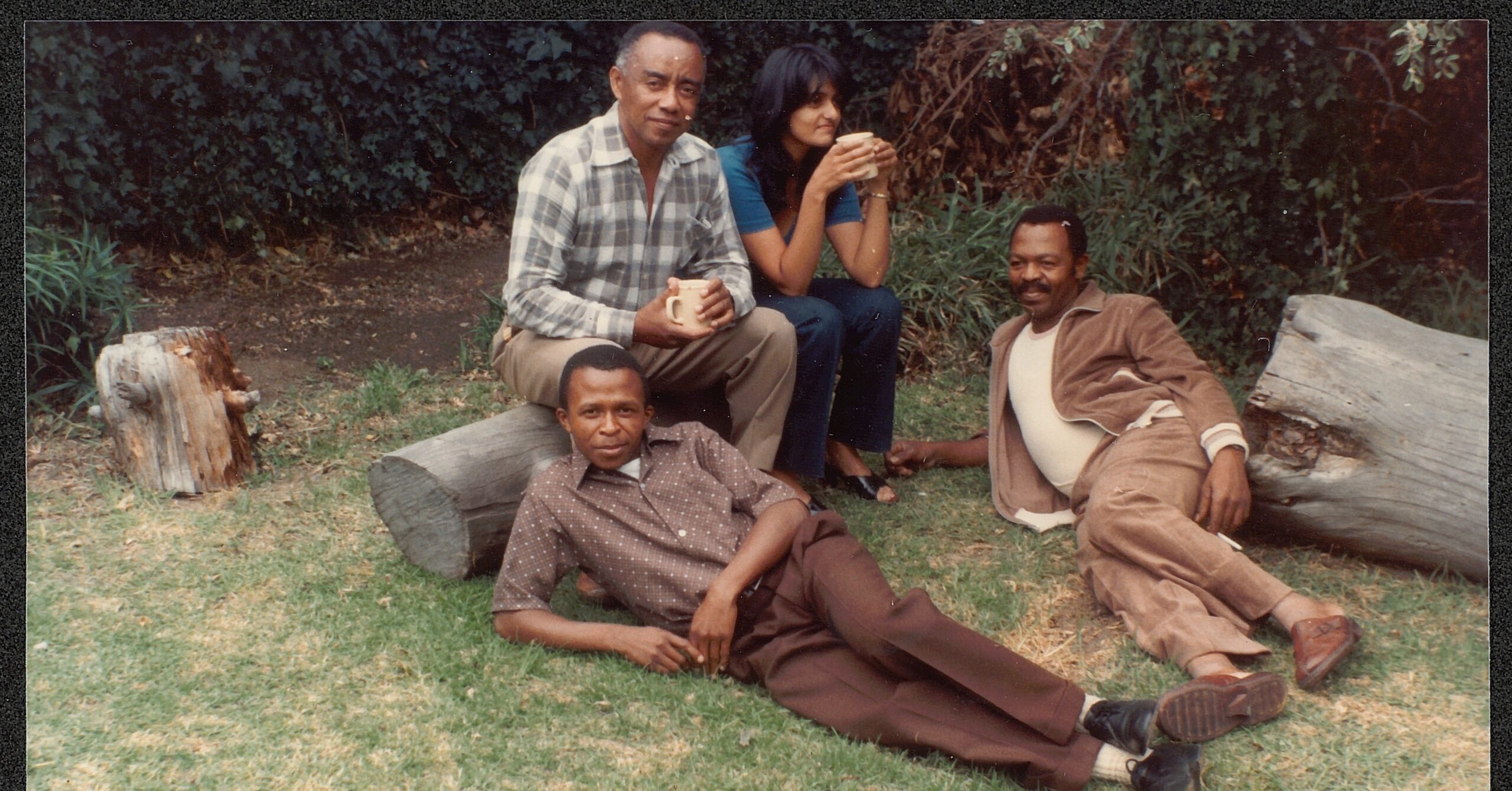
Marcus Solomon: And I think that was a very important lesson for me particularly. Some people who have gone to university can read, write books; others, etcetera. So, the thing is you have to learn, like Lindy. We met Lindy. In fact, I’ve got a lovely photo, I think I shared that photo.
Lindy Wilson: Yes, you did.
Marcus Solomon: When Francis and Lindy, they invited myself and Neville and so on. And Michael Richman the lawyer. In any case, so it’s very important that each one comes with something good.
John Samuel: Yeah, the notion that people are ideological or are not ideological, is a very simplified idea, because everybody has some kind of ideology. What is important in SACHED was not to let that ideology dominate and in fact rupture the organisation. And that’s primarily the reason why we went for a non-partisan position because, as I used to say in that time, you name it and we’ve had followers from whale watchers to tree lovers…
[speaking over one another, laughing]
Lindy Wilson: But also, it was education, so you could be non-partisan, and in a sense, you didn’t have to have it all under one ideology, which it wasn’t.
John Samuel: The composition of our people was so diverse that if you narrow it down to one ideology, it would have torn the organisation apart.
Lindy Wilson: It would have, and that’s what our country is. And, isn’t it diverse?
Marcus Solomon: Absolutely.
Lindy Wilson: You know that when you capture, like the World Cup, where you capture every South African’s imagination, it’s the most brilliant nation on God’s Earth. And that happens every ten years. [laughs] And I think that’s the diversity. It’s building with the diversity that’s so exciting. That’s the point.
Marcus Solomon: Yes, that’s how nature and humanity and the world is!
John Samuel: One of the issues that I was confronted with is, how do you hold the organisation together? From an organisational point of view, that’s why we introduced the National Coordinating Committee meetings. Because short of bringing everybody together, you couldn’t have done that. And that gave a forum where we could argue our hearts out. And we did, we did speak and we did debate.
Marcus Solomon: [laughs]
Lindy Wilson: Yes, that’s very clever, John. A separate thing to argue your heart out. Not separate [clarifying] but a place to do it.
John Samuel: A structure within the organisation.
Marcus Solomon: John, if you had gone to a business school to study business management you would have fucked up the whole situation [laughs]. Here you work with a bunch of loyal, honest, hard-working people. All you have to give them the resources, and Jesus, did we run with that! You know?
[01:20:00 Minutes]
You know, like [unclear name/s] used to talk of Derek, he can be very what appears to be free with resources. But with Derek, he would never spend a bloody cent on himself. We were looking for the SACHED car over the weekend and Derek had the car. I said, “Derek, where’s the car?”, “Oh, some comrades had to go to Durban” to some COSATU bloody meeting. I said, “Derek, that’s the SACHED car, if something happens, we’re going [be in trouble]”. He says, “don’t worry”. And they did that. The people didn’t go on a picnic or some booze thing. They went on a serious mission. Of course, it is not what would be acceptable, but there was one thing we were very clear on – There was no looting or corruption, Jesus. People would spend – you hear Lindy saying she didn’t get paid for seven years!
Lindy Wilson: Maybe it was five.
Marcus Solomon: It was not the point [whether] it was four, one years. The thing is, people were so honest because the time was – here we’re not going to use the resources that is meant for a core of people.
Lindy Wilson: You need commitment.
Marcus Solomon: Absolutely. So, with that freedom of doing things, John, it was amazing. We’ve always said, Jesus, we’re glad you’ve got the leadership up there that gave us the space to do what we knew working in a region. The other thing, regions were different. So, you have to do that amount of autonomy, whatever for people to do that meets the, situation in each region, in each area.
John Samuel: No, it’s really interesting in fact. And the time this kind of position was breached was when Rob Adams and Mandla, while they worked at SACHED in their offices, were planning to blow up the towers. To blow up the towers, the Hillbrow and the other.
Marcus Solomon: I remember that.
John Samuel: And they had been infiltrated right from the start. So, every step they took, the special branch, knew. And that, that was a lesson, a salutary lesson for us in fact.
Lindy Wilson: And that reminds me that we should mention that every single year they planted informers as students. The special branch did this. And, I won’t talk about what we did, but we used to wait and see who it was.
Marcus Solomon: Yeah, it was very difficult to read, by the way…
Lindy Wilson: And we somehow detected them. But only once we didn’t, I believe. Because on one [occasion], I’ll never forget, somebody had gone into the UNISA exam room and they didn’t all meet each other because they did different tutorials. And he saw sitting, like across the desk from him, someone who was in the security police, who was our third-year student [laughs], who was getting his degree. And he came back in absolute horror and said, “who is this guy”, [and I said] “he’s a SACHED student”. So, we missed on one occasion, but it’s really worthwhile knowing. Every year we knew when we interviewed people and this was actually when we used to try and detect who they might be. But it’s quite important, I’m sure that happened in Johannesburg.
John Samuel: Oh yeah, we worked on the basis that there had to be people. I just want to tell you, my last sort of story because I need to go.
Lindy Wilson: Ok.
John Samuel: In the middle years I think we have managed to arrange a meeting with the head of UNISA, the principal. Because, they had constantly denied our existence. Because, as far as they were concerned, there was no tutorial support. The students didn’t need it, and there was no tutorial support.
[01:25:00 Minutes]
In any case, I have this meeting, and I ask about the segregated graduation ceremonies.
Marcus Solomon: Shame on you!
John Samuel: To give me an idea why [they are segregated]. Oh, “but these people like it. They like to be on their own”.
[everyone laughs]
Lindy Wilson: So, did you invite your them to a SACHED tutorial?
John Samuel: I looked at Evie [laughs] Now here’s the kicker. A couple years later, the international institution that governs distance education all over the world. ICTE, International Council of Distance Education says to UNISA, “if you want to come to the next international conference you must have SACHED’s approval”.
[laughter!]
And they, and we had a meeting amongst ourselves and we said “No. We are not going to recommend their participation at the international conference”. But, in 93, 94, UNISA began discussions with us and eventually took over the entire program.
Marcus Solomon: Wow, Jesus.
John Samuel: Including Evie and Thandi. Yeah, they took the entire program.
Lindy Wilson: I’d forgotten that.
John Samuel: Yeah, they took the staff, the tutorials, the library concept.
Lindy Wilson: And did they start having tutorials?
Marcus Solomon: I didn’t know that.
John Samuel: We certainly must never underestimate the power of that bursary project.
Lindy Wilson: That’s amazing.
John Samuel: And one last story there; in 93, we were on a television program, something about the future, present, or something like that. And during the course of the debate, the presenter asked me the question (because he’d heard about UNISA) said, “and assuming you’re in charge of education, what would you do with UNISA?” And I said, “I’d shut it down”. The next day, I’m in my office, on the ninth floor in Shell House in Johannesburg. Somebody comes up – Madiba wants to see you.
Marcus Solomon: [laughs]
Lindy Wilson: I bet he did, I’m sure.
John Samuel: So, I go down, and Madiba says to me, “what is this I hear about you trying to close down UNISA? That’s my alma mater”.
Marcus Solomon: [laughs]
John Samuel: I had to explain to him You know, we just commissioned a report a few months before, and the overall passing rate for black students at UNISA was 4%.
Marcus Solomon: You’re not serious! Jesus!
Lindy Wilson: That’s incredible!
John Samuel: And so, I told him this, and I said, I’d give him a copy of the report to show him, and he said, “oh, that’s okay. That’s okay”.
Lindy Wilson: The 4 percent were probably on Robben Island, actually.
Marcus Solomon: [laughs] Yeah, probably the few people who studied abroad.
Lindy Wilson: That’s very interesting, John.
Marcus Solomon: Oh, my God!
John Samuel: Okay I must leave now.
Lindy Wilson: Thanks very much, all of you.
Marcus Solomon: Thanks, everyone.
Lindy Wilson: See you, Marcus.
[general chatter]
Laurence Stewart: Yeah, I’ll send you guys the transcript in about a week and a half. A transcript of it and then you can have a look at, yeah.
[Everyone saying goodbye]
[END]