MYRA HARRISON: SACHED Teacher Upgrading Project MPUMULANGA
-
by

Like Zambia had been, working at SACHED was of course also highly formative for us – there we learnt the freedom to start new ventures, and the possibility to try new professional initiatives, within a surrounding context where freedom was limited and new ideas were always suspect. SACHED is where I first heard the term ‘islands of excellence’ from John, and so it turned out to be. And while the dark shadows of apartheid and the security apparatus dominated life outside SACHED, we also remember a lot of jokes and laughter with our colleagues on the inside.
SACHED was a magic web – of committed people, both full-time and tutors – across the racial divides that seemed practically and politically insuperable in the 1980s. Some gave up their weekends and worked for SACHED projects over many years. Several helped across the different projects. Bursary tutors would also give seminars for Clive’s Matric teachers in the Teacher Upgrading school holiday programme, and I would be drafted in as well. I recall tutoring teachers on the psychological aspects of Macbeth by holding a debate on who was most to blame for Macbeth’s downfall: Macbeth himself and his vaulting ambition, or the arch-villainess, Lady Macbeth? Sparks flew.
Despite the dark side of apartheid South Africa being ever-present, as we worked we learned from SACHED about effective leadership, and how to bring together highly opinionated and diverse staff from equally diverse locations around the country (plus a contingent of visitors from overseas, including us). We saw successful fund-raising at first hand and learned how to speak to potential donors. We all voted at staff meetings, when so many SACHED staff could not vote outside. Life at SACHED then was a series of lessons on surviving and living, and not giving in.
I had worked for SACHED, after all.
Working at SACHED, 1984 to 1988
Viewed from the outside
Growing up in England, our knowledge of South Africa was shaped by political reporting, student politics, and the occasional shocking event that was reported in British newspapers. I still just remember hearing my mother say one day, as I was getting ready for school, “Oh no, they’ve shot all those people” – she was looking at a photograph of Sharpeville across the front page of the News Chronicle . There was dismay in her voice. The dreadful scene prompted the first political comment I can really recall from my home. Sadly, it was not the only time that violence in Sharpeville hit the headlines.
When the Soweto uprising happened in 1976, our reaction was not really to feel surprised, more a wondering, ”Why had it taken so long to happen?” Some years later, in 1983, the suggestion from the British Government Overseas Development department (it was ODA then, later DFID and now FCDO) of going to work in South Africa – for SACHED – gave us real pause for thought. The memory of Sharpeville and other images and reporting were still clear in my mind. What were we going to find there, and how were we going to work? And we had two small children, would they be safe? Would we? What was “SACHED”?
By that time we had already worked in different countries in Africa under the British aid programme (ODA) – in the Sudan, in rural Zambia and in Malawi, gaining front-line chalk-face experience and developing some inventive skills in education and teacher training. Our parents all visited us in both Zambia and Malawi, bravely facing up to new cultures and beliefs, non-existent roads, vehicle and ferry breakdowns, a lack of familiar food and medical care, and a way of life they could hardly have imagined. As it happened, they thrived on the experiences, and relived them often after they got home. SWAPO freedom fighters, Government Ministers having a chat with them at a beauty spot, crossing the Zambezi at full flood in a dug-out canoe, multiple tyre blow-outs, were all taken in their stride. Perhaps the spirit of adventure was not too far below the surface after all.
We learned a lot about surviving and teaching, working in increasingly resource-poor education systems, without enough books for teaching language and literature, or materials for experiments in science, or even food for the students. We had to learn how to think independently of the poorly-equipped system, to be innovative, and to teach our students as well as we could without the usual teaching aids. We were definitely ready for new challenges but little of our previous experience could really prepare us for everything we encountered while working for SACHED.
Firstly we had to convince friends that ‘going to work for an NGO in South Africa’ was not ‘working to prop up the apartheid regime’ and going against our, and their, principles. We knew it was an opportunity to oppose, not support the South African government. As longstanding boycotters of SA apples and wine, and having many African friends, this was important. We had to know more about SACHED.
Heading ‘South’
It was Dr Roger Iredale, Chief Education Adviser of ODA who contacted me at my parents’ home to ask me to consider working in South Africa for SACHED. I was, to say the least, hesitant, but he gave me time to think about it. Clive was immediately positive – a great opportunity to show opposition!
Roger set up an operation of persuasion, arranging for me to meet up with various people who had background knowledge, including some who had worked with or knew SACHED, and South Africans who were in England on scholarships: Ray Carpenter who advised Publishing on quite revolutionary book design for Read Well and Write Well; Chris More, a journalist with the Sowetan newspaper on a journalism scholarship in London; British Council employees; the director of an education resource centre in Gravesend; Roger Iredale himself; and – waiting until last – John Samuel, SACHED Director.
All the people I met were enthusiastic, seeing the political and personal opportunities offered by working at SACHED to build on my experience and translate it into something meaningful in the context of apartheid South Africa. “Are you taking your children? That’s great” went a little way to remove some misgivings. However, it was John of course, ‘the great persuader’, who finally clinched it, at an interview in London in late 1983:
‘’Why do you want to go to South Africa?” First question asked (John).
”I don’t.“ First reply (me). This led to some discussion…
“Well, you can sit in England watching what happens on your television, or you can come down and do something about it!” Final response.
And so the die was cast.
In the discussion between the first question and last statement, John and I discovered that we had both spent time teaching in Zambia, a bond which links all teachers from that time wherever you meet them and no matter how long ago that time was. A surprising number of South Africans have spent time in Zambia, including some whom, like Mervyn Ogle, we got to work with later while we were at SACHED. Some experiences in life are very formative and teaching in Zambia was one. Less than 10 years after Independence, the country’s education system was still young (as we were). It taught us of necessity to spread our wings and trust ourselves as teachers. And to enjoy the highs and lows, both of which were plentiful. This shared bond of teaching in Zambia has endured ever since.
Typically, John didn’t tell me, or indicate in any way, that I had passed the test and got the job – I had to ask one of the British Council staff who had set up the interview afterwards, very quietly. “Oh – yes, of course!” Also typically, John didn’t tell me until a few years ago that he had to do a big persuasion effort with the ANC to get approval for me to come. SACHED turned out to have a lot of secrets.
Like Zambia had been, working at SACHED was of course also highly formative for us – there we learnt the freedom to start new ventures, and the possibility to try new professional initiatives, within a surrounding context where freedom was limited and new ideas were always suspect. SACHED is where I first heard the term ‘islands of excellence’ from John, and so it turned out to be. And while the dark shadows of apartheid and the security apparatus dominated life outside SACHED, we also remember a lot of jokes and laughter with our colleagues on the inside.
SACHED – what we did
I was recruited by the UK Overseas Development Administration (ODA) to work for SACHED – a British contribution to non-government activity in education. This was a highly unusual decision by ODA, as almost all overseas activities at that time would have been in support of governments and their official education systems. Roger Iredale, Chief Education Adviser in ODA and my predecessor in that role, justified this as supporting the development and autonomy of South Africa’s people, the real wealth of the country.
My role – a Project in SACHED terminology – was to establish a teachers’ resource centre and English language teacher training for black teachers, particularly in Soweto – to give them the opportunity to develop their professional talent for teaching in a way that would be formalised by an official, recognised, overseas, certificate. The Royal Society of Arts in the UK approved the new course, sent a Moderator (Dr Peter Hill) to South Africa to review the course material and training, the candidates’ assignments and teaching, and awarded RSA certificates to the successful candidates.
Teacher training for black teachers had always been limited in scope and vision, and they had often been taken on as teachers with Std 8 education. For the teachers who took this RSA-endorsed course (and some SACHED staff who also enrolled) this was the first professional recognition of their skills and knowledge they had received, and it was international! The certificates were presented by Rainey Colgan of the British Council at a ceremony in the SACHED offices. I remember my Aunt and Uncle were visiting us at the time, and came to the ceremony. They were absorbed into the jubilant crowd, fascinated, and totally amazed by the response of the teachers receiving their certificates. It was an event that impressed itself on their memories, and they never forgot it.
Clive’s SACHED project: the Teacher Upgrading Project, was to assist those teachers without a Matric qualification to achieve this, as lately mandated by the government for all teachers. It involved finding tutors, organising lectures on Saturdays and through holiday periods, and providing moral support to them in those difficult times. He also engaged a ‘Pitmans’ graduate from the SACHED typing course to assist him. Cecilia ended up living with us and becoming a lifelong friend.
The Teachers Resource Centre was the backbone of my role and was equipped with books, videos, and other teaching aids as part of my engagement by the British government through the British Council. It was the basis for the RSA course and became a place where teachers could come in and look at teaching materials, talk about teaching matters, and other things.
Gradually it also became recognised as a safe place, a sanctuary, where they could be open about the violence, intrusion, and suffering that was taking place on the township streets and in schools. The resource centre became a refuge for Soweto teacher friends who would come in and just sit, drink tea, and eventually talk – about soldiers shooting into groups of students in their school yards; armed soldiers listening to them teaching from outside classroom windows, and bursting in to shout at and threaten the teacher if they didn’t like what they heard; one teacher being shot with a rubber bullet while walking along the road (and showing the vicious burn on his side). These stories helped to fill in the picture of the daily life of teachers in Soweto, the dangers, risks, disrespect, stress and isolation they felt. The resource centre became a safe space for the teachers, where they felt able to talk freely and be listened to. The ‘resources’ became not just educational but also therapeutic and supportive.
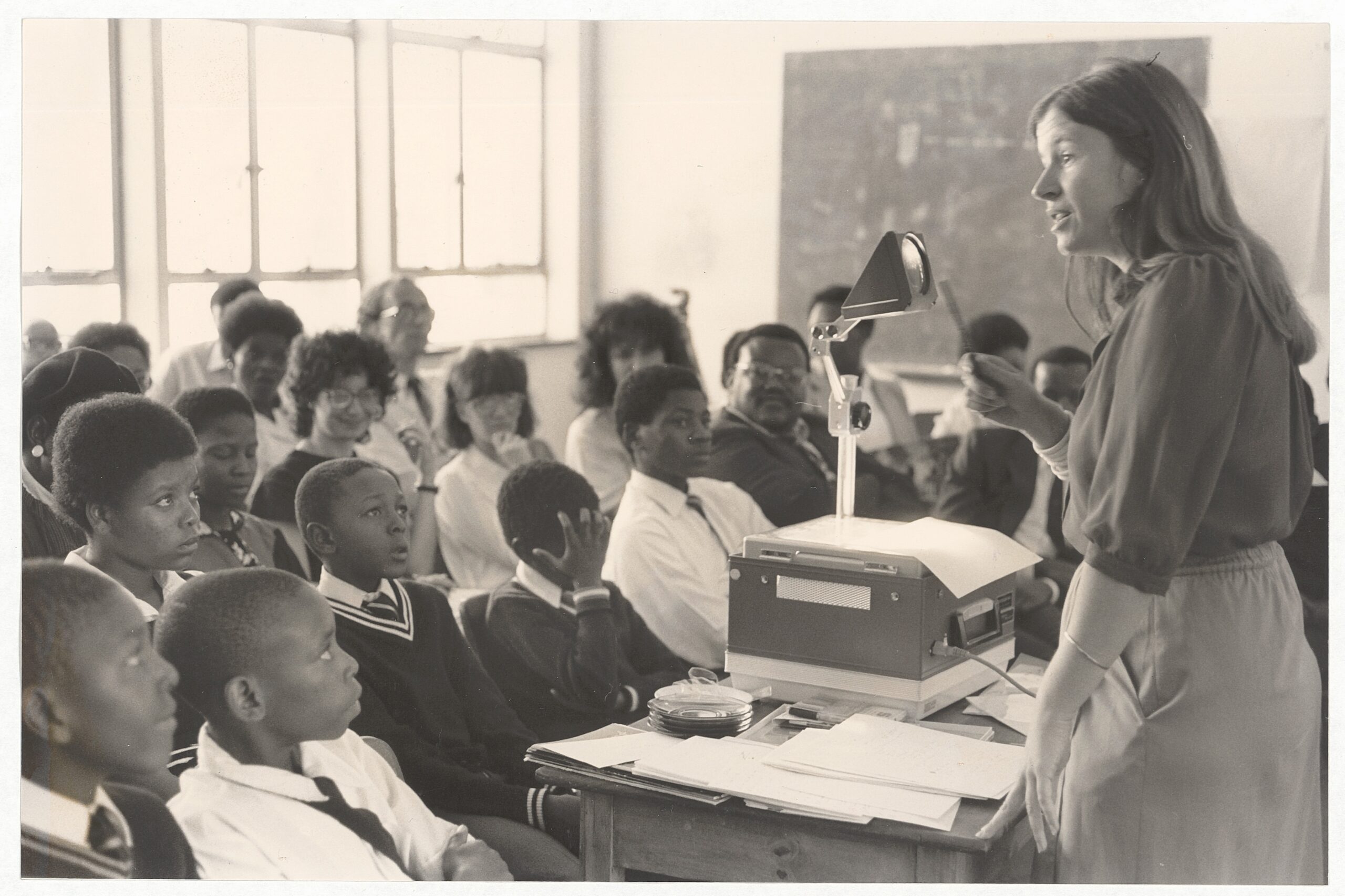
Another less formal part of my work was ongoing support for teachers in the schools of Soweto and other nearby townships and settlements. SACHED produced a wonderful magazine for secondary students called Upbeat, which I could immediately see was a potential mine of useful articles, stories, games and material that could be used for teaching. I started to produce an accompanying 4 or 5 page set of exercises designed for teachers to use to develop their students’ English comprehension and use of English beyond their recognised (and uninspiring) textbooks.
SACHED’s Distribution guys [Joe and …?] did such good work in promoting these exercises alongside Upbeat that they became a regular monthly activity, teachers being thirsty for material to use that was both interesting for their students and could help teachers extend their knowledge of teaching. This led to regular requests for me to hold workshops and teaching demonstrations in schools, using Upbeat, and for the first time I taught a class of over 200 students. Some schools even said they didn’t want to have the magazine without the ‘Upbeat exercises’. Luckily, SACHED had a jewel in the form of Joe Setloboko, the mastermind of printing, and however late I was in finishing them, he always printed off my pages in time for them to go out with Upbeat.
The workshops were an essential part of working with teachers, and not only as a form of in-service teacher training. It was even more important to understand the context and conditions under which teachers worked and students learned, to be willing to go into townships and share a small part of their lives. It was not always safe, and sometimes one of my SACHED colleagues would advise me not to go, or to get out quickly, if a particular area was simmering, and trouble was anticipated along the road. However being where the teachers were teaching and where students studied and lived was a small but necessary part of understanding and sharing the need for improving (and revolutionising) education in South Africa. Sitting safely in an office in Johannesburg was not an option.
In fact I ran workshops in various parts of South Africa, under the auspices of SACHED offices – in Pretoria townships, Pietermaritzburg and Durban in particular. And John negotiated for me to run Easter week training workshops for teachers with the Namibian Council of Churches in Windhoek – every year for three years. These were early indications of SACHED’s reach across the changing landscape of education in the 1980s.
Sometimes the pendulum swung the other way: as an exchange, some Namibian teachers from the Namibian Council of Churches, complete with dreadlocks, came to SACHED to visit the resource centre and learn from our activities, an ostensibly simple and harmless professional visit. As we took them to observe a training workshop we were running at a school in the outskirts of Pretoria, our van was stopped on the highway by a truck full of soldiers, complete with rifles. All our suspicious teaching materials were unloaded and searched on the roadside while rifles were aimed down on us from the back of the truck, as we stood about waiting. As they really were teaching materials, we were eventually, and reluctantly, allowed to proceed.
As it happened, we had to set up the final assessments of teachers for the RSA course in 1988 in SACHED Johannesburg, with volunteer children drafted in as students, as it was clearly unsafe both for us and the examiner from the UK – Peter Hill – to be visiting township schools and classes at that time. Peter had to negotiate with RSA to enable this unusual solution, as teachers normally had to be assessed teaching their own students, but he had developed an enthusiasm for SACHED and the project by that time and got the permission.
SACHED was a magic web – of committed people, both full-time and tutors – across the racial divides that seemed practically and politically insuperable in the 1980s. Some gave up their weekends and worked for SACHED projects over many years. Several helped across the different projects. Bursary tutors would also give seminars for Clive’s Matric teachers in the Teacher Upgrading school holiday programme, and I would be drafted in as well. I recall tutoring teachers on the psychological aspects of Macbeth by holding a debate on who was most to blame for Macbeth’s downfall: Macbeth himself and his vaulting ambition, or the arch-villainess, Lady Macbeth? Sparks flew.
Many of the teachers we met in both our jobs became our friends, and their back-stories were rich in the telling. The resource centre was engaged in making educational (and political) videos – it is where noted documentary-maker Enver Samuel first learned about video production. For Soweto’s 10th anniversary in 1986 we uncovered stories of what happened to several teachers during the uprising 10 years previously. Enver and I and other members of the resource centre staff were able to persuade them to relate their experiences on camera: one lady teacher was dragged out of her house unclothed into the street by the security forces. And another teacher, now a respected priest hoping to get his Matric, turned out to be a former gang member (one of the ‘Americans’).
I was a committed SACHED member, but I was also employed by ODA, through the British Council. This situation turned out to be very useful, as I was able to get hold of resources that wouldn’t normally have been available. The support of the Royal Society of Arts and Peter Hill is one example. Others included the offers of visits from highly qualified visiting consultants to give advice or offer seminars on literature or language teaching (like Marion Geddes – who also participated in our video-making), and equipment for the resource centre, including our state-of-the-art video camera and editing suite, books and videos. We also received donated shelving for the books and materials, and an electric typewriter.
All along we learned about fund-raising, how hard it was, how essential to NGO work in such a dangerous and difficult context, how sometimes SACHED finances were precarious. Though John was great at convincing donors to part with much-needed funding for SACHED, it wasn’t all plain sailing: we once went out for ‘a quick lunch’ with John before an important meeting he was to have with a donor at 2.00pm. We (mainly Clive and John) got into a hot discussion about the British Labour Party and Neil Kinnock. Suddenly it was after 3.00pm and the donor meeting had been comprehensively missed. Later we collectively, and a little ruefully, rationalised the disaster thus: “Never let fund-raising get in the way of a good argument!”
We also played our part more productively, though inadvertently, in fundraising: when the resource centre was just about to open officially, we received the promised second-hand metal shelves from the British Council for our books and videos, which unfortunately needed assembly. With only the morning to do this before the opening, half a dozen of us SACHED colleagues, including Evie Nonyongo, Beatrice Matlala(?) Clive and myself, got down on hands and knees to start screwing the shelves together. Whereupon, John arrived with some potential overseas donors, taking them on a tour of the SACHED offices. After general greetings they moved on, leaving us all somewhat embarrassed. When I taxed John afterwards with not forewarning us so we wouldn’t be caught with our bums in the air, he just laughed and said, “Don’t worry about it, those bums were worth 50,000 dollars!”
The other,darker side of the picture
Going to South Africa in 1984 after working in other African countries was painful and frightening for us, and worrying for our friends and families, but felt entirely like the right thing to do at that time – and after that interview discussion with John. He sussed us out – Clive and me – we didn’t want to be passive observers of the struggle, ultimately we wanted to play our part.
The dark side of life was always present in those 1980s days of states of emergency and persecution of comrades. SACHED wasn’t immune, and neither were we. Fabricated accusations and other dirty tricks affected us, our children, and our friends. Some colleagues were detained for long periods.
The 1986 security police raid on the Johannesburg SACHED offices – rifles at the ready, doors locked, desks ransacked – is seared in my memory. I was locked inside.
I had gone down early to SACHED (6.30am) to do some important editing on our Soweto anniversary video, knitting together three videos into one story, and found armed security police loitering at the office entrances. This was not an unusual sight in Johannesburg at that time so I ignored them and went up to my office on the 8th floor of Union St. Shortly afterwards I went along the corridor towards the resource centre to start editing. A very large armed man was completely blocking the corridor so I asked him politely What was happening? (meaning = What are you doing here?) “There is going to be a raid. No one is coming in, and you are not going out.” I retreated to my office. I was locked inside SACHED. Alone.
I was thinking very fast in the next half hour. In the days before mobile phones, contact by landlines was the main means of communication. However, SACHED phone lines were locked overnight from 6.00pm to 8.00am, so I could not call anybody (who?) from my office. I could not leave the building, or even the 8th floor. While thinking this out, I realised with a cold shock that I had put out the videos I was going to edit on the main table in the resource centre, the night before. They were clearly labelled ‘Soweto 1’, ‘Soweto 2’, ‘Soweto 3’.
Does danger increase the capacity to think? Perhaps. I remembered I had caught sight of our cleaning lady, Nora, being unnoticeable in the kitchen – she was also locked in, but to clean she had keys for all the offices. The Bursary programme operated on Saturdays, so the phone in Evie’s office (Head of the Bursary Project) was the only one that was not locked. If I could get the keys from Nora, and get into Evie’s office, and the phone was open, I could phone out, quietly. But the armed man was on guard in the corridor.
I went nonchalantly to the kitchen to see if the tea urn was on, and quickly persuaded Nora to lend me the keys. Then I slipped quietly to Evie’s office door, and in, while the guard was facing the other way. The only number I could remember at that point was our own, so I phoned home and spoke to Clive who was still there. Telling him very quickly what was going on as far as I knew – a security raid on SACHED – I urged him to phone Jenny (Deputy Director, whose number I knew we had at home) and get her to inform John. ASAP.
Hoping that would work, I then had to return the keys, negotiate with the guard to let Nora go home (‘She has been here for hours already and has finished her cleaning work’) and then to persuade him to let me go past him and into the resource centre. I told him I had left some work there that I needed to complete – which of course was true. I got in and picked up the precious raw videos of our Soweto film. Taking them from their boxes and tearing off the Soweto labels I put them into other boxes labelled ‘geography teaching resources’ in our video cupboard and left the real geography videos in a harmless pile.
Eventually the security police got around to the 8th floor offices, and until then I was locked inside, waiting for six or more hours. Having one’s office ransacked and papers and items pawed over is extremely unpleasant, but I was more nervous about the resource centre. What if they collected all the videos and took them away to look at? That morning I learned another useful lesson: when you have right on your side, you can laugh at the security police – if you’re careful.
In the resource centre we had a table with a large model of hills and valleys (an actual geography teaching resource) brought in by a teacher and lent to us to show other teachers how contour lines work. John was there observing all the searching the police carried out. One of the police stared at the model with great suspicion – to John: ‘What is this made of?” John to me: ‘Myra, what is this made of?’ Me to John: ‘Papier maché.’ John to police ‘Papier maché.’ Both of us convinced the policeman had no idea what papier maché was.
Another policeman was looking at our harmless and professional language teaching books: ‘Have you got anything by Marx?’ And another, making his way slowly down the corridor examining the many protest posters on the wall, and stopping at one, an anomaly in the circumstances, being anti-smoking: ‘That is the only one of these that makes any sense!’
The police did open the video cupboard and stare at the shelves of videos: ‘What are all these about?’ ‘Language teaching, geography teaching, this is a resource centre for teachers to borrow materials for their teaching.’ Clearly this was boring enough not to incite them to take the videos away to watch, including the hidden Soweto 1, 2 and 3.
Our video resources had been useful on other occasions too. In Union Street we had some mostly unused back stairs; a well-known anti-apartheid lawyer who worked nearby would appear that way from time to time and ask me if we could hide some video evidence from witnesses in the resource centre for a while, as he feared a raid was about to take place on his office. Of course I said yes, and they would disappear from sight among our teaching videos until he reappeared at the back door some weeks later and asked for them back.
The dirty tricks did not stop at the SACHED office. Our younger daughter received an official letter telling her that she had no student visa and must leave the country. She was 10 years old, and luckily found it quite amusing. On another occasion the police phoned SACHED and asked for me. As I was out the call was transferred to Clive, the other Harrison. He was told that I had caused a hit-and-run accident in a Johannesburg suburb some six weeks before, and my car registration had been noted by a witness. I knew I had not had an accident, nor had I ever been in that suburb. Fortunately we didn’t have to fight off this accusation, as Clive was thinking on his feet and remembered that the week they stated I had been in Windhoek running one of the Easter training workshops for the Namibian Council of Churches. He told the police I had been in Namibia (and of course could prove it with my passport and ticket). The only answer was ‘Oh you mean South West!’ Click, brrr.
As ever, such persecution, whether severe, slight, terrifying, short-term or ongoing, of us or of others, only served to strengthen our resistance.
Despite the dark side of apartheid South Africa being ever-present, as we worked we learned from SACHED about effective leadership, and how to bring together highly opinionated and diverse staff from equally diverse locations around the country (plus a contingent of visitors from overseas, including us). We saw successful fund-raising at first hand and learned how to speak to potential donors. We all voted at staff meetings, when so many SACHED staff could not vote outside. Life at SACHED then was a series of lessons on surviving and living, and not giving in.
And afterwards?
After SACHED I joined ODA, working under Roger Iredale, and eventually succeeded him as Chief Education Adviser. But the truism that ‘SACHED people get everywhere’ is borne out by experience. A few examples: I took my SACHED learning with me to ODA. John was influential in the ANC and later for Mr Mandela at the Mandela Foundation. Cecilia studied in Scotland and achieved her PhD. Enver has been given awards for his documentary film-making.
At SACHED John was always the Boss, but like the best friendships, almost without noticing it, gradually we also became firm friends. Leaving SACHED in 1988 was hard, especially as the future in South Africa was still very uncertain, and leaving our teacher friends behind was painful. But over the next few years John and we have continued to meet and talk, including of course about the challenges facing South Africa in education. Actually, this has never stopped; it is a shared mutual passion, whatever roles or positions we succeeded to.
While John was Director of Education for the ANC it felt as if the beating heart of a new South African education system was close by. John would send a document or float an idea: “What do you think?” I would consider and send him my thoughts, based on my knowledge of other systems, and of course all that Clive and I had learnt at SACHED, which is what he was after. Naturally they weren’t always (ever?) taken up, but it felt satisfyingly that we were able to contribute to the ongoing debate.
In 1993 I had been posted to the new ODA office in Pretoria. Pretoria! Always a difficult place to comprehend or live in, when you’ve worked in SACHED.
However, being in Pretoria at that moment gave a grandstand view of the election and then the inauguration of a new, long-awaited President, Mr Mandela. Some of my ODA work colleagues were asked to be election observers, but I got a different view: the Head of the office wanted to go out and see what was happening at polling stations on election day, would I go too? The satisfaction was palpable – groups of people in the street cheering and waving at our diplomatic car as we passed, and happy to talk whenever we stopped. “How does it feel to vote?” “It feels great!” For the first time, Pretoria felt different on that day.
It felt different on Inauguration Day too. We watched the official proceedings on tv, then went to the Union Buildings to mingle. Massive crowds were still on the sloping ground, beginning to drift down. And among them, I met a former SACHED Bursary colleague (Nokozola). Uncanny.
Both events were transformations. Having dinner with John on election night, I asked him how it had felt to cast his vote for the first time. He admitted ironically that he had been worried ‘I might do it wrong’! (He didn’t.)
In 2001 John, Clive and I embarked on a collegial piece of work for DFID (successor to ODA) in Limpopo Province. Working at the provincial level brought new insights – national policy is fine, but implementation by Polokwane was a different matter. It helped that we were able to confer with old ANC comrades of John’s.
When John became CEO of the Mandela Foundation we learned a huge amount about the great man, the global perception of him and the reverence he inspired. We also joined in celebrations, at John’s instigation including concerts in Joburg and in the Eastern Cape with Mr Mandela present (and met another former SACHED colleague).
In 2003 we were invited to a full-power event in Westminster Hall in London celebrating the connection of Rhodes Scholarships with Mandela Scholarships (becoming known as the Mandela Rhodes Scholarships) – with Mr Mandela, PM Tony Blair, and President Clinton, along with many other international former Heads of State and senior officials who had been Rhodes Scholars early in their careers. The reception afterwards quite appropriately took over the National Portrait Gallery, so the (painted) great and good watched from their positions on the walls as we, the less-exalted, got pretty well hammered, especially in company with the Australians.
In 1996, when Mr Mandela was conferred honorary degrees by eight UK universities, the ceremony was held at Buckingham Palace. My connection with South Africa (and SACHED?) was recognised by an invitation from the South African High Commission to attend – something that my friends were enchanted to hear about, as no one else we know has been inside the Palace.
It was disconcerting to have to approach through those huge gates, and then walk across the enormous square to the Palace. Once through rooms of velvet furnishings and august pictures in massive frames, vast gardens spread out behind the building, and this is where the ceremony took place: a military band playing under some trees, people strolling across soft green lawns, and a huge marquee offering tea and the tiniest, sweetest cakes in the world.
The eight ceremonies took place with speeches in English from six universities, and in Latin from the other two. The Duke of Edinburgh was there as Edinburgh University Chancellor, dressed in a long cloak of black velvet and gold. I felt pride on Mr Mandela’s behalf, and for his great dignity, mixed with a sense of absurdity at the setting and mediaeval nature of the event, and a kind of disbelief that I was there at all. I had worked for SACHED, after all.

Just found this – at Buckingham Palace, Sonny Ramphal I think with NM.