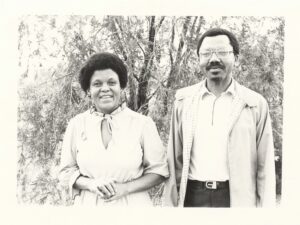
Group Interview, Helene Perold, John Samuel and Bridget Thompson, 20 May 2024
-
by

Publishing, making materials, was critically important in supporting the wider objective of the liberation of South Africa. (John)
There wasn’t a lot of rhetoric at SACHED. There was a kind of deeply entrenched value base that informed everything we did and a way of working and a culture. But we felt passionately about things, very strongly in many cases. But it wasn’t grandstanding by any means. And, you know, I think the material that we produced was thoughtful and measured, but it was countering a status quo. It was very clear what we were trying to do. It was resisting a status quo and putting that down in black and white in a way that said, “here we are, you know, this is what we stand for”. (Helene)
Laurence Stewart: Everyone comfortable with it being recorded?
John Samuel, Helene Perold, Bridget Thompson: Yes.
Laurence Stewart: Okay, thank you. I will have to send some consent forms, I know those are the, nobody likes doing them, neither do I, but I have to. So, just about myself: I’m a researcher on the Archiving SACHED Project. I’ve done about 15 individual interviews with different people, including Helene; Louise Vale has done other interviews and Tammy-Lee has, who is based in Cape Town, has done individual interviews as well.
This is the first group interview that we’re trying with a broad theme as the with a theme as rather than as a life history. We’ve been doing life history interviews with other people. I’m based at Wits. I’m in the History Workshop. I’m a history student. And I kind of got into SACHED through my work in archives at Wits. I’m not specifically doing any work on adult education, although I have learned a lot and have an interest in it now. That’s about me. I don’t know. If brief introductions perhaps from everyone else, if possible.
Helene Perold: John, do you want to go first?
John Samuel: No, go Helene.
Helene Perold: [laughs] Okay, I’m Helene Perold. I now work as a freelance researcher, although I’m trying to work less and rest more, but never mind. Yeah, and very happy to be here and very keen to be talking about the publishing program and whatever else you want to raise, Laurence.
Laurence Stewart: Cool. Thanks, Helene.
John Samuel: Well, I’m retired in a wonderful place in Nelspruit. I never thought I’d end up in Nelspruit, but here I am. And so, I am retired, but still remain an activist.
Bridget Thompson: Okay, well, I live in Cape Town. I feel like I’m a little bit of a – sorry, I’ve got a crying cat that needs some attention. And I feel like a little bit of a pretender at this meeting because I didn’t participate intensely in the publishing process. I was the Western Cape representative on the Publishing Editorial Board and I learned from being on the board and I appreciated being on the board and I must say like much of my other SACHED experience, it has influenced the NGO that I’m currently running, called the Art and Ubuntu Trust, and our publishing program there.
But I’m not sure how much I can contribute to the memory of SACHED’s publishing except those things that I learnt, and certainly, you know, after SACHED closed, one began to appreciate the value of what was done there and the value of the publications that were produced, both in the publishing project and throughout SACHED as a whole. For example, the African Studies series that Neville Alexander produced could be so useful today the cartoons, the comics, Mhudi and one on Slavery would have been so useful, would be so useful today. So that’s really my contribution. It’s really from the point of view of somebody who, in retrospect, understands the value of what was being done at SACHED. But I didn’t have a deep involvement in the publishing, per se, at that time.
John Samuel: Maybe, Bridget, you could relate some of your experiences in the wider AV field in terms of, you know, the kind of aims and objectives, the broader, which was similar to publishing, in some ways. In the sense of, you know, in the sense of the kind of things we were trying to do.
Bridget Thompson: Yes, well, there was always a very clear framework in the audiovisual in the four years that I was at SACHED. And that was I think, you know, Enver Motala’s paper that he produced at that time about the role of service organisations in the struggle really characterises the ethos which underlay the work that we did, and it was how can this work facilitate and assist the mass uprising that was happening around us and how can we through education empower people –
[05:00 Minutes]
empower was a very commonly used phrase term – to have knowledge and also the means to the competencies to express themselves. So, work that we did in the audiovisual department was first of all through the library. When I joined SACHED in ‘86, I joined in Cape Town and I wasn’t involved nationally, I think, until later. There were some very wonderful resources that had been collected by Lindy Wilson. A collection of photographs and so on, on African history and Neville had this African studies project. And there was a constant turnover in the SACHED Cape Town office of people wanting materials, wanting resources.
And I have to say that hasn’t changed up until today. Throughout South Africa, you still get people, and in the Art and Ubuntu Trust we do very extensive grassroots work at the community centres. There is a thirst for useful materials that and there’s an incredibly appalling lack of access to basic information about our history about different disciplines, and there’s such a clear gap in the 15-25 year-age group. I know nothing about primary education. I mean, I know Jean Pease had that project to do with primary education, about kids who dropped out of primary education. I still think that project would be very valuable today. That 15 to 25 year gap, you know, like am I going to finish school? How am I going to finish school? What am I going to do after school? What skills will I have and how will I make that step to the next stage whether it’s to a college or university or whatever? And so, there’s a gap for resources in that group. And something that I learnt very explicitly in the publishing editorial meetings was that I think it was Helene who reported back that many of the books that were produced by the publishing project were produced with scholars in mind, learners, what they call today learners.
How one has to keep up to date with all the lingo. But in fact, they were used by teachers. And so very deliberately in the Art and Ubuntu Trust, we have targeted our books at teachers. We haven’t even tried to target them yet. It’s great if learners get access to them, but we’re hoping they will reach teachers. Because teachers are the ones who are crying out for resources, very overtly. But then to go back to audiovisual, so audiovisual was framed by this need to produce stuff which supported the work of the different projects. Audiovisual was a service department within a service organisation. So, it wasn’t a department which could have an idea that this would be a useful thing for education and then go ahead and produce it. It had to wait for a project to say, “well we need videos” on X or we need slide tapes on Y or we need posters on whatever. I think that the methodology that we developed was a very useful methodology and it was certainly… In that there was an integrated practice of production, distribution, and training, which is unusual in the sphere that we work in today, which is, you know, where commercial methods dominate.
And it was applauded in our final evaluation session where we had some educationists [unclear first name] Kritikos from In the UKZN [University of KwaZulu Natal], the main guy from Wits and Don Pinnock from Grahamstown, they all said it was a very good method. But then it transitioned into something else. And the thing is that in the world of independent filmmaking, which I’ve subsequently entered, it can be very problematic to have those very restrictive paradigms on what to produce and how to produce. It can make the product very functionalist. You do actually have to allow “artists” a certain freedom to develop their passions, develop their attitudes, and express them in the medium. I think the medium is more productive and, in the end, more educationally useful than if you’re producing according to a very strict commission. Unless the people who commission
[10:00 Minutes]
are educated in the medium themselves. And if they are, then you have a more productive relationship. So you get, for example, you find examples of series that have been produced by the BBC or series that have been produced by Channel 4, where the commissioning editors have been very imaginative, and they’ve understood the medium, and they’ve produced really powerful, useful educational series, and you think of, for example, Basil Davidson’s series on Africa, or – sorry, I just forget his name, the Kenyan intellectual – Ali Mazrui and so on.
So, I think that we had a bit of a mix-up in SACHED and we certainly didn’t have the means to do the kind of work that could have been productive. But today, I’m sorry, this is a really long answer to the question, please forgive me. But today, for example, SABC education is an incredible resource and it has filled me with frustration since ‘94 about how it’s been misused rather than used it could be the most dynamic resource in the huge gaps that we have in education in South Africa. Okay, but I’ll stop there I hope that was helpful. A lot of it is scratching my mind to go back to the past.
Laurence Stewart: It’s just a conversation. So, I guess you were talking about publishing and social change we can speak about continue to speak about that for sure.
Helene Perold: John, how do you respond to the point that Bridget is making about the boundaries and the risk of becoming a functionalist? I mean, you know, what’s your feeling about that?
John Samuel: I haven’t really thought too much about it, but it might be something that, that we were struggling with in terms of the pure line that separated projects from the kind of service departments. Sometimes I think we might have been guilty of being too rigid in saying that service departments had to respond to a particular need. In other words, we may have killed some of the creativity because of that approach. But I suspect in the actual workings, we might not have been as rigid as that because once it got underway, there was a fair amount of leeway in terms of what people could do. So, you know, I’m pretty sure that on reflection the sort of separation between projects and service departments might have been too artificial in a way, in fact. But Helene the way in which publishing as a project found root in SACHED. I mean, maybe if you could talk a little about that. That I think would be useful as a starting point to recollecting you know, the contribution of publishing to the wider objectives of SACHED.
Helene Perold: Well, John, in thinking about this morning, I was actually going to ask you to start that conversation [laughs]. Because you were the driver. And you said to me that you thought we should be republishing and publishing because books are very important. And so, I was going to ask you as an opening question, you know, what was your thinking at the time?
John Samuel: Yeah, you know, there were a couple of things, I think. One was: when I joined SACHED, I was utterly astounded, both by the quality of the resources that were available, and the work that had been done up till that time under the leadership of David Adler and Theo Derkx. And it struck me that we were sitting on a goldmine.
[15:00 Minutes]
That I knew that we had to do something about it. But also, I’d just come back from 12 years of working in Zambia and Ghana. And I was at the cutting edge so to speak, of the reading revolution in both these countries. And I saw first-hand what the power of the book was. You know, watching a 13-year-old pick up a book for the first time in her life and reading it from cover to cover and then turning to you and saying, “I now feel powerful, I have read a book”. It was a lesson I found very difficult to forget. So, coming to SACHED in fact, at a time when I did, when there was no doubt in my mind that there was a rapidly growing consciousness and a deep desire. It wasn’t ever spelt out in any great detail, but a deep desire, in fact, to open up a new world through education.
This is what struck me, that there were large numbers of young people who had been the by-product of the ‘76 uprisings and had in fact stumbled upon a new consciousness. It was also the impact of the Black Consciousness Movement at that time and then, of course, the Independent Movement in many African countries by that stage, virtually the whole of the African continent had been freed. And so, there was a different mood sweeping through the country. And I felt, that partly because of the manner in which the role that reading had played in my own life, but partly because of what I witnessed and participated in both Ghana and Zambia, I knew that publishing, making materials was critically important in supporting the wider objective of liberation of South Africa.
Helene Perold: Yeah, and I think it’s you’ve phrased it very well. You know, what the implication though is that, was that we were moving out of the realm of newsprint and fringe publishing. If you think about, you know, the LACOM materials that were produced and the Khanya materials, all of those were for internal circulation, if you like, within particular spaces, like the trade union movement or the work that Khanya was doing. Whereas when one goes into publishing, suddenly we were venturing into something that is traditional, more mainstream. And that brought with itself, that brought challenges. For example, that – I don’t know if you remember, John, that NCC [national coordinating committee] meeting – where I had to argue the labour theory of value in a case, trying to make a case for authors to be acknowledged for the material they were writing.
Because up until then, the tradition was, this is the work of an organisation and you do not acknowledge individuals. And we did. We had to. We had to say who was producing this and that on behalf of SACHED. It was a SACHED publication, but it was written by certain people or produced by certain people. And that was a huge debate, and there was quite a lot of resistance to that. And I think that was one manifestation of moving into a more traditional sphere. And then, of course, we were working with Ravan Press which was within the publishing industry but very much on the left. So that was a good partnership and very helpful. But it, it did mark a different
[20:00 Minutes]
I wouldn’t say we ever worked towards commercialisation. Because the distribution of the publications was never really through mainstream bookshops or anything like that. And when Ashley came on board to do distribution, you know, had to work on different strategies and that was very much in keeping with how SACHED worked.
So, I think, on reflection, it was an interesting development, John, from the organisational perspective, which up until then had been very much… I was going to say sort of people’s focused when you think of working through the newspaper project and doing the newspaper supplements and so on. And the workbooks, which were – they were workbooks. They were working material. Everything was always – it was functionalist, Bridget, to use your term. I think that was a characteristic of how we produced stuff. And there were very clear boundaries and the values were very clear as well. And I remember, John, when you just said that you knew that publishing materials was critically important in terms of the struggle that I felt we were waging. We employed a woman in the production department, a white woman, who had very little political consciousness, if any. And I can’t remember her name, but she was proofing materials for workbooks, but also for the publishing project. And I would manage her work, supervise her work, and I found mistakes.
So, one day I sat her down, and I explained to her that this was not simply a job. That the value of doing this proofing lay in its accuracy. And that there was a reason why she had to be particularly careful. Because this work was being produced for people who had been denied quality material, who were subjected to Bantu Education, and who we were trying to support by producing high quality material, and no mistakes were to be countenanced. And so, I located her work for her on a daily basis within the context of a bigger struggle, and she got it, she picked up. So, you know, I think we were driven by that, and I think it was a shared objective, and it was very much within the value of the way SACHED worked and what people were valuing. But I was going to also suggest, John, and I don’t know whether you can help us do it on sort of on the hoof. I was saying to Laurence, you know, we really need a timeline for how things developed in SACHED. I think we need a timeline. But we also need a timeline in the publishing project because I kind of lost track on the newspaper with what came first and what came next. I mean, you weren’t there for a lot of that time, John, but you know, when I was talking to Laurence, and I noticed in the transcript, Laurence, that I got confused about what was the name of the project that Clive Nettleton was working on when I joined, and then we did People’s College, and then we did Learning Post. I think that’s how it came about. Is that right Laurence?
Laurence Stewart: Yeah. We have got a, we have worked on a timeline and we’ve got it’s been, we’ve trying to circulate it to some people to add to it. It’s co-created through some of the interviews and a bit of Louise and Jenny Glennie.
Helene Perold: Oh, good.
Laurence Stewart: Yeah, we getting there. We can talk about it here, but yeah, we are developing it and I know it’s a long time ago as well [laughs]. No need to worry too much about it.
Helene Perold: And did you come across the name of the publication that we were doing in the Weekend World in ‘76?
Laurence Stewart: Prior to People’s College?
Helene Perold: Yeah.
Laurence Stewart: Um, I don’t think… Oh! I came across it in the archive the other day. It was it was a tiny two-page educational supplement. Is that correct?
[25:00 Minutes]
Helene Perold: Yeah, it was quite limited, I think. Well, I think it was four pages, yeah.
Laurence Stewart: Yeah, and quite a lot of maths and stuff. I did find, I found it in the archive. It ran for about a year. I can find it. I’ll put in an email.
Helene Perold: You can tell it to me, please. It’s irritating me that I can’t remember.
Laurence Stewart: Okay, sure.
John Samuel: Would that have been the beginning of our work in newspapers?
Helene Perold: Well, Clive was already working on it when I joined in April ‘76. And it had been running for about a year or so. So, but it was much more limited than People’s College. I mean, I think it was because Weekend World came out in broadsheet, and so we had a broadsheet that was then folded into tabloid and gave us four pages. And I think that was pretty much it. And I think there was English and maths and maybe some science, I’m not sure. But I don’t think we did any history or anything like that. Yeah, so the vision for People’s College was an entirely different animal and Bridget, in some respects, the point you make about creativity you know I think that did come to the fore in the African history component in People’s College, which preceded the work that we all did on African history.
And that was Luli Callinicos. And I mean, that was really the very first that was being done of that kind. And it kind of evolved and within a certain paradigm, very much history from below. And it was entirely novel and I think very valuable and has served as a foundation for many other developments since then. And that would have been in, what was that, Laurence? ’77?
Laurence Stewart: Yeah. It ran for 6 months, From March to October. Yeah, in ‘77 and then it got banned.
Helene Perold: Yeah, that fateful October. But you know the ‘70s were marked by a sort of the development of that whole Marxist revisionist history movement. And I’m thinking of Dan O’Meara and Duncan Innes and many other academics who were abroad and then came back and then there was the sort of Van Onselen as well and so on. And the history from below stuff. And I’m thinking also then of, I just want to see the year [looking at a book] That was one of the reasons why we then also did Write Your Own History, which Leslie Witz wrote for us. Which was in…
John Samuel: It would have been about ‘83, ‘84?
Helene Perold: First was ‘88. But certainly when we were working on the People’s College material and the page that Luli was writing, it was sort of in the mould or on the back of quite a lot of the other work that was being done at universities and in academia. So, it was part of that kind of movement, you know, and I think really all credit must go to her and to all the people she worked with for producing some absolutely unique material. And then we did struggle with other things. And it was such a huge menu that we were putting out every week, including adult literacy and worker education. And then there was the maths and science and English stuff.
[30:00 Minutes]
So, I mean, looking at it now, I just find that it’s such a it was a hugely ambitious project, but we did it as we did so many other things in SACHED.
John Samuel: Yeah, I think that some of that earlier work demonstrated later that these things were possible, that you could do them. I want to pick up on your reference to quality in the publishing, because I think that unlike many other organisations that were also producing material and so on, we paid a large amount of attention to what would enable or promote better access to reading material by spending more time on things like layout, design, reading levels, language, and so on. Bearing in mind, for example, that the majority of our readers were English second language readers. So, there was a whole lot of areas where I think we kind of opened up new avenues, even before mainstream publishers, as we called them in those days, Jaws [perhaps Jaws, but not clear] 1, 2, and 3.
And in a way, in fact, I think one of our contributions from that ‘80s was this opening up of new ways of publishing. So, for example, the manner in which we designed Read Well and Write Well had a direct impact on books that were published after that. Publishers sat up and paid attention to that and benefited from the work and the money we had spent on thinking about issues like that. And I think what was critical to this was that we were not content just simply to publish stuff and just and throw it into the market, so to speak. We wanted to know how it was being used. And so, our ventures into publishing from actually – you may not remember this, but we actually set up a full commercial publishing and distribution arm to SACHED, an independent company.
Yes, that was meant to explore, for example, all the spaza shops in townships as a potential source for distributing SACHED material. So, you know, we ventured from time to time into mainstream avenue. And I think there were times when we got our fingers burnt, but nevertheless, we knew that it wasn’t good enough to produce first-class material and then let it sit on the shelf.
Helene Perold: Yeah. And I was going to ask you… Yes, John, and sorry, just to your point, you know, I think we did think long and hard about how one uses illustration, for example, to engage readers and those devices that we used in Right to Learn. And then that long saga that I went through to get those electron micrographs; well source them and get permission to use them in The Cell. Because I’ve never seen such, I studied biology at school myself, but I’ve never seen such extraordinary “live” as it were, real time photographic illustration the contents of cells. And it was at the time of the academic boycott and we weren’t supposed to be getting stuff from anywhere, and I had to go find out where they were located and then made the case for why they should support us and make them available for publication in this book so that we could actually share them with
[35:00 Minutes]
… The people who were being deprived of all resources and in particular, such rare and quality material and we succeeded. And, you know, I think it was a combination of our will and determination and the way we positioned it that made some of that stuff happen. But Bridget, I was going to ask you about the board. Please remind me what kinds of things we were talking about? If you remember…
Bridget Thompson: I remember a discussion about Write your Own History and responses to it. And I remember the discussion about how the books were used. That’s the one that particularly rings in my mind. I can’t really remember much else, but I must say I’ve been quite riveted by your and John’s comments about the thinking that went into illustrations and design. And I have a question, which is perhaps not immediately appropriate for the interview, but maybe it’s a closing question, but I’m wondering what happened when the decision was taken to close SACHED? What was the thinking around how to carry forward that body of knowledge that was condensed in the publishing project? All of this understanding about how to produce books, which were functionally useful, which were well illustrated, well designed, had thought through the issues of second language readers, and so on. I mean, what’s happened? Was there any consideration about what was going to happen to that body of knowledge? Or has it just been located in individuals who worked in the project and then carried on and worked for other publishers and took their knowledge with them? But I’m very curious about that.
And the other question that I have is that I mentioned that in the audiovisual department, the integration of production training and distribution was very valuable, but clearly within SACHED as a whole for all of its media products, that integration made possible feedback into the quality of the product and the usefulness of the product and the function functionality of the product. And then the other question that I have is that of course the ‘70s and ‘80s was that rising tide of new knowledge new research and so on. But in my work, particularly with [unclear first name] Mbeki and Ernest Mancoba, I’ve become aware of the intellectual world, the black intellectual world of the ‘20s and ‘30s and ‘40s, in which newspapers were so critically important and in which there was such a strong exchange of intellectual ideas across the country and across language groups, and very little in English.
Mainly in indigenous languages. I was wondering whether those newspapers had any impact. Was there anybody who had worked on those newspapers, edited those newspapers, or read those newspapers who played a role in SACHED’s publishing thinking? Because Ntongela Masilela [check name] who’s done this extraordinary architecture of intellectuals from the mid-19th century to the mid-20th century, I don’t know if you’re familiar with his, new African movement and he did this huge website on it. He sees that the 1950s and the Sophiatown movement, which many of us look back to for romantic, nostalgic reasons, as a better time, or the times we were living. He sees, in fact, the Sophiatown movement as the demise of a certain black intellectual independence, which had been expressed in indigenous languages in newspapers, and he identifies it as going far back as what he calls the “The constellation of the Xhosa intellectuals of the 1880s”. So, what I’m wondering is, how much consciousness was there in SACHED of this pre-existing knowledge base? Or, again, did it just come through individuals? Maybe something like yourself, John, with your own political background, or somebody like Neville – you’d feed your experiences from that early political exposure and that early political exchange into SACHED. I’m just curious about that as well. Because I feel there’s an incredible lack in our society at the moment of knowledge and understanding of where we’ve come from and what our intellectual heritage is. I think it’s incredibly dangerous.
[40:00 Minutes]
So, I think the SACHED moment is a very important linkage moment, and trying to understand how does it link to what came before, and how does it continue into our complex current situation?
John Samuel: There are two things, in fact; I mean, one which I just want to quickly comment on is the demise of SACHED. I think it’s both sad and a tragedy, in fact, the manner in which it happened. Sad because people like myself and many others who had been involved weren’t… the continuity, even though we weren’t working at SACHED, but I think we could have provided more support through SACHED at that time. But, you know, one says that with a certain amount of hindsight. But the other point that you mentioned, Bridget, about the early intellectualism in a number of different parts of South Africa, in fact, in the ‘20s, ‘30s, and in some instances, even before that. And it’s something that both Neville and I had a particular interest in, and that is the emergence of the black intellectual in that earlier period. And the challenges they faced because, on the one hand the advent of colonialism brought with it Christianity and Western education and notions of freedom and democracy and liberty and so on.
And this is what those early intellectuals were exposed to. And so, on the one hand there were these ideas that came with colonialism. And on the other, there was a striving path for independence, driving resistance, even in those early days. So, we would draw a lot on that in thinking about what we published and what we didn’t because I think particularly now and then, and this is a lesson for the present Bridget, that given where we are in education today, I think we have behaved arrogantly and conceitful in neglecting our past. The Akan people in Ghana have a way in which they take their wise concepts and use symbols to capture the wisdom. And there’s this symbol of the bird that’s flying forward, but his feet are back. And basically, that saying says “you have to go forward, at least you have to go backward into your past and pull out and bring something into your future”. And the more I think about it, in fact, the older I get, the more I’m convinced that there was a fundamental fracture in 1994 between that past and the present and the future. And one of the consequences of that is that we lost our way because we fail to draw on the wisdom and the lessons and the history of those struggles, which were very powerful.
Bridget Thompson: I agree.
John Samuel: And kind of behave arrogantly as if we are discovering new truths.
Helene Perold: Yeah, and I think John we mustn’t forget, not on this point exactly, on the point of how we made the material and how we tried to interrogate visibly what was lying behind it. You know, I think the history work in People’s College, the Write your Own History the various other work that Neville did,
[45:00 Minutes]
all of those were in an attempt to make this visible and bring it to life. And everybody who sees that book in my home that you published, John, on the basis of those articles, says, “where can I get a copy? We need this.” It is so absolutely, desperately needed. But then there was resistance because in the Right to Learn we did that thing at the end of each chapter, which was very crude…
Laurence Stewart: Sorry Helene, we’ve just lost your connection. I don’t know if you can hear us?
Helene Perold: I think that we were reflecting the radical, the conservative and the moderate and how they would see the content of the chapter from those different points of view and the UDF was conflicted about that. That’s what, you know, that led to that whole thing with Raymond Suttner threatening to necklace me if we went ahead and published. I mean, what were they thinking? Well, we know – they didn’t want any contestation, they didn’t want any different points of view. And it was crude. I’d be the first to admit it, but it was an attempt to say there are ways of thinking about this stuff. This book makes no apologies for the way it is written. And it wasn’t those little sections we were talking about. We were talking about the fact that it has a perspective. And we live by that perspective and this set of values. And it wasn’t universally welcomed.
John Samuel: Yeah. I think if you remind Raymond about that now, he probably wouldn’t know where to hide [laughs].
Helene Perold: Apparently, he’s very ill, so it’s not the time. I do harbour a grudge. I have to say, I have not forgotten.
Bridget Thompson: I do think some of these things need to be exposed and spoken about without wanting to hurt somebody who’s ill. But a lot of people would now be embarrassed about their behaviour. But in order to move forward, there also has to be some kind of a mea culpa. There has to be some kind of reckoning and some kind of exposure. Not to say that anybody was, some people were perfect and some people weren’t, but that whole question of how we deal with debate in our society.
Helene Perold: Yes.
John Samuel: Yeah.
Helene Perold: That was one of SACHED’s strongest characteristics. We held in our midst so many different points of view. But we found consensus, we found each other, we listened. I mean…
Bridget Thompson: And did productive work.
Helene Perold: Yes, and we produced. Of course we did fight about things, but how not?
John Samuel: Yeah, and I think part of that, in fact, was informed by a genuine desire to move beyond the rhetoric. When I went overseas a couple of times when I was at SACHED, and I remember going to a conference on worker education and when I arranged a sort of demonstration of our material, it was astounding that around our table had gathered a huge crowd because people were saying, you know, we haven’t seen this kind of quality of material. Particularly materials that are trying to capture a different vision of society, striving towards change. And it’s that, I think that commitment to go beyond the rhetoric that probably held us together in our desire to actually produce quality stuff for the people of this country.
[50:00 Minutes]
Helene Perold: Well, I think there was something very special. I mean, when you commit to print, it has an enduring quality. It’s an artifact and it’s out there and it represents you and obviously being in the mass media like newspapers, it can make it very vulnerable for whoever’s putting down whatever they’re thinking. But we did make the statement that here we are and this is how we see things. And whether it was through maths and science or whatever, ostensibly, in the education context, somewhat apolitical, one might have thought, but of course intensely political at the same time. We were able to say, but you can do this. This is how we learn about it. This is a way to approach it, and then you can also do maths. You can also do the English.
This is a way of doing it that makes sense to us and the learner-centred nature of the material, I think, was its greatest asset, and you know, Bridget, when you talked about how it was used by teachers, that is true. And I think it showed them how one can actually put learners at the centre instead of, like when I was at school, you were getting a barrage of content dumped on you, which you were then supposed to dissect and understand and memorise, basically. Whereas we were put in for a methodology that cared about the people who were studying this, and it was a form of direct engagement through print. And to this day, you know, I think I’m not sure there’s a lot out there that’s as intensely purposeful in the way that we were really keen for people to succeed – those kids.
Bridget Thompson: I agree, and one can add to that and say it was a serious riposte to both Bantu education and Christian national education, to the whole hierarchies within education. And I’m also wondering if it isn’t a serious alternative to the outcomes-based mess which currently prevails in some form or another.
Laurence Stewart: Sorry, I just wanted to say – I’m sure you would have received a message, but it’s going to cut in three minutes. We can rejoin. I’ve sent a second link as I described in the email. I don’t know if maybe we should just take that break now and then join using the second link.
Helene Perold: Yeah, let’s do that.
Laurence Stewart: John, you’re covered with that.
John Samuel: Yeah.
[short break for changeover]
Laurence Stewart: Just waiting for John. Sorry I kind of interrupted you a bit though Bridget, while we wait for John. You were talking about the kind of second, the kind of fracture between the Bantu Education and Christian…
Bridget Thompson: So it was that publishing was an answer, it was a riposte to both Bantu education and Christian national education in the sense that the methodology that was promoted was learner-centred. And that question about whether it wasn’t even some kind of answer to this outcomes-based mess which the education system has evolved into now. Kind of learner centred education.
Laurence Stewart: Yeah, and after ninety-four, do you think there have been attempts to adopt learner-centred education?
[55:00 Minutes]
Drawing on some of SACHED’s principles, ideas? Where was it lost? Was it lost at ninety-four or later?
Bridget Thompson: Outcomes based is supposed to be learner-centred, I don’t know, what I understand from teachers – I’m not an expert on this and Helene maybe you know more than I do – but what I understand from teachers is that they’re kind of lost in admin, and they don’t have the resources to help the students to develop their own independent learning processes. It seems to have gone to the other extreme. I think the SACHED publications were a nice balance between substantial content presented in an accessible and appealing way, and accessible and digestible way. With thought and care taken around, as you’ve been describing Helene, around design, illustrations, layout and readability. This isn’t an area of expertise for me, and I’m sharing second hand information.
Helene Perold: Well, you know what’s happened, I mean, they may still call it outcomes-based education, but I once confronted – can’t remember her name in the national department – she said, “oh well, before ‘94, we were doing outcomes-based education in the Western Cape, and we thought that it would be an easy matter for teachers to approach teaching that way”. And I said, “in what way was it ever going to be easy?” Because this particular methodology, and you’re expecting these children to… And there was a whole constructivist paradigm as well that was coming from that, that the learning was stemmed from the experiential learning of the children. And, who was going to get on to that? You know, I mean, how is that ever going to work? And she admitted that they’d miscalculated and not understood the fact of scaling up something that was assumed to work in one pocket in our country to the general country as a whole.
But now, with… Well, I’ve just done a bit of work on foundation phase vulnerable learners and the teachers are saying that they are so pressed to get through the curriculum that they’ve got no time. Obviously in big classes in particular, with massive overcrowding, they’ve got no time to help kids who fall by the wayside. You either coop up or, you know, and some of those past kids simply knowing that they’re not coping, because academic performance is an absolute priority right now, and so it’s not a good situation, isn’t it?
Bridget Thompson: It’s terrifying.
Helene Perold: So, I mean the other interesting thing is that SACHED’s long history in distance education played in, and I haven’t thought of this before, but as we’ve talked it just came to mind, that we were drawing on our distance education methodology, which is learner-centred because you are literally working one to one. And that enabled us to share a unique methodology, which I think most teachers weren’t exposed to, unless they’d done work through UNISA or something. And I think that’s one of the… You know, translating that, and that was SACHED’s bread and butter, basically. Especially in Turret College. Translating that into a form that would be more widely used and where in the publishing project we had the time to refine and try out and we would go through different illustrations to choose which was the best approach and there was always a lot of discussion and debate about that. Whereas with the workbooks and certainly the newspaper it was deadline, deadline, deadline and it was much more difficult.
[01:00:00 Minutes]
So, one had the benefit of time with the books to spend more time on refining that methodology. And we did a lot of teacher guides. So, there was that intention as well with Read Well, Write Well, and I can’t remember what others but obviously there was also the wealth of material in Upbeat, some of which you were referring to, Bridget, and I know that those comics would have huge potential in language learning and very easy to translate that into different languages for foundation phase or slightly older learners. And they would have great appeal. I don’t know where the push for that would come from. I mean, maybe if I was 30 years younger, I’d be sort of willing to look for a solution, but it’s actually tragic that they’re not out there in a kind of systematic way.
Bridget Thompson: Maybe the thing is to find some people who are 30-years younger who are interested [laughs] and share the experiences with them. Should we try and help John get in?
Helene Perold: Let me call him and see what’s happening
Laurence Stewart: Yeah, I did send him an individual email with the link just in case he maybe got mixed up somewhere, but I think yeah calling him is the right thing.
Helene Perold: Or maybe someone like Laurence, who’s much younger, would have the…
Laurence Stewart: Yes, I’m in social history at Wits, so we apply some of these kinds of methodologies. But I’m really into like spending time in archives and [stops]…
[Helene speaks to John on the phone]
Bridget Thompson: Sorry, you were saying Laurence you’re into spending time in archives?
Laurence Stewart: Yeah. Well, I’m, I really like writing histories and finding out about sort of little-known local histories. That’s the whole of the History Workshop’s program. But of-course there’s the other side of making them accessible and sort of popular. Which links to this, but that would be my link into this kind of field. Yeah.
Helene Perold: Oh, there he is. Hi, John.
John Samuel: Right. Yes, sorry.
Laurence Stewart: I just wanted to ask just to restart the discussion, I wanted to just ask about some of the, any kind of, you’ve spoken a bit about the limitations within the SACHED publishing unit… Between commercialisation versus and the dangers of commercialisation, perhaps that’s a problem, but what were some of the challenges within the publishing unit throughout that? During newspaper publishing time and after into books?
Helene Perold: We didn’t have challenges; it was all plain sailing [laughs].
John Samuel: [laughs] I think what you have to remember in fact, at the time when we initiated the publishing project, it was one of the most intense repressive periods in this country. And so, you had, for example, People’s College being banned. And then later on, New Nation suffered the same fate and they carried Learning Nation. So, there was this wider political terrain that had to be negotiated very carefully. But while you have this period of intense repression, you also had this period of intense resistance.
[01:05:00 Minutes]
I mean it’s ironic that at the height of the great repression, you have the formation of COSATU. And so, what was happening was that as the struggle against apartheid continued, spaces were being opened up and created. Because I think the lesson that we learned in the ‘80s, that while the state was all powerful, it certainly didn’t have the capacity to administer that control in the manner in which you thought it could.
And so, we were able to take advantage of some of that, but not without – so, for example when we were distributing Upbeat, there were major challenges. We couldn’t, for example, take them directly to schools because we knew that they’d be confiscated straight away and the police would be called. So, we would arrange to meet with people from the schools and somebody’s home and they would then take a couple of hundred copies of Upbeat back into the school or some other place. So, I think the very fact that we were trying to do something that went against the repressive period, in itself was probably the biggest challenge. But we had to negotiate that very complicated territory at that time, in fact. Because on the one hand, you didn’t want to fall into just simply hand it over to the big [publishers], what we called Jaws 1, 2, and 3. These were Macmillan and somebody else, but the Oxford, the three major publishers. And yet at the same time, we had to use some of their distribution capacity to get our books out. So, I think, there were a range of wider challenges that the project faced.
Helene Perold: Yeah, and money wasn’t that easy, John.
John Samuel: It depends, in fact, at what time and which project. I mean, Upbeat, for example. I’d raised Upbeat funding for three years in advance.
Helene Perold: Wow.
John Samuel: You know, people couldn’t stop giving us money for Upbeat. And some of the other books, I think Right to Learn also generated funding. So, it varied in fact, but it wasn’t, you know, smooth sailing.
Helene Perold: Yeah. Carry on, John.
John Samuel: No, I just wanted to find a way of linking the SACHED Archive Project as presently being worked on with that past and again, remembering the symbol of the Akan people about going back and coming forward into the present and impacting on the future. One of the ideas I’ve raised in the project is that once we’d, we don’t have to wait for the completion… But in getting our hands on previous material, SACHED material, like the African history series, like the comics and some of the books, that we should begin a serious dialogue with the library communities of this country. And the objective would be for us to say to them, “look, we have all these resources, right, ready, developed, available. What we would like you to do is add on to your program in the library, let’s say a discussion group on African history”,
[01:10:00 Minutes]
right, “and we will supply the materials”, because we already have a text on African history. So, in that way, we could get a group of young people around the table in a library reading about African history and in the same way using the comics for example to prompt a group of young people to take up writing so that the comics provide both the background but the inspiration to show them that “you can do this as well”.
You can write and to give them a sense that authorship is not limited to just a few select people. That in fact, authorship can be something that they themselves could be part of. So, the reason I raise this is that it’s all well and good getting all the archives done and so on, and we may find ourselves all dressed up but nowhere to go. And so, finding, in fact, audiences to work with becomes critically important. And the libraries, the advantage is that you have a ready-made infrastructure, you have resources, you have people, you have access to physical resources and so on. So, I just wanted to mention this as a way of linking up the current discussion with what we should be doing or at least what I think we should be doing with these archived resources: bringing them back to life!
Bridget Thompson: I agree with you because the libraries are related to education, but not directly within the education system. And, you know, my experience knocking on the doors trying to lobby with DBE [Department of Basic Education] and DHET [Department of Higher Education and Training] has been extremely unfruitful. And so, when we do our work, we work with community art centres as a way of sidestepping and then the community art centres themselves have relations to the local schools and they bring people in. I think libraries is a genius idea because it’s also linked to education, but not quite directly within those difficult sectors.
John Samuel: And it’s fairly decentralised as well. Some libraries are run by municipalities, others by provincial departments, and so on.
Laurence Stewart: I just wanted to ask about during the 80s, how were some of these materials disseminated, especially the books? Where did, where were they used?
Helene Perold: Well, we set up a whole distribution project, which actually Ashley ran, and he had to devise a whole lot of different strategies because some of them were going to teachers and we were selling them. So, we weren’t in a position to give them away. And so that was also a constraint. And then also through the SACHED networks country, around the country, we would use our contacts to help distribute books in schools and for independent learners and that kind of thing. But the distribution wasn’t easy, hey John?
John Samuel: No, in fact, when we tried to do something about it, we set up this company. And we brought in, for example, Learning Post, Ravan, they all bought in shares in the company because they were facing exactly the same problem; a non-profit organisation trying to enter the commercialising world, but not wanting to carry that agenda. And so, it was really quite a challenge, but we did have, I mean, as Helene said, it was a multiplicity of channels. So just let me give you, tell you a little story. There was a chap called Manu Tuwani [check name] who lived up in the north. And every three or four months, Manu would arrive in Johannesburg, right,
[01:15:00 Minutes]
And he would spend a few days at SACHED. And what would he do? He would go through all our material. And give us an advance [of] money on what he was taking. And Manu would then go back. And what Manu did was, he had reading clubs in different parts of the Northern Province. And then take these books to these reading clubs, and they would then meet around the books. And three or four months later, he’d be back. We had a deal with African, Heinemann African Writers Series. They supplied us African writers’ series at a discounted price. We then sold that in turn. I can remember going into the office one day and seeing a whole pile of, what they called in those days, postal orders. And these were people coming from, you know, I was curious and they were little villages out in the Eastern Cape, Kwazulu-Natal, somehow the other person that heard about this, because we carried an extremely small advert in one of the Sunday papers, and people would write in together with their postal orders for this.
So, there were and like Manu Tuwani, we had one or two other people who would come in buying material from us and take it and in return sell it. I mean, the distribution network for Upbeat was absolutely astounding. It included people who today, for example, the person who was the Vice Chancellor of the University of Zululand was an Upbeat distributor at one stage of her life. I mean, it’s just that whole Upbeat distribution story is worth telling.
Bridget Thompson: I remember Rita Edwards and Bongani, I forget Bongani’s surname, in the Cape Town office were the distributors for Upbeat. And I know Rita Edwards has passed away, but I don’t know if Bongani’s still alive, and I don’t know how one would get hold of him. But he’d have a story to tell. Because they used to go out every day. He had a car, and they used to drive and drive around the townships in Cape Town delivering Upbeats. Maybe Mercia might remember all of the details of what they did.
Helene Perold: Yeah. I mean, we had to be inventive, you know, we had to use our networks.
John Samuel: I mean, the, ultimately, the story, in fact, of producing […] No, I was saying, ultimately, Upbeat, I can’t remember the exact number of years, but it must be over 8 or 9 years that we brought out an issue almost every month for 8 or 9 years. When you think about it’s unbelievable.
Helene Perold: Yeah. And it grew better and better.
Laurence Stewart: I don’t, I think it was actually about, I don’t know if it was every month, but I think it was all the way from about ‘82 to ‘96. I don’t know. In the 1990s, it was maybe once every two or three months, about 14 years. Yeah.
Bridget Thompson: Does anybody have a complete collection?
Laurence Stewart: Yeah. We have basically collected a full collection. We don’t know exactly what a complete collection looks like because, especially in the 1990s, we don’t know how many were produced in a given year. But it’s part of our digitization project. I guess that’s one of the ways of just making a lot of this material public. All of the, many of the books that were produced, especially that were produced by SACHED are being digitised and will be put just online as a kind of resource. But of course, part of the reason I’m asking these questions about dissemination is we also need to work out how to disseminate and share this today rather, you know, it’s a different, slightly different context.
[01:20:00]
Helene Perold: Look, I think we’re in an entirely different situation now, Laurence. We didn’t have any social media then and we had our networks and a grapevine. But there was no social media, there was no internet, so I think one could do things now very differently. And yeah, I remember, I’d have to look it up, but some years ago when I was running HPA [Helene Perold Associates] we did work with a group of people who were establishing some social media platform that young job seekers could look at. And when I think of some of the organisations that are supporting young people and especially in relation to employment, making links with them and notifying them about this material that’s online. If you want to encourage your siblings or you need some help with whatever you’re studying – I think it’s an entirely different world. I don’t think you’d have many of the constraints [we had]. [You are] dealing with digitised material anyway, which is so accessible. So, I think there’s a wealth of possibilities now.
Bridget Thompson: It is, but there are many people still who have data challenges. Just income challenges in terms of getting access. And I’m just thinking about South African History Online. It’s been a phenomenally successful project. I mean, everybody refers to it if they want to know any information about South African history.
Helene Perold: So even if one used the various platforms to advertise the availability of the material and but then I think what John’s saying is that, or what I’m leveraging off what he’s saying is that, depending on your resource base and your time, obviously, in going out to engage and projectise, if you like, some of the stuff where one sets up a working relationship with institutions like libraries or [unclear word]. Civil society is profuse with all kinds of groups that are working. So, it would be more than just putting out the information, it would have to be the relationships.
Laurence Stewart: And also, the thing with something like South African History Online is, everyone has spoken about the quality of SACHED content and also the form in which it’s presented. So, African History Online doesn’t really, one, the quality is a bit variable, but also the form it’s just a written paragraph. You know, it’s for a particular kind of engagement.
Bridget Thompson: But it’s an indication of how online is being used.
Laurence Stewart: Yeah.
Helene Perold: But Laurence will you guys be able to, in your timeline, also just list the books as they came out (which will be very useful)?
Laurence Stewart: We’ll, we, yeah, it’s an aim and we’ll get there [laughs]. I know this is what you would like to see.
Helene Perold: Yeah. Simply because of the ravages of time on the memory [laughs] I think John’s got one of the best memories. I know mine’s not, mine’s a bit shaky by now.
Laurence Stewart: And to go back and just ask a question a bit about what was being spoken about before, but Helene you said that some of the content was in some sense, apolitical, but also intensely political. I just wanted to ask about some of the broad ideological aims that SACHED had when choosing which, what to publish?
Helene Perold: Well, the premise was always and I think John, your starting point when we first talked about this was that we’ve got all this material and it needs a wider audience.
[01:25:00 Minutes]
It needs more exposure beyond what the newspaper project or Turret College is doing. And you’ve described what your vision was behind that. So, I think our starting point, Laurence, was that we would take the material that we had and rework it. And in the reworking, obviously one would update, but one would also have a chance to recast it. But we weren’t, initially, we didn’t start from scratch. And I think we wouldn’t have launched a publishing project if we were starting from scratch. There wasn’t a need to, whereas what we had was, material that, you know, once it’s in the newspaper, it’s there today and gone tomorrow. Either around fish and chips [correct phrase?] or it’s just being used for other purposes. So, I think there was that sense of: it’s an opportunity to widen the reach, but it’s also an opportunity to I wouldn’t say preserve, I would say to recast material.
And then as things went along, obviously, we started responding to the environment with new projects, like the Write Your Own History, like Right to Learn. And those were very much a product of their time. But the people who were working on those books were SACHED people who had been, you know, involved in the organisation for some time [trails off]. So, there was a shared ethos and a shared understanding of what was lying behind it and how we did things. I have to say that you know, you were talking about going beyond the rhetoric. There wasn’t a lot of rhetoric at SACHED. There was a kind of deeply entrenched value base that informed everything we did and a way of working and a culture. But we felt passionately about things very strongly in many cases. But it wasn’t grandstanding by any means. And, you know, I think the material that we produced was thoughtful and measured, but it was countering a status quo. It was very clear what we were trying to do. It was resisting a status quo and putting that down in black and white in a way that said, “here we are, you know, this is what we stand for”.
So, when I said it was apolitical, but intensely political, it was – I mean, politics was, you know, we were grounded in politics in the moment, and in our history, and in the vision that we were working towards of a future. So, when we were doing English, we were working through a syllabus, but we would always use it, and I was just looking in, in many of our books, we had these quotes at the beginning. And I was looking at some of the authors, and sometimes they were African, and sometimes they were Italian, and, you know, we were – I don’t know where we found them, as kind of like opening quotes. Write Your Own History has one that says – it looks like a poem: “I, you, they, we, we’re all gathered around, talking, asking, looking, I was pencil and paper, by the tiny lapse of the sky, the dark sky, recording the conversation, time passed, which lights up today and tomorrow, making it clear.” I mean, that sums us up. But it’s written by somebody called Antonio Musapi [check name]. Who who would have thought? [laughs] And so, you know, the material is – in terms of the way we present as the learners, there were always black learners or a number of races depicted.
[01:30:00 Minutes]
We showed who we were through the decisions that were made about the presentation and so on, and the examples we used trying to use African-based or South African-based examples wherever we could, and drawing on our history and so on. So, the politics was in there, but it wasn’t grandstanding and it wasn’t flag flying. It was trying to do a serious job of educating and enabling people to uncover, in this book in particular, in a very practical way, what questions to ask, read books on your topic, how to draw up a chronological table. I mean, this is DIY, right? On writing your own history… And it is extraordinary, it’s extraordinary work. I don’t know how else to put it. But working within that bigger political context that John was describing. So, language was a major issue and the whole Afrikaans saga in 1976, it was fundamental to who we were.
And so there was this ongoing engagement between on the page stuff. And I always tell the story of how when I first joined SACHED and I think I mentioned this to you, Laurence, and I started writing something for an article for The World publication that I can’t remember its name now. And Clive Nettleton looked at this and read it and then said, “it’s all very well ducky, but you’re not writing for the Rand Daily Mail editorials”. So, I was obviously professing a point of view on something very strongly. “That’s not how we do it here”. To learn, you know, how to teach poetry. So, there was, politics was a big and a small ‘p’.
Bridget Thompson: I’d like to add to that and say that what I do remember about the publishing and tutorial boards is that there was always a process of consultation that was being reported back on. So, books were tested, audiences were tested. And so, that made, I think, the publications very robust. And I think we speak about the networks. I mean, there was an extraordinary family of people around the country. I had the privilege of going to every single SACHED office to do different work. And there was this incredible network and they all fed in one way or another, into the ideas that were shaped in SACHED. And I think you often find development practitioners, whether they’re educational practitioners they often dream up ideas without actually engaging with the people who these ideas are meant to be helping. And I think that was really distinctive about that group. And that also relates back to the integration of production, distribution and training that there was this methodology of consultation. So, the things were real and were practical and usable and robust.
Helene Perold: Yeah. Thanks for that.
John Samuel: Here’s a story if you want to assess the impact of the printed word that SACHED produced on the wider world. Anglo-American had a charity called the Chairman’s Fund, and they supported quite a significant amount of the newspaper, the education project, and a couple of other things. And so, I would meet with the chairman of the chairman’s fund every quarter to give him the progress report. So, at one of our normal meetings, we as usual, began talking, very civilised conversation. And right in the middle of this conversation, he leaned across the table and pointed a finger at me and said: “you so much as publish another word about the mining industry and you will not smell a penny from us”. And then promptly restarted the conversation about the weather.
[01:35:00]
Helene Perold: [laughs]
Laurence Stewart: And did you publish anything else about the mining industry?
John Samuel: Yeah, we went on later to publish a whole series, in fact. I think in People’s College, there’d been a series on social history, which included, I mean, it wasn’t a debatable question. And, you know, even conservative academics agreed on this point that the mining industry’s wealth was built on the backs of blacks. I mean, there was nothing to contest, but that wasn’t the issue. The issue was that we were reaching thousands and thousands of people with this message. And that’s what worried him more than the actual message itself. And that’s the power of print.
Helene Perold: But it was always a bit, I know with the books, it was long labour and very intense and then the book would get published and I always had this feeling like there was a deathly silence after that. Whereas at least with the newspaper, you knew that it was going out and the next one was coming out the next week and you did have reactions. So, it was a little bit more difficult to get that, you know, feedback of the bigger impact. But we did get, I mean, there’s no doubt. We were enormously hungry to get hold of the material and, yeah.
Laurence Stewart: But you also spoke about earlier writing books which were kind of of their time. So, especially what comes to mind is the book on Chris Hani written by Thami Mali, I think produced with SACHED. But that, that must have linked directly to the context of the time as did many of the other books.
Helene Perold: Did we do a book on Chris Hani, John? I don’t think so. I think it was later, Laurence.
Laurence Stewart: It was about ‘92, ‘93. But it’s published by SACHED Books and it was written by Thami Mali who worked, I think worked in SACHED as well.
John Samuel: Worked in SACHED yes. Yeah, that would have been right, yeah.
Laurence Stewart: What were some of the major publications, you know, I don’t know, which are memorable to people?
Helene Perold: You know, I think the Read Well, Write Well stand out on the sort of formal education side. I think Working Women and The Right to Learn. I mean, we did two editions of The Right to Learn, which you know, it really sold incredibly well. And the Write Your Own History as well.
Laurence Stewart: From the worker-side I think Freedom from Below is quite popular even today.
Helene Perold: Yeah. Yeah.
John Samuel: Yeah.
Bridget Thompson: Comics.
Laurence Stewart: Can you tell me a bit about the comics, it is the first I am hearing about them.
Helene Perold: From Upbeat.
Bridget Thompson: Yeah, I’m thinking of Mhudi and…
John Samuel: Down 2nd Avenue, Equiano’s…
Helene Perold: Equiano, yeah. Equiano was the one about slaves.
[all say yes]
Helene Perold: And Mhudi. Didn’t we do the Sol Plaatjie?
Bridget Thompson: Absolutely.
[interrupting one another]
John Samuel: Down 2nd Avenue…
Bridget Thompson: Yeah. I’d love to have copies of them today. Are they going to be digitised?
Laurence Stewart: mmm
Bridget Thompson: Oh, wonderful.
Laurence Stewart: Are you saying that these are in all in Upbeat, right? Contained within…
Helene Perold: No, there were several separate public, stand-alone publications. I think you’ve got them.
[01:40:00 Minutes]
Laurence Stewart: I’m not sure. Louise told me that you have them, Helene. Is that true?
Helene Perold: I’ve got two here.
Laurence Stewart: Okay.
Helene Perold: I’ve got Equiano. I’ve got Down 2nd Avenue. And they’ve got games on the back pages.
John Samuel: You know Helene, I carried this into when I was at the Mandela Foundation. One day I jokingly said to Mr. Mandela you know, “you don’t have great recognition unless you’re in a comic”. And he laughed.
[everyone laughs]
But in the end, we went ahead and we did I think six comic inserts in The Star. And eventually it was published as a standalone. But I remember him giving me back those words when he launched the first comic. And he said, you know, to the audience, “I’m told that unless you appear in a comic, you are nobody”.
Helene Perold: I see these were actually, we called them People’s College Comics. And they were published in 1988. We did a lot of publishing in 1988, John. No listen these are gold. I mean, I would love to see them translated into other languages. I mean, there is such an opportunity with this. John, how’s your memoir coming along? Do you know?
John Samuel: I’ve put it on hold for the time-being.
Helene Perold: Sorry, I mean, I’m asking the question because as we’re talking, I’m remembering all the different things you’ve done since the SACHED days. So, I hope you feel when you feel better, you better get…
John Samuel: Yeah. Laurence, I’ve gotta go.
Laurence Stewart: That’s okay.
John Samuel: But are you, do you think you’ve had enough?
Laurence Stewart: It’s okay. I think we’ve gone through the range of things I was gonna ask and I’ve kind of supplemented with a few questions. No problem. Thanks so much, John.
Bridget Thomson: John, nice to see you again. Look after yourself. Take care.
John Samuel: Thanks, bye.
[general chatter]
Laurence Stewart: I just wanted to let you know, you don’t have to, the magazine before People’s College was the Weekend World Magazine.
Helene Perold: Oh, was it? What was it called?
Laurence Stewart: Yeah. Weekend World Magazine. Yeah. It was a few, like, three or four pages with, inside the Weekend World. Found a whole lot of copies of it. We’re not exactly sure what to do with it. But, just about the project, we’ll let you know I’ve taken just a few notes about also some of the notable publications we’ve got. We’ve got Read Well, Write Well, Write to Learn, Freedom from Below all in the process of being digitised as well as the full set of People’s College. And maybe Helene, I must talk to you about the comics about to find a way to digitise them. ‘Cause I can see you don’t want to let go of them, but maybe we want to digitise them.
Helene Perold: And I’ve still got to get my right to learn back from you anyway. So, I’ve got it waiting for you. You know what? I’m going overseas on Friday. If you want to pick them up or something and do them and return them to me with the right to learn.
Laurence Stewart: I’m afraid I’m away for the next, until Friday until Saturday. So, we’ll have to revisit it when you come back.
[end]
Additions from Bridget Thompson, Helene Perold (emailed 21 May 2024)
Bridget Thompson: John’s question took me by surprise as I wasn’t expecting to talk about audio-visual – so just to add a few points quickly. The focus of the work when I was there (86 through 89) was on making AV resources accessible in a sensible practical equitable way to all the projects and this involved networking with other existing libraries for example the Cape Provincial film library serviced libraries across the Cape province (todays Eastern Western and Northern Capes) had a huge collection of useful material SACHED didn’t have the capacity to replicate it so we acquired catalogues from other libraries, systematised, augmented where possible and catalogued our own small video collection of mainly radical documentaries which were hugely in demand for social /educational programmes. Also ensured these were available to all the SACHED offices
We conducted a survey on how the SACHED projects used AV material and focussed training efforts on empowering them with the basic protocols of using a film in an educational setting and how to care for AV materials. These were very un tech savvy times, when putting together a tv and video to show a film could be challenging. We did very limited training in production – this was primarily around slide and tape which was the low-cost way of making a ‘video’ I ran an oral history slide and tape workshop in Cape Town for community groups. Much later one of the participants produced a nice CD rom on the 73 strikes
Luli Callinicos had done a slide and tape on Gold and workers, her book, I’d done one as a student on working women’s triple burden and Jon Berndt did one (for SACHED) called Picture Talk – a political analysis of photography – these were transferred to video and lent from the library. We also worked with the American social history project who used slide and tape effectively in the US adult education scenario – we acquired their products for the library. All these were popular and used extensively. If the library records exist, they’d give some indication of how as I think feedback was required when items were returned.
There was such a thirst for knowledge which analysed history and society both here and internationally and of course this was pre internet so hard copies were vital resources. I have copies of the SACHED catalogue. We had one AV intern, the late Oupa Lehulere who later revived Khanya and then initiated the Jozi book fair under its auspices. He learnt photography, design and basic video making. He was largely taught by Jon Berndt. Production was extremely limited by budgets and access to equipment. We did a handful of new productions: some on study skills some on media per se some on oral literature and poetry (Diana Simson produced a lovely short documentary called Poetry for the people) one on democracy, but there wasn’t the will within SACHED to develop this aspect of AV and it was as I mentioned somewhat bedevilled by the functional requirements – and the lack of understanding of the best ways to work with the medium. It’s not uncommon to see people versed in the print medium try to transfer its processes unsuccessfully to AV. I’ve seen this dynamic play out in other organisations – notably in UNESCO, so SACHED was not alone. There was however huge unrealised potential, as with the print medium, to deploy the combination of insight and skills in the new educational/publishing and SABC education scenario.
Helene Perold: I’m struck by the diversity of the productions, the ingenuous strategies used to work with limited resources, and the creativity that mushroomed within a difficult and contested political context.
Bridget Thompson: PS I forgot to mention a year-long training project we did with Khanya Cape Town African history students – together with Omar Badsha and Roger Meintjies, using a darkroom built and equipped by Jon Berndt and three stills cameras and three cassette tape recorders, we introduced a class of about 20 or 25 history students to oral history interviewing and recording techniques and photography.